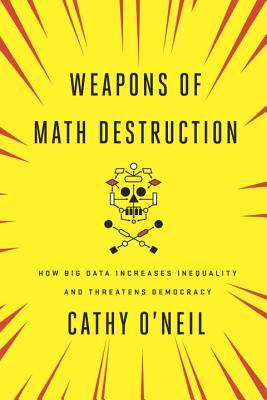
Weapons of Math Destruction
How Big Data Increases Inequality and Threatens Democracy
Book Summaries
Hosts: Clara
Timeline
Summary Preview
In 2011, fifth-grade teacher Sarah Wysocki was fired from her job at a Washington, DC public school. Her students, her colleagues, and her community considered her an excellent educator. But a secretive evaluation metric called IMPACT had flagged her as subpar. The algorithm looked at student standardized test scores and concluded Wysocki wasn't measuring up. The problem? Previous teachers in her classroom had cheated on those tests, inflating the baseline so dramatically that no teacher could possibly meet it. Wysocki couldn't appeal. The formula was proprietary, hidden from view. So she left the high-needs DC school for a wealthy Virginia district. The algorithm didn't just fire a good teacher—it took a strong educator away from the students who needed her most.
This is what mathematician Cathy O'Neil calls a Weapon of Math Destruction, or WMD. The term is deliberate. Just like nuclear weapons, these mathematical models operate at enormous scale, cause devastating damage, and their inner workings are hidden from the people they affect most.
Here's how O'Neil defines a WMD. It has three essential components. First, **opacity**—the model's logic is invisible to those being evaluated. You can't see how it works, can't challenge its conclusions, can't correct errors in your data. Second, **scale**—it doesn't judge one person at a time. It processes millions, applying the same flawed logic across entire populations. Third, **damage**—it doesn't just make mistakes. It punishes the poor and marginalized, locking them into cycles of poverty while the wealthy escape scrutiny.
The most dangerous feature of WMDs is that they create what O'Neil calls **toxic feedback loops**. Here's how it works. The model makes a prediction based on flawed data. That prediction shapes decisions about real people. Those decisions produce new data that confirms the original flawed prediction. The model appears accurate—but only because it created the reality it claimed to predict.
In Wysocki's case, the feedback loop worked like this: Cheating by previous teachers created inflated test scores. The IMPACT model used those scores to set impossible standards. Wysocki failed to meet them. She was fired. The model's verdict appeared correct—after all, her students' scores didn't improve. But the model never asked whether the baseline was accurate in the first place.
O'Neil argues that society has accepted a dangerous assumption: that mathematical models are objective. We trust numbers in a way we don't trust human judgment. But every model is built on human choices—what data to include, what to leave out, what to define as success. Those choices encode human prejudice, misunderstanding, and bias. A model's blind spots reflect the priorities of its creators.
Here's the framework for identifying a WMD. Ask three questions about any algorithm that affects your life:
**Is it opaque?** Can you see how the score was calculated? Can you access the data used to judge you? Can you appeal the result? If the answer to any of these is no, you're dealing with a potential WMD.
**Does it operate at scale?** Does this model affect thousands or millions of people? Is it applied uniformly without accounting for individual circumstances? Scale amplifies small errors into massive harm.
**Does it cause damage?** Does the model punish people? Does it deny opportunities, increase costs, or restrict freedom? Does it disproportionately affect the poor, the marginalized, or the vulnerable?
If all three answers are yes, you've identified a Weapon of Math Destruction.
The Wysocki story illustrates all three components. The IMPACT model was opaque—teachers couldn't see how their scores were calculated. It operated at scale—applied to every teacher in the DC school system. And it caused damage—firing good teachers, pushing them out of high-needs schools, and depriving poor students of quality education.
O'Neil makes a crucial point: WMDs don't just make mistakes. They punish the poor while protecting the wealthy. A white-shoe law firm evaluates candidates through personal interviews and recommendations. A cash-strapped urban school district relies on a secret formula. The privileged get human judgment; the masses get machines.
Think about what happened to Sarah Wysocki. She was a teacher in a poor district, evaluated by an opaque algorithm that couldn't account for cheating by previous teachers. She lost her job. Then she moved to a wealthy Virginia school, where presumably she's evaluated by people who can see her teach, talk to her students, and understand her context. The algorithm didn't just cost her a job—it punished the students who needed her most.
This is the hidden threat O'Neil exposes: mathematical models that appear neutral but actually encode human prejudice, operating at massive scale with no accountability. They don't just reflect inequality. They actively create it.
So here's the question that should haunt anyone who cares about fairness: If a machine can fire a beloved teacher and no one can ask why, what happens when the same kind of model decides who gets a loan, who goes to prison, or who gets hired for a job?
About the Book
Mathematician Cathy O'Neil exposes how big data algorithms—from teacher evaluations to predictive policing—encode human prejudice, operate in secret, and create toxic feedback loops that devastate the poor and marginalized. This urgent exposé reveals the hidden machinery of inequality and offers a practical framework for fighting back.
Key Takeaways
Audit algorithms for fairness before they cause harm
Companies should be required to regularly audit their algorithms for legality, fairness, and accuracy, with the burden of proof resting on them—not on victims—to demonstrate their models don't encode prejudice or create self-reinforcing cycles of disadvantage.
Demand transparency in any algorithm that affects your life
You have the right to know when a score or algorithm is being used to judge you, what data feeds it, and how to challenge or correct errors—opacity is the first sign of a Weapon of Math Destruction.
Shift from group proxies to individual data for fair evaluations
Algorithms that judge you based on how 'people like you' behaved (via zip code, race proxies, or demographic averages) codify past injustices; demand systems that evaluate your actual behavior and circumstances instead.
Use the relative harms framework to design ethical algorithms
When building or evaluating a model, identify all stakeholders and weigh the relative harm of false positives versus false negatives—context determines which error is worse, and the algorithm should be optimized accordingly.
Apply the three-part test to spot dangerous algorithms
Any algorithm that affects your life should be checked for opacity (can you see how it works?), scale (does it affect millions without individual consideration?), and damage (does it punish or trap people?). If all three are yes, it's a Weapon of Math Destruction.
Adopt opt-in data collection to break predatory feedback loops
Following Europe's model, companies should not collect or sell your data without explicit permission—this would destroy the data broker industry that feeds toxic e-scores and microtargeting campaigns that exploit vulnerability.
Change the algorithm's objective from extraction to service
The same mathematical model that creates harm when optimized for profit can become a force for good when its goal shifts to helping people—as seen with slavery detectors and child welfare algorithms that funnel resources instead of punishment.
Use public pressure and media exposure to force algorithmic accountability
Companies respond to consumer backlash and media scandals—documenting harm, going public, and organizing can force changes to opaque scheduling systems, predatory pricing, and biased hiring algorithms that profit from trapped workers.
Who Should Listen?
A data scientist or engineer who wants to understand how their models can unintentionally harm vulnerable populations and how to build ethical alternatives.
A social justice activist or policy maker fighting against systemic inequality who needs to understand the algorithmic mechanisms that perpetuate poverty and discrimination.
A teacher, social worker, or public defender who has seen opaque algorithms ruin their clients' or students' lives and wants to learn how to challenge these systems.
A concerned citizen who has ever wondered why they were denied a loan, job, or insurance by an invisible score and wants to understand the hidden forces shaping their opportunities.