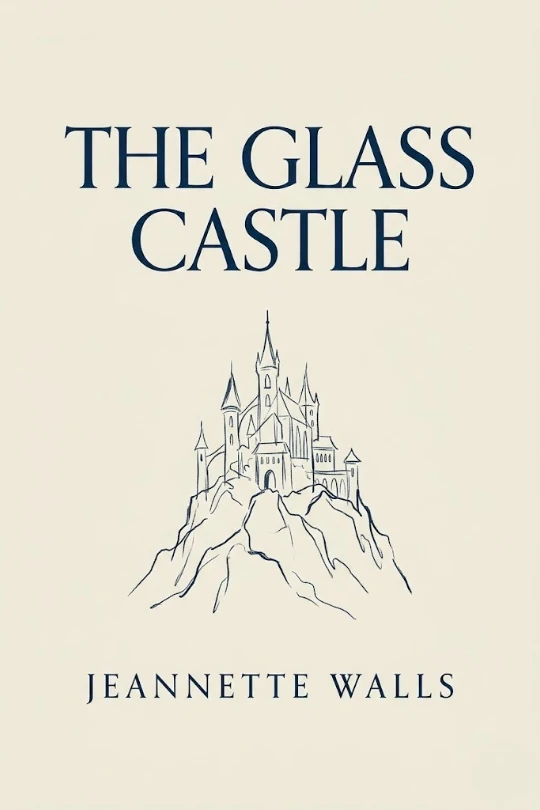
The Glass Castle
Book Summaries
Hosts: Clara
Timeline
Summary Preview
On a cold March afternoon in New York City, Jeannette Walls sat in the back of a taxi, heading to a social gathering. She was worrying about whether she had overdressed for the evening. Then she looked out the window and saw her mother.
Mom was dressed in rags, rooting through a dumpster.
Jeannette didn't get out of the cab. She didn't call out. She just watched as her mother pulled items from the trash, examining them with the practiced eye of someone who had been doing this for years. The taxi drove on, and Jeannette went to her party.
A few days later, they met for lunch at a Chinese restaurant. Jeannette looked across the table at her mother—a woman in her sixties, intelligent, educated, an artist who had come from a wealthy family. A woman who was now homeless. Jeannette asked what she could do to help.
Mom's response was immediate and sharp: "I'm fine. You're the one who needs help. Your values are all confused."
This moment, which opens *The Glass Castle*, captures the central tension of Jeannette Walls's extraordinary memoir. Here was a daughter who had escaped poverty to build a successful career as a journalist in New York. And here was her mother, living on the streets, insisting that it was her daughter—not herself—who had lost her way.
The book that follows is Jeannette's attempt to make sense of this contradiction. How did two intelligent, capable parents end up choosing a life on society's margins? And how did their children survive it?
The memoir traces the nomadic childhood of Jeannette and her three siblings—Lori, Brian, and Maureen—as they moved from desert trailer parks to run-down mining towns, always one step ahead of bill collectors, police, and the consequences of their father's drinking. It's a story that explores several themes that will echo throughout the narrative: the painful process of letting go of childhood illusions about your parents, the struggle to understand why people you love make terrible choices, the destructive patterns of codependency, and the way poverty creates conditions where abuse can flourish.
The opening scene on the New York street sets up a contrast that runs through the entire book. Jeannette, now in her twenties, had achieved what any reasonable person would call success. She had a career, an apartment, stability. Her parents had nothing. And yet, when she offered help, her mother rejected it with a conviction that suggested Jeannette was the one who had abandoned true values.
This is not a story about simple villains and victims. Mom wasn't a monster. She was an artist who believed that struggle was beautiful—that a tree battered by wind was more magnificent than one that grew straight and protected. She was an "excitement addict," as she called herself, who found conventional life unbearably boring. And Dad, for all his failures, could charm a room full of strangers with his intelligence and wit, could make his children feel like the luckiest kids alive when he gave them stars for Christmas because he couldn't afford presents.
But charm and intelligence don't put food on the table. They don't keep a three-year-old from cooking hot dogs alone. They don't prevent a father from drinking away his paycheck while his children go hungry.
The book raises a question that it never fully answers: To what extent were the Walls parents victims of circumstance—Dad's likely childhood abuse, Mom's rebellion against her wealthy mother—and to what extent were they making conscious choices? When Mom refused to sell land worth a million dollars while her children starved in a house with no plumbing, was that a philosophical commitment to non-materialism, or was it something darker?
Jeannette doesn't pretend to have resolved these questions. She presents the facts of her childhood with a reporter's eye for detail and a daughter's complicated heart. She doesn't excuse her parents, but she doesn't condemn them either. She tries to understand.
The title itself—*The Glass Castle*—points to this complexity. The Glass Castle was Dad's great dream: a solar-powered, self-sufficient glass house he would build once he struck it rich. He drew detailed blueprints. He talked about it constantly. For years, the children believed. The Glass Castle became a symbol of everything Dad promised but never delivered—the hope that kept them going, and the illusion that kept them trapped.
And so the memoir begins with that image of Mom in the dumpster, and with the question that haunts every page: How do you love people who have failed you, hurt you, and let you down, while also acknowledging the truth of what they did? How do you reconcile gratitude for the good moments with anger at the neglect? How do you build your own life when your parents chose, again and again, to tear theirs apart?
These are the questions *The Glass Castle* will explore across the decades of Jeannette's childhood, from the desert landscapes of the Southwest to the coal-stained hills of West Virginia. The answers, when they come, are never simple. But the search for them is what makes this story so unforgettable.
What kind of childhood produces a daughter who can sit across from her homeless mother in a restaurant and be told that she's the one with confused values? And what kind of mother says it?
About the Book
Jeannette Walls grew up nomadic, hungry, and neglected, raised by brilliant, charismatic parents who chose poverty over responsibility. This memoir traces her escape from a childhood of fire, abuse, and broken promises—and the shocking discovery that her mother hid a fortune while her children starved. A raw, unforgettable story of survival, love, and the lies families tell themselves.
Key Takeaways
The people who hurt you most can also love you most deeply.
Jeannette Walls's father threw her into a sulfur spring to teach her to swim and later pimped her out to a pool hustler, yet he also gave her the planet Venus for Christmas—illustrating that love and cruelty often coexist in the same person, and accepting this contradiction is the first step toward healing.
Survival requires learning to see neglect as freedom.
When three-year-old Jeannette caught fire cooking alone, her mother praised her for getting 'right back in the saddle,' transforming dangerous neglect into a lesson in self-reliance—a coping mechanism that allowed the Walls children to endure chaos by reframing it as adventure.
A beautiful dream can become the most dangerous lie you tell yourself.
The Glass Castle—a solar-powered glass house Dad promised to build—kept the family hoping through hunger and cold, but it was also an excuse to avoid providing for them, showing that dreams can be both lifelines and traps when they replace action.
Some people choose suffering because it makes them feel noble.
Mom's philosophy that 'struggle gives beauty' justified letting her children starve while she sat on a million dollars' worth of land, revealing how romanticizing hardship can become a moral cover for selfishness and neglect.
The moment you stop believing in your parents is the moment you start saving yourself.
When Jeannette realized her father would never build the Glass Castle and her mother would never protect her, she made two resolutions—never be whipped again and leave Welch—proving that disillusionment, however painful, is the foundation of self-rescue.
Codependency is a silent collaboration in destruction.
Mom called herself an 'excitement addict' who found stability boring, and she enabled Dad's alcoholism by refusing to enforce boundaries—demonstrating that the partner who doesn't drink can be just as responsible for the family's collapse as the one who does.
You can escape poverty, but you cannot escape the questions it leaves behind.
Even after building a successful life in New York, Jeannette was haunted by why her mother let them starve when she owned valuable land—showing that material escape does not resolve the moral and emotional riddles of a traumatic childhood.
Forgiveness is not about excusing the past, but about refusing to let it define your future.
At the end of the memoir, the Walls siblings toast their father's memory—not because they have forgotten his betrayals, but because they have built lives strong enough to hold both the love and the pain, proving that healing means carrying the scars without being ruled by them.
Who Should Listen?
Readers who grew up with alcoholic or neglectful parents and are still trying to make sense of their childhood.
Anyone who has ever loved a charismatic but unreliable person and struggled to reconcile the charm with the harm.
People interested in memoirs about overcoming poverty, family dysfunction, and the long shadow of trauma.
Those who appreciate unflinching, honest storytelling that refuses to offer easy answers about complicated family bonds.