Book Summaries
Hosts: Ethan
Timeline
Summary Preview
For nearly three thousand years, the story of the Trojan War has captivated audiences. Homer's *Iliad* and *Odyssey* tell of a ten-year siege, legendary heroes, and a city reduced to ashes. But here's the problem: Homer wrote his epics around 700 BCE, roughly five hundred years after the war supposedly took place. That's like someone today writing a detailed account of the Battle of Hastings. How accurate could it possibly be?
Most scholars long considered the Trojan War a myth—a good story, but not history. Then came 1988.
That year, a team of archaeologists began new excavations at a site in northwestern Turkey called Hisarlik. What they found revolutionized our understanding of the ancient world. The dig revealed not one Troy, but multiple cities built on top of each other, layer upon layer of settlement stretching back thousands of years. And in one particular layer—labeled Troy VIi—they found something remarkable: evidence of massive fires, violent destruction, and unburied human skeletons. The date? Circa 1210 to 1180 BCE.
This was precisely the period when Homer's war would have occurred.
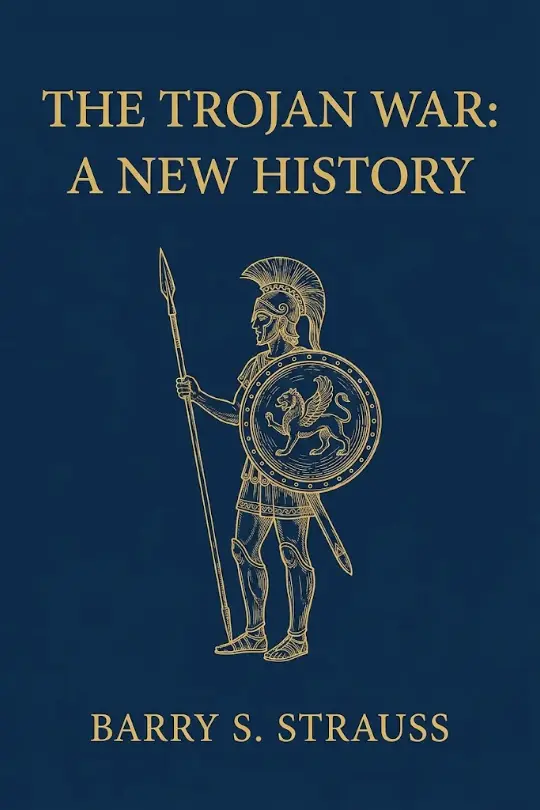
Barry Strauss, a historian of ancient military history, argues that this archaeological revolution changes everything. In his book *The Trojan War: A New History*, he makes a bold claim: the Trojan War really happened. Not exactly as Homer told it, perhaps, but the core events—a Greek coalition sailing against a wealthy Anatolian city, a prolonged conflict ending in fire and slaughter—are grounded in historical reality.
Strauss's approach is straightforward. He takes Homer's account seriously but not literally. Then he checks it against the archaeological record, Hittite texts, Egyptian documents, and everything else we know about Bronze Age warfare. The result is a picture that builds on Homer but differs significantly from what most readers take away from the poems.
Consider the city itself. Troy was no ordinary settlement. Its position at the entrance to the Dardanelles—the narrow strait connecting the Aegean Sea to the Black Sea—made it one of the most strategically valuable locations in the ancient world. Any ship carrying grain, timber, metals, or slaves between the Mediterranean and the Black Sea had to pass within sight of Troy's walls. Control the city, and you controlled the trade route. This wasn't just about a stolen woman. This was about power, wealth, and empire.
The 1988 excavations confirmed what Homer described: a wealthy, fortified city with massive walls, a citadel rising a hundred feet above the plain, and an underground spring that provided fresh water even during siege. Troy in 1200 BCE was in its heyday, a regional power with strong fortifications and extensive alliances.
But the archaeological record also reveals complexity that Homer's epic smooths over. The multiple settlement strata show that Troy was destroyed and rebuilt many times over millennia. The destruction layer at Troy VIi shows signs of prolonged conflict, not a single dramatic night. The unburied skeletons suggest violence so intense that normal burial practices were abandoned.
Strauss draws a crucial distinction. Homer wrote poetry, not history. His purpose was to entertain and inspire, not to document. The gods who intervene in battles, the single combats that decide the fate of armies, the ten-year siege that conveniently compresses time—these are literary devices. But beneath them lies a core of historical truth.
The Greeks were the Vikings of the Bronze Age. They built some of history's first warships, light and maneuverable oared galleys that could raid coastal settlements with terrifying speed. Troy's wealth made it a target. Its location made it vulnerable. And the growing power of Mycenaean Greece made conflict almost inevitable.
Strauss argues that understanding the Bronze Age context is essential. This was an era that preferred to speak in personal terms rather than abstractions. Instead of justice, security, or national interest, Bronze Age people talked about family and friendship, crime and punishment. The Trojan War wasn't a conflict between nations or ideologies. It was a feud between powerful families, played out on an epic scale.
The new excavations have proven that Homer was right about the city. Troy was real, wealthy, and fortified. It was destroyed by fire around the time Homer's war would have occurred. But was it destroyed by Greeks? Was there really a ten-year siege? Did Achilles and Hector actually fight?
Those questions remain open. But Strauss believes the evidence points toward yes—or at least, toward something close enough that the distinction between myth and history becomes less important than understanding what really happened on that windy plain overlooking the Dardanelles.
The tension between Homer's poetry and the archaeological record creates a fascinating puzzle. How much of the *Iliad* is accurate? How much is invention? And how do we separate the two when our only detailed account comes from a poet writing half a millennium after the events?
What if the truth is stranger than the myth? What if the real Trojan War was even more brutal, more complex, and more human than Homer's epic suggests?
About the Book
For 3,000 years, Homer's epic of the Trojan War captivated the world—but was it history or myth? Barry Strauss uses revolutionary 1988 excavations at Troy to reveal a stunning truth: the war happened, but not as Homer told it. This gripping account strips away divine intervention to expose the gritty reality of Bronze Age warfare, from political intrigue and brutal raids to the devastating human cost behind the legend.
Key Takeaways
History is not what happened, but what we choose to remember.
The Trojan War was a real historical event grounded in archaeological evidence, yet our understanding of it is filtered through Homer's epic poetry written 500 years later, reminding us that the line between myth and history is often drawn by the storyteller, not the historian.
The greatest wars are fought not for love, but for power disguised as principle.
Helen's abduction was a convenient romantic cover for a brutal geopolitical struggle over trade routes, wealth, and strategic alliances, revealing that the most enduring conflicts are rarely about their stated causes.
Honor is a currency that demands payment in blood.
Achilles' withdrawal from battle over a stolen war prize and Hector's refusal to retreat despite wise counsel show how the Bronze Age code of personal honor could override strategic reason, leading to catastrophic losses that no amount of plunder could compensate.
The cost of war is paid first by those who have no voice in declaring it.
From Iphigenia's sacrifice to Andromache's pleas ignored on the walls, the women and children of Troy and Greece bore the heaviest burdens of decisions made by men obsessed with glory, proving that the innocent are always the first casualties of heroic ambition.
True strength lies not in invincibility, but in the courage to face one's own mortality.
Achilles' rage after Patroclus's death and his eventual weeping with Priam reveal that even the mightiest warrior must confront the universal truth of human fragility, and that compassion for a shared fate is a greater power than any weapon.
The most devastating victories are won not by force, but by deception.
The Trojan Horse—whether literal or metaphorical—demonstrates that cunning and psychological warfare often succeed where brute strength fails, and that the greatest threat to a fortified city is not the army outside its walls, but the enemy within.
Every hero's fall leaves a wound that echoes through generations.
The cycle of vengeance from Achilles killing Hector to Neoptolemus killing Priam shows that violence begets violence across time, and that the death of one champion creates a chain of grief and retribution that outlasts the original conflict.
The truth of our past is buried in fragments; the rest is story, and the story is enough.
Archaeology confirms the fire, the skeletons, and the city, but the poetry of Homer gives meaning to the ruins, teaching us that while we may never know exactly what happened, the stories we tell about our origins shape who we become more than the facts themselves.
Who Should Listen?
History buffs who love archaeological detective work and want to know what really happened at Troy.
Fans of Homer's Iliad and Odyssey who are curious how much of the epic poem matches historical reality.
Military history enthusiasts interested in Bronze Age warfare, logistics, and the gritty details of ancient combat.
Readers who enjoy myth-busting narratives that separate legend from fact in famous historical stories.