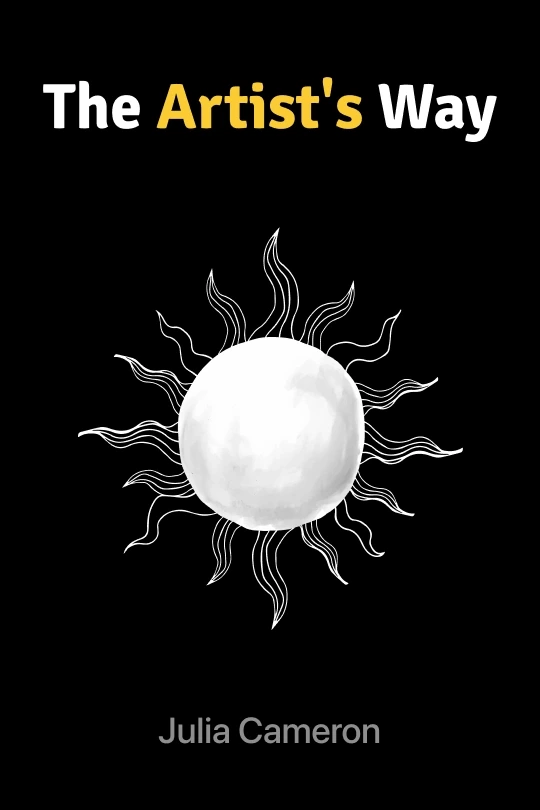
The Artist's Way
A Spiritual Path to Higher Creativity
Book Summaries
Hosts: Clara
Timeline
Summary Preview
You know someone like this. Maybe it's you.
They have season tickets to the symphony. Their bookshelves overflow with novels they've read and loved. They can tell you everything about their favorite painter's technique. They go to gallery openings, film festivals, poetry readings. They surround themselves with art the way a plant surrounds itself with sunlight.
But they never create anything themselves.
They have a novel in a drawer, half-finished since college. A guitar gathering dust in the corner. A camera they take on vacation but never use otherwise. They talk about "someday" the way other people talk about yesterday. Someday they'll write that book. Someday they'll take that painting class. Someday, when they have more time, more money, more confidence, more something they don't currently have.
Julia Cameron calls these people *shadow artists*. And she wrote *The Artist's Way* for them.
The term is precise. A shadow artist is someone who lives in the shadow of art, not in its light. They orbit the creative world like a moon, reflecting the work of others but generating none of their own. They're the person who becomes a therapist because they love stories—but they collect other people's stories instead of writing their own. They're the music critic who never learned to play. The art collector who never picked up a brush.
Here's what Cameron says that changes everything: "Very often audacity, not talent, makes one person an artist and another a shadow artist." It's not about skill. It's not about training. It's not about having the "right" background or the "right" genes. The difference between someone who creates and someone who only consumes is simply the willingness to try, fail, and try again.
That's a radical claim. And if it's true, it means creative blocks aren't about a lack of ability. They're about something else entirely.
Cameron identifies the root cause as fear. Not one fear, but a whole family of them. Fear of failure, certainly—that classic block. But also fear of success, which is real and paralyzing. Fear of being too old to start. Fear of being too young to be taken seriously. Fear of what your family will think. Fear of what your friends will say. Fear of wasting time on something that might not work. Fear of discovering you're not as good as you hoped. Fear of discovering you're better than you thought, because then you'd actually have to do something about it.
Underneath all of these is a deeper fear: the fear of claiming your own creative identity. The shadow artist stays in the shadows because it's safe there. No one can judge your work if you never show it to anyone. No one can reject you if you never put yourself forward. The shadow artist has built an entire life around avoiding that moment of exposure.
But here's the problem Cameron identifies: the shadow artist is never fulfilled. All that art they consume, all that creative energy they absorb from others—it doesn't satisfy. It only reminds them of what they're not doing. They feel a constant, low-grade ache. A sense that something is missing. A suspicion that they're living someone else's life.
Cameron's core premise is that everyone has creative gifts. Not some people. Not the specially chosen. Everyone. Creativity is not a rare talent bestowed on a lucky few. It's a natural human capacity, like breathing or dreaming. But most people have had their creativity conditioned out of them by parents, teachers, and a culture that treats art as frivolous and "real work" as the only legitimate pursuit.
The shadow artist, in other words, was created. And can be un-created.
This is where the 12-week program comes in. Cameron designed it as a structured recovery process, not unlike the 12-step programs for addiction. Because she sees creative blocks as a kind of addiction—an addiction to safety, to hiding, to the familiar misery of not trying. The recovery program has one goal: to help the shadow artist step out of hiding and reclaim their creative identity.
The first step is simply recognizing that you are a shadow artist. That you have been hiding. That your creative blocks are not a sign of inadequacy but a symptom of fear. This recognition alone can be liberating. It shifts the problem from "I'm not talented enough" to "I'm scared enough to avoid my own gifts." And fear can be faced. Talent, or the lack of it, feels fixed and unchangeable.
Cameron's program is built on the idea that creativity is a spiritual practice. She uses the word "God" throughout the book, but she defines it broadly—not as a specific religious figure but as the source of creativity, the creative energy that flows through the universe. This framing serves a practical purpose: it takes the pressure off the individual artist. You don't have to generate creativity from nothing. You just have to open yourself to the flow that's already there.
The shadow artist's job, then, is not to become creative. It's to remove the blocks that prevent creativity from flowing through them. And that's what the 12 weeks are designed to do.
Here's the question that should sit with you as you begin this journey: What would you do if you weren't afraid? Not what would you accomplish—what would you do? What would you try? What would you make, badly and imperfectly, just for the joy of making it?
Because that's where the artist's way begins. Not with talent. Not with mastery. With audacity. With the willingness to step out of the shadows and into the light, even if you stumble.
About the Book
A 12-week program for anyone who has ever dreamed of creating but felt blocked by fear. Through daily morning pages, weekly artist dates, and a series of exercises, Julia Cameron guides you to silence your inner critic, reclaim your creative identity, and build a sustainable artistic practice. It’s a spiritual, practical, and transformative journey.
Key Takeaways
Identify and counter your inner Censor with daily affirmations
The Censor is the internal voice of fear and self-doubt that blocks creativity. By writing affirmations ten times daily, recording the negative 'blurts' that arise, and creating counter-affirmations, you build a new mental habit that weakens the Censor's power over your creative identity.
Use morning pages and artist dates as non-negotiable daily and weekly practices
Morning pages (three pages of stream-of-consciousness writing every morning) clear mental clutter and flush out the inner critic, while weekly artist dates (two hours of solo playful exploration) replenish your creative well. Together, they form the essential infrastructure for unblocking creativity.
Treat anger as a directional signal, not an emotion to suppress
Anger reveals where you have betrayed yourself or been betrayed by others. When anger arises, ask what betrayal it points to and what one concrete action it invites—then take that action rather than acting out the emotion through blame or venting.
Shift from a scarcity mindset to an abundance mindset by tracking synchronicities and practicing authentic luxury
Believing that creativity, success, or support is scarce blocks possibility. Counter this by noting meaningful coincidences as evidence you're on the right path, and by giving yourself small, genuine pleasures daily to retrain your brain that abundance is normal, not exceptional.
Use jealousy as a map to identify what you truly desire, then create an action plan
Jealousy of another artist is not a sign of pettiness but a clear indicator of your own unclaimed desires. Write down three specific jealousies, identify the desire underneath each, and create a concrete, small-step action plan to move toward that desire.
Break the perfectionism loop by completing a project despite imperfect parts
Perfectionism is fear wearing a mask of excellence, keeping you stuck in an endless revision loop. To break it, identify one project you've been polishing, stop fixing the same element, and force yourself to complete the whole thing—you can revise later after finishing.
Recognize creative U-turns and workaholism as fear-based blocks, not laziness
When you get close to success, you may unconsciously create crises or fill your schedule with busywork to retreat to safety. Identify these patterns with the five-question emotional barrier exercise and the workaholism quiz, then use an artist's manifesto to set protective boundaries.
Form a Sacred Circle of fellow creatives for long-term accountability and support
Creative recovery is a spiral, not a linear journey, and requires ongoing community. Gather 3-5 committed creatives to meet weekly, following strict feedback rules (no unsolicited critique), to hold each other accountable for morning pages, artist dates, and continued practice.
Who Should Listen?
The aspiring novelist who has a half-finished manuscript in a drawer and a voice inside that says they aren't good enough.
The corporate professional who feels a deep, unfulfilled ache for painting, dancing, or writing but has convinced themselves it's too late to start.
The recent retiree who finally has time to pursue their creative passions but feels paralyzed by decades of conditioning that art is frivolous.
The experienced artist currently in a creative drought who needs a structured, compassionate system to break through perfectionism and workaholism.