Book Summaries
Hosts: Clara
Timeline
Summary Preview
In 1945, as World War II ended in Europe, the United States government launched a secret program. Its goal: recruit Nazi scientists. Not just a few. Over 1,600 German scientists and technicians would eventually come to America. Their crimes would be hidden. Their pasts would be erased. Their expertise would be used to fight the next war.
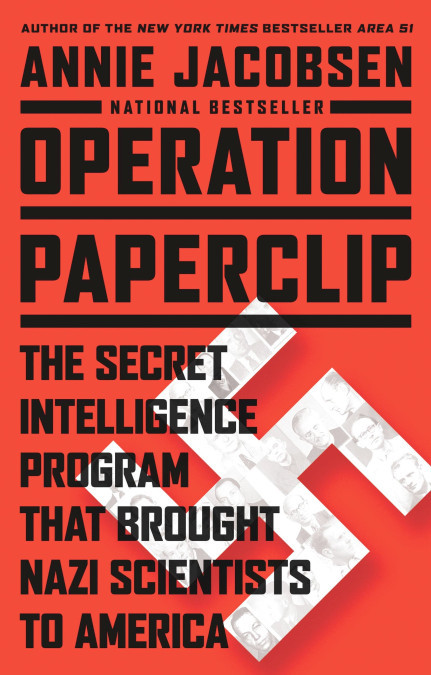
This is the story Annie Jacobsen tells in *Operation Paperclip: The Secret Intelligence Program That Brought Nazi Scientists to America*. Published in 2014, the book is an investigative exposé built on declassified documents, Freedom of Information Act requests, and interviews with descendants of the men who built Hitler's weapons. Jacobsen spent years digging through intelligence dossiers, Nazi records, and trial testimony. What she found was a systematic, government-sanctioned cover-up.
The program had what Jacobsen calls a "benign public face." To the American people, these were brilliant scientists who had simply been doing their jobs. The rockets they built helped win the space race. The medical data they collected saved pilots' lives. The chemical weapons knowledge they brought made America stronger. This was the story the government wanted told.
But behind that public face lay something else entirely: a "classified body of secrets and lies." The scientists who came to America under Operation Paperclip were not merely technicians who happened to work for the wrong side. They were, in many cases, dedicated Nazis. They were SS officers. They were men who worked directly with Adolf Hitler, Heinrich Himmler, and Hermann Göring. They were war criminals.
Consider the numbers Jacobsen presents in the book's prologue. Of the 21 scientists she profiles in depth, eight collaborated directly with Hitler, Himmler, or Göring. Fifteen held Nazi Party membership. Ten joined the paramilitary SA or SS. Two received the Golden Party Badge, Hitler's personal award. One earned a one-million Reichsmark prize from the Führer himself. Six faced Nuremberg trials. One was convicted of mass murder and enslavement, yet later worked for the US Department of Energy after serving a reduced sentence.
These were not "nominal Nazis," as the government later tried to claim. These were men embedded in the apparatus of the Third Reich.
The program was driven by fear. The Cold War was beginning. The Soviet Union had captured German territory and was seizing its own scientists. American intelligence officers were terrified. They believed the Soviets would gain a decisive technological advantage. The Joint Intelligence Committee warned that the United States should prepare for "total war" with the Soviets, including atomic, chemical, and biological dimensions. In this climate of existential dread, moral objections were pushed aside.
The Joint Intelligence Objectives Agency, or JIOA, ran the program from the Pentagon's elite "E" ring. Operating in secrecy, the JIOA recruited scientists for weapons projects across the Army, Navy, Air Force, and eventually the CIA. The program's official name, Operation Paperclip, came from a bureaucratic workaround: intelligence officers attached a paperclip to the files of the most troublesome Nazi cases, signaling that they should bypass standard State Department review. A simple office supply became the symbol of a profound moral compromise.
The book opens with a stark contrast. On one side, the public image: patriotic scientists helping America win the Cold War. On the other side, the classified reality: men who had overseen forced labor camps, conducted lethal medical experiments on prisoners, and developed weapons of mass destruction for the Nazi regime.
Jacobsen's goal is not to demonize these men, but to expose the truth. She argues that Operation Paperclip was "without precedent, entirely unprincipled, and inherently dangerous." The program represented a fundamental departure from American democratic ideals. The same nation that had just fought a war to defeat Nazism was now actively recruiting its architects.
The book profiles twenty-one key figures. Their stories reveal the depth of the deception. There was Wernher von Braun, the rocket scientist who became the face of America's space program, while hiding his SS membership and his role in procuring enslaved laborers from Buchenwald. There was Otto Ambros, the chemist who managed IG Farben's factory at Auschwitz and helped produce the nerve gas sarin, later convicted of mass murder but freed early and hired by the US Department of Energy. There was Dr. Hubertus Strughold, the aviation medicine expert who supervised doctors who performed lethal freezing experiments on prisoners at Dachau, later celebrated as the "father of space medicine" and honored with his name on an Air Force building.
The moral stakes are established from the very first pages. Jacobsen asks a question that echoes throughout the book: Can scientific accomplishment cancel out past crimes? The answer, she suggests, is not as clear as it should be.
For the government, the answer was yes. These men had knowledge America needed. Rockets that could reach space. Nerve agents that could incapacitate enemy armies. Medical data that could save pilots' lives. The Cold War demanded sacrifice, and the sacrifice was principle.
But for the victims, the answer was different. The prisoners who died building the V-2 rockets in underground tunnels. The concentration camp inmates frozen to death in tubs of ice water. The men and women injected with deadly diseases in the name of medical research. Their suffering was not erased by the space race or by America's military superiority.
Jacobsen's investigation reveals a pattern of systematic deception. The government classified trial records to protect its recruits. It coached scientists on how to answer questions about their pasts. It quietly relocated those whose crimes became too public to ignore. The secrecy was not an accident. It was a deliberate strategy.
The program left behind an enduring legacy. Ballistic missiles. Nerve gas munitions. Space technology. Weaponized plague. These were the products of Operation Paperclip. They were built by men whose pasts had been whitewashed, whose crimes had been hidden, whose victims had been forgotten.
As the book makes clear, this was not a story of a few bad apples slipping through the cracks. It was a coordinated, government-wide effort to acquire scientific knowledge at any moral cost. The JIOA, the CIA, the Army, the Navy, the Air Force—all were involved. All knew the truth. All chose to hide it.
The question Jacobsen leaves readers with is simple and devastating: In the name of national security, how much are we willing to sacrifice? And once we make that sacrifice, can we ever get back what we lost?
About the Book
After WWII, the US secretly recruited over 1,600 Nazi scientists, hiding their war crimes to win the Cold War. Annie Jacobsen’s explosive exposé reveals how rocket pioneers, chemical weapons experts, and concentration camp doctors were given new identities and celebrated as American heroes—while their victims' truths were buried in classified files.
Key Takeaways
Moral Compartmentalization Allows Atrocity to Be Repackaged as Progress
The program succeeded because officials like John J. McCloy created a mental firewall, categorizing men as 'scientists' or 'war criminals' as if the two could never overlap, allowing them to celebrate rocket scientists while ignoring the enslaved laborers who died building their rockets.
A Bureaucratic Paperclip Can Symbolize the Collapse of a Nation's Soul
The program's name came from a mundane office supply used to flag files that should bypass State Department review, proving that profound moral compromises often begin not with grand evil but with small, convenient workarounds that become institutionalized.
National Security Fear Is the Most Effective Eraser of Ethical Memory
The Cold War's existential dread allowed the US to systematically erase the pasts of 1,600 Nazi scientists, proving that when a nation convinces itself it is fighting for survival, it will sacrifice any principle—including the one it just fought a war to defend.
The Victims' Truth Outlasts Every Government Cover-Up
Gerhard Maschkowski's Auschwitz tattoo could not be classified, sealed, or destroyed by the Pentagon's archives, serving as a permanent record that the suffering of the enslaved and murdered is more enduring than any rocket launched into space or medal pinned on a chest.
Science Without Conscience Is a Weapon That Eventually Turns on Its Owners
The same unprincipled methods adopted from Nazi doctors—experimenting on unwitting subjects, prioritizing knowledge over humanity—eventually consumed American citizens like Frank Olson, proving that a system built on moral blindness will devour its own.
Justice and Pragmatism Cannot Run on Parallel Tracks Without Colliding
The US prosecuted Nazi doctors at Nuremberg while secretly employing the same men in Heidelberg, demonstrating that a nation cannot simultaneously condemn war criminals in open court and hire them in classified labs without destroying the meaning of both justice and security.
The Most Dangerous Lies Are the Ones a Nation Tells Itself About Its Heroes
Wernher von Braun was celebrated as a space pioneer while his SS membership and role in procuring enslaved laborers from Buchenwald were hidden, proving that the stories a country tells about its heroes often require the erasure of those who paid the price for their achievements.
Silence Is Not the Absence of a Decision—It Is the Loudest Endorsement of Injustice
The Senate never held hearings, the attorney general never opened a case, and officials quietly flew Walter Schreiber to Argentina, proving that the most devastating moral failures are not acts of commission but the collective, deliberate silence of those who choose not to look.
Who Should Listen?
History buffs who want the untold story behind the space race and Cold War military technology.
Readers fascinated by moral dilemmas in national security, especially how governments justify compromising ethics for strategic gain.
True crime and investigative journalism fans who appreciate meticulously documented exposés of institutional cover-ups.
Anyone who grew up idolizing NASA's Apollo heroes and wants to understand the hidden human cost of those achievements.