
Premium
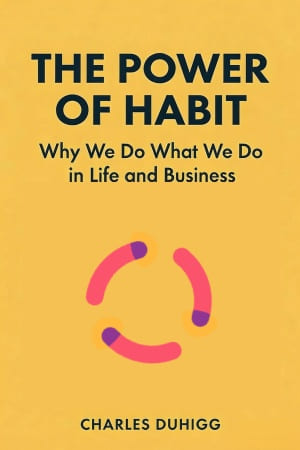
The Power of Habit: Why We Do What We Do in Life and Business
by Charles Duhigg
“Transform your life and work by mastering the neurological loop of cue, routine, and reward.”
Key Takeaways
- 1Deconstruct habits into a three-step neurological loop. Every habit consists of a cue that triggers a routine, which delivers a reward. Lasting change requires diagnosing and manipulating this loop, not simply relying on willpower.
- 2Identify and cultivate keystone habits for systemic change. Certain foundational habits, like exercise or meticulous record-keeping, create ripple effects that trigger widespread positive reorganization in personal lives and corporate cultures.
- 3Belief in change is a non-negotiable prerequisite for transformation. The science of habit rewiring only succeeds within a framework of belief, often fostered by community or crisis, which provides the resilience to endure the initial discomfort of change.
- 4Replace the routine while preserving the cue and reward. Habit change is most effective not through elimination, but through substitution. Isolate the craving driving the habit and find a new, healthier routine that satisfies the same core reward.
- 5Organizations run on institutional habits and collective routines. Corporate culture and performance are driven by ingrained organizational habits. Strategic change requires targeting specific routines, like safety protocols, to alter the entire company's trajectory.
- 6Willpower functions as a muscle that can be strengthened. Willpower is not a fixed trait but a learnable skill. It can be depleted but also fortified through practice and the establishment of automatic routines that conserve mental energy.
Description
At the intersection of neuroscience, psychology, and sociology lies a fundamental force governing human behavior: habit. Charles Duhigg’s *The Power of Habit* investigates the science behind why routines exist, how they become automatic, and the profound ways they shape outcomes for individuals, companies, and societies. The book posits that habits are not destiny but neurological patterns that can be diagnosed, dissected, and ultimately redirected.
Duhigg structures his exploration around the "habit loop," a cycle of cue, routine, and reward that becomes embedded in the brain's basal ganglia. Through compelling narratives—from a woman transforming her life after trauma to the turnaround of the aluminum giant Alcoa—he demonstrates how identifying the components of this loop is the first step toward change. The narrative delves into the concept of "keystone habits," pivotal routines that, when altered, can catalyze widespread transformation, as seen in the success of Olympic athletes or the operational overhaul of major corporations like Starbucks.
The investigation extends beyond the individual to the architecture of social movements and corporate cultures. Duhigg examines how habits function within organizations and communities, arguing that deliberate habit formation is behind effective leadership and successful social change, such as the civil rights movement. The book distinguishes itself by grounding its insights in rigorous reporting and interviews with researchers, rather than offering a simplistic self-help formula.
Ultimately, *The Power of Habit* provides a foundational framework for understanding human behavior. It is essential reading for leaders seeking organizational change, individuals aiming for personal improvement, and anyone curious about the invisible mechanisms that dictate daily actions. Its legacy is a demystification of habit, replacing vague notions of willpower with a concrete, actionable model for intentional living.
Community Verdict
The critical consensus celebrates the book's masterful synthesis of complex science into engaging, story-driven journalism that feels both intellectually substantial and broadly accessible. Readers consistently praise the compelling case studies—from P&G's Febreze to Alcoa's safety culture—as effective vehicles for the core concepts. A significant point of contention, however, is the book's practical utility; while many find the framework illuminating for personal change, others critique the final section for not providing a more explicit, step-by-step implementation guide, leaving them wanting a clearer bridge from theory to action.
Hot Topics
- 1The practical application gap between the fascinating science and a concrete personal change plan.
- 2The effectiveness and memorability of the book's narrative case studies versus dry scientific explanation.
- 3Debate over whether the book is a groundbreaking work of science journalism or a repackaging of known psychological concepts.
- 4The strength of the "keystone habit" concept for driving systemic change in organizations and personal lives.
Related Matches


Popular Books

Holy Bible: The Narrated Bible NIV
Anonymous
One Direction: Who We Are: Our Official Autobiography
One Direction
Walking with God through Pain and Suffering
Timothy J. Keller
A Gospel Primer for Christians: Learning to See the Glories of God's Love
Milton Vincent

The Sibley Guide to Birds; Second Edition, Revised and Enlarged
David Allen Sibley

War Songs: Metaphors In Clay And Poetry From The Vietnam Experience
Grady Harp
Just Mercy: A Story of Justice and Redemption
Bryan Stevenson
Our Magnificent Bastard Tongue
John McWhorter

A Court of Mist and Fury (A Court of Thorns and Roses, #2)
Sarah J. Maas

NIV, Archaeological Study Bible: An Illustrated Walk Through Biblical History and Culture
Anonymous, Duane A. Garrett, Walter C. Kaiser Jr.

The Art of French Pastry
Jacquy Pfeiffer, Martha Rose Shulman
The Body Keeps the Score: Brain, Mind, and Body in the Healing of Trauma
Bessel A. van der Kolk
Browse by Genres
History
Business
Leadership
Marketing
Management
Innovation
Economics
Productivity
Psychology
Mindset
Communication
Philosophy
Biography
Science
Technology
Society
Health
Parenting
Self-Help
Wealth
Investment
Relationship
Startups
Sales
Money
Fitness
Nutrition
Sleep
Wellness
Spirituality
AI
Future
Nature
Politics
Classics
Sci-Fiction
Fantasy
Thriller
Mystery
Romance
Literary
Historical
Religion
Law
Crime
Arts
Habits
Creativity