
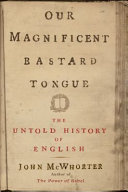
Our Magnificent Bastard Tongue
"Reveals English not as a pure Germanic language, but a Celtic-influenced hybrid forged by forgotten collisions."
- 1English grammar is a historical accident, not a logical system. Its rules emerged from chaotic linguistic contact, not deliberate design. Prescriptive grammar often codifies arbitrary patterns that solidified through historical happenstance rather than inherent superiority.
- 2Celtic languages left a profound, hidden imprint on English syntax. The pervasive use of the meaningless auxiliary 'do' and the '-ing' progressive tense are grammatical fossils, likely borrowed from the Celtic substratum of ancient Britain rather than inherited from Germanic roots.
- 3Language simplifies as it becomes a lingua franca. When adults learn a new language for trade or administration, they streamline its complexity. English lost its elaborate case and gender systems not through laziness, but through its utility as a common tongue.
- 4Vikings accelerated English's grammatical transformation. Old Norse speakers learning Old English as adults imposed a simplifying pressure, stripping away inflections and pushing the language toward its more analytic, word-order-dependent modern structure.
- 5Prescriptivism often defends arbitrary aesthetic preferences. Rules like avoiding sentence-ending prepositions or split infinitives are not guardians of clarity, but stylistic edicts from a later era, mistakenly elevated to the status of fundamental law.
- 6The history of English is a story of violent and intimate contact. The language's character was shaped not in isolation, but through the successive invasions, settlements, and daily negotiations between Celts, Angles, Saxons, Vikings, and Normans.
John McWhorter's Our Magnificent Bastard Tongue dismantles the standard, sanitized narrative of English as a straightforward descendant of Germanic Anglo-Saxon. Instead, it posits a more provocative and tangled lineage, arguing that the very soul of English grammar was fundamentally reshaped by long-overlooked Celtic influences and the simplifying pressures of its role as a bridge language. McWhorter challenges the reader to see English not as a pure lineage but as a linguistic mongrel, its most idiosyncratic features born from forgotten collisions and adult learners' adaptations.
The book's central thesis hinges on two grammatical quirks unique among Germanic languages: the pervasive use of the meaningless auxiliary 'do' (as in 'Do you know?') and the '-ing' progressive tense ('I am reading'). McWhorter marshals comparative linguistic evidence to argue these are not native Germanic developments but likely borrowings from the Celtic languages spoken by the Britons whom the Anglo-Saxons conquered and lived alongside. This Celtic substrate theory reframes English as a hybrid. Furthermore, he details how the Viking invasions introduced a new wave of adult Old Norse speakers learning Old English, catalyzing a drastic simplification of its complex inflectional system.
McWhorter extends this analysis of contact-driven change to explain English's startling grammatical simplicity compared to its cousins like German or Icelandic. He frames this streamlining not as decay but as a natural outcome of the language's history as a lingua franca in a multilingual Britain. The book also delves into the arbitrary nature of prescriptive grammar rules, separating genuine structural patterns from later-invented stylistic preferences often mistakenly defended as essential to clarity or correctness.
Ultimately, the work is a manifesto for a more accurate and vibrant understanding of linguistic history. It targets language enthusiasts, history readers, and anyone curious about why English operates as it does. McWhorter's legacy here is to replace a static, tree-diagram history with a dynamic, network-based one, celebrating English's 'bastard' origins as the source of its distinctive, resilient, and magnificently peculiar character.
Readers celebrate the book's revelatory core thesis—the Celtic and Viking reshaping of English grammar—as intellectually thrilling and accessible. McWhorter's engaging, conversational prose successfully demystifies academic linguistics for a general audience. However, a significant critical strand finds the argument occasionally repetitive and wishes for deeper engagement with counter-arguments from within the linguistic establishment. The central ideas are widely deemed persuasive and fascinating, even if some desire a more rigorously fortified presentation.
- 1The persuasive power and potential overreach of the Celtic substrate theory for English grammar.
- 2McWhorter's accessible, witty prose style versus desires for more academic depth and counterpoint.
- 3The book's effectiveness in challenging ingrained prescriptivist attitudes about 'correct' English.
- 4Debate over whether the central thesis is revolutionary common sense or a provocative oversimplification.

Just Listen: Discover the Secret to Getting Through to Absolutely Anyone
Mark Goulston

Bad Samaritans
Ha-Joon Chang
The Essays of Warren Buffett: Lessons for Corporate America
Lawrence A. Cunningham, Warren Buffett

Stumbling on Happiness
Daniel Gilbert

Outliers: The Story of Success
Malcolm Gladwell
The Artist's Way
Julia Cameron

The Almanack of Naval Ravikant
Naval Ravikant, Eric Jorgenson

Chip War: The Quest to Dominate the World's Most Critical Technology
Chris Miller
The Lessons of History
Will Durant

How to Win Friends & Influence People
Dale Carnegie
Transformation in Christ
Dietrich Von Hildebrand
Sapiens: A Brief History of Humankind
Yuval Noah Harari