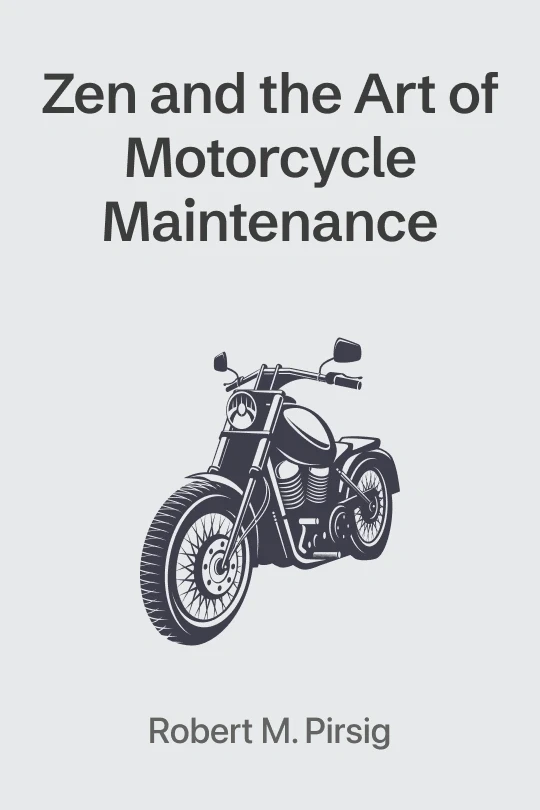
Zen and the Art of Motorcycle Maintenance
An Inquiry Into Values
Book Summaries
Hosts: Ethan
Timeline
Summary Preview
The group sets out from Minneapolis on a bright morning, two motorcycles carrying four people across the American landscape. The narrator rides with his eleven-year-old son Chris on the back. Their friends John and Sylvia Sutherland follow on their own bike. They've made trips like this before, and the four of them communicate through gestures and shared rhythms built up over years of riding together.
But this journey is different from the start. The narrator feels it in the way the land opens up around them, in the memories that surface unbidden as they cross the Central Plains toward the Dakotas. He's taking this route not just to reach a destination, but to think. To sort through something that has been pressing on him for years.
The experience of traveling by motorcycle is central to everything that follows. From inside a car, the narrator explains, you're a passive observer. The world passes by like a television show, framed by windows, separated from you by glass and metal. But on a motorcycle, the boundary dissolves. "You're in the scene," he writes, not watching it. The wind hits your body. The road vibrates through the handlebars. The smells of hay and dust and gasoline reach you directly. You feel the cold when the temperature drops and the heat when the sun beats down. You are part of the landscape, not separate from it.
This difference between being in the scene and watching it from a distance becomes the book's central metaphor. The narrator wants to understand why so many people live as spectators in their own lives, why they feel disconnected from the technology that surrounds them, and why this disconnection leaves them restless and unsatisfied.
The group travels on smaller roads, avoiding the impersonal highways that push people through the country at high speed without letting them see anything. The narrator notes that people along these back roads seem different—more courteous, more present, more willing to stop and talk. They have time to be where they are. This observation leads him to reflect on modern life more broadly. Most people, he thinks, move through their days in a state of constant hurry, and the result is a kind of "endless day-to-day shallowness," a monotony that consumes years without leaving much behind.
This is why he wants to give a Chautauqua.
The word comes from an old American tradition—traveling tent shows where speakers would address important topics at length, taking time to explore ideas thoroughly. These Chautauquas were pushed aside by faster forms of communication, and the narrator believes this shift has made the national consciousness run faster but less deep. His own Chautauqua will unfold over the course of the trip, weaving together observations about the road with deeper explorations of the problems he sees in modern life.
The immediate inspiration for his talk comes from John and Sylvia Sutherland. They are good friends, but something is off between them, a tension the narrator can sense but can't quite name. The trouble centers on their different attitudes toward technology, particularly toward the motorcycles they ride.
The narrator believes in knowing his machine, in being responsible for its maintenance. He can diagnose problems, make adjustments, keep the bike running well. John takes the opposite approach. He wants to leave maintenance to professional mechanics. When the two of them discuss this, communication breaks down completely. John becomes angry, and the more the narrator probes, the angrier John gets.
This isn't really about motorcycles. The narrator realizes that John and Sylvia use their motorcycle trips to escape from technology, not to engage with it. They want to get away from the world of machines and systems and return to something simpler. But they are dependent on the very technology they flee. This contradiction bothers them, and they don't want to examine it too closely.
The narrator sees this as symptomatic of a larger problem. Entire movements have sprung up in opposition to technology, and people feel oppressed by forces they can't quite name. But running away isn't the answer. The Buddha, the narrator says, is present in all things—including machines. To think otherwise is to diminish the Buddha and oneself.
These early miles of the journey establish the physical and intellectual landscape the book will travel through. The narrator and his companions cross the plains as the weather shifts around them. Storms gather on the horizon. Chris grows restless on the back of the motorcycle. The miles pass, and with them come the first hints of the deeper story waiting to be told.
For the narrator, this trip is not just a vacation. It's a return to places he has been before, to memories that belong to someone he used to be. Someone he calls Phaedrus.
As the group rides on, the narrator feels Phaedrus's presence growing stronger, like a ghost that has been waiting for him to come back this way. The ideas that will fill the Chautauqua are not entirely his own. They belong to that earlier self, the brilliant and troubled man who pursued a vision of truth so relentlessly that it destroyed him. The narrator is haunted by what Phaedrus found, and by the fear that he might find it again.
The motorcycle hums beneath him. The road stretches ahead. And the journey into the heart of Quality has only just begun.
What happens when a man sets out to understand the very nature of reality, and the answer he finds shatters his mind?
About the Book
A father and son ride across America on a motorcycle, but the real journey is inward. Blending philosophy, memoir, and practical wisdom, this book explores the split between technology and human values, the nature of quality, and the search for meaning in a fragmented world. It is a meditation on how to live an engaged, authentic life.
Key Takeaways
You Are In the Scene, Not Watching It
The difference between experiencing life and merely observing it is the difference between riding a motorcycle and driving a car—on a motorcycle, the boundary between self and world dissolves, and you become part of the landscape rather than a passive spectator behind glass.
The Knife of Reason Kills What It Cuts
Analytic thought, while powerful, always destroys something essential in the process of dissection—when we break the world into parts to understand it, we lose the wholeness that gives life meaning, and we forget that we are the ones doing the cutting.
Science Cannot Answer Its Own Questions
The scientific method contains a fatal flaw: for any observation, an infinite number of rational hypotheses exist, and science provides no way to choose between them—meaning the search for truth through pure reason alone leads not to certainty but to an endless regression of possibilities.
Quality Is the Tao—It Cannot Be Named, Only Experienced
The ultimate reality is not subjective or objective but the ground from which both arise; like the Tao, Quality is the pre-intellectual source of all meaning, and the attempt to define it in words destroys the very thing you are trying to grasp.
The Greatest Trap Is Holding Onto What You Value
Value rigidity—the refusal to let go of a fixed idea of how things should be—is the most dangerous gumption trap; like a monkey who will not release the rice in a jar, we remain stuck not because we cannot escape, but because we will not question what we think we need.
Mu: The Answer That Breaks the Tyranny of Yes and No
When a question is framed in a way that cannot contain the truth, the wisest response is not affirmation or denial but Mu—a recognition that the question itself is too small, and that real understanding requires stepping back to ask a better question.
The Divided Mind Cannot Love Wholly
The narrator's greatest failure was not his madness but his neglect of his son—he was so consumed by the philosophical war between classic and romantic that he forgot the most important duality of all: the distance between himself and the child who needed him to open the glass door.
Healing Begins When You Stop Running From Your Ghosts
The journey to wholeness requires confronting the past selves we have tried to erase—Phaedrus was not a separate person to be feared but a part of the narrator that had to be reclaimed, and the moment of reconciliation came not through logic but through a son's simple, persistent love.
Who Should Listen?
Mechanics, engineers, and craftspeople who feel their work is dismissed as soulless or merely technical and want to reclaim its dignity and artistry.
Artists, writers, and creatives who struggle with the logic and structure of their tools or mediums and seek a deeper, more integrated creative process.
People in recovery from mental health challenges or trauma who are seeking a narrative that validates their experience of fragmentation and offers hope for reconciliation.
Anyone feeling alienated by modern technology or the pace of contemporary life, who wants a practical and philosophical guide to re-engaging with the world with care and attention.