

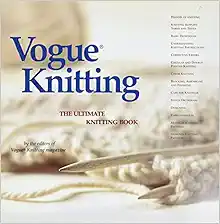
Vogue Knitting: The Ultimate Knitting Book
by Vogue Knitting
“The definitive technical encyclopedia that transforms knitters from novices into confident, self-sufficient designers.”
Key Takeaways
- 1Master multiple cast-on and bind-off techniques. Different methods create edges with varying elasticity and strength, allowing you to select the perfect finish for any garment.
- 2Learn professional finishing and seaming methods. Invisible seams and polished blocking elevate hand-knit items from homemade to professionally crafted pieces.
- 3Utilize the comprehensive stitch dictionary for design. Hundreds of charted and photographed stitch patterns serve as a foundational library for creating custom textures and fabrics.
- 4Apply systematic principles to design your own sweaters. The book provides a structured worksheet and formulas for calculating shaping, sizing, and construction from scratch.
- 5Diagnose and correct errors with precision. Clear instructions for fixing dropped stitches, mis-crossed cables, and gauge problems salvage work and build technical confidence.
- 6Understand yarn fibers, tools, and pattern terminology. A solid grasp of materials and standardized abbreviations is essential for executing any published pattern successfully.
- 7Explore colorwork techniques like Fair Isle and intarsia. Step-by-step guides demystify complex color knitting, opening the door to intricate graphic and patterned designs.
- 8Supplement with online resources for advanced techniques. The book's scope is vast but not exhaustive; modern methods like magic loop may require external video tutorials.
Description
Vogue Knitting: The Ultimate Knitting Book positions itself not merely as an instruction manual, but as the canonical technical reference for the craft. It begins with a concise history of knitting, establishing its cultural lineage, before methodically cataloging the essential tools and materials. The core philosophy is one of comprehensiveness and choice, presenting multiple validated methods for every fundamental action—from casting on to binding off, increasing to decreasing—empowering the knitter to select the technique best suited to the project's aesthetic and functional demands.
Its pedagogical strength lies in the seamless integration of detailed illustrations, step-by-step photographs, and clear textual instructions. This multi-modal approach clarifies everything from basic knit and purl stitches to advanced colorwork, cabling, and lace. A significant portion of the book is devoted to the often-overlooked art of finishing: blocking, seaming, creating buttonholes and pockets, and adding linings. The substantial stitch dictionary provides a visual catalog of textures, while the design section offers a mathematical framework for constructing sweaters, complete with worksheets for custom measurements and shaping.
The book concludes with a selection of modular and traditional garment patterns, serving as practical applications of the preceding lessons. Its target audience is the serious knitter—whether a dedicated beginner or an experienced practitioner seeking to fill gaps in their knowledge. It functions less as a linear tutorial and more as a permanent, authoritative desk reference, aiming to be the single volume a knitter reaches for when a question of technique arises. Its legacy is that of a technical bible, a trusted source that demystifies the mechanics behind beautiful, durable knitted fabric.
Community Verdict
The knitting community regards this volume as an indispensable, if flawed, cornerstone of the craft library. Its unparalleled breadth and the clarity of its visual instructions are universally praised, with many declaring it the single most comprehensive reference they own. The detailed photographs and diagrams for techniques like finishing and error correction are consistently highlighted as transformative, turning frustrating hurdles into manageable steps.
However, a significant and vocal critique centers on its organizational architecture and occasional technical oversights. The indexing system is widely condemned as inadequate, making specific information difficult to locate swiftly. Furthermore, the book’s ambitious title sets a high bar it does not fully meet; notable omissions include in-depth coverage of circular knitting, socks, hats, and modern methods like the magic loop. The advanced design section and stitch dictionary, while valuable, are reported to contain confusing instructions and typos that can undermine confidence. The consensus is that this is a brilliant supporting reference for knitters with some foundational experience, but it should not be expected to stand alone as a truly "ultimate" guide to every knitting discipline.
Hot Topics
- 1The severe criticism of the book's index and organizational structure, which makes finding specific techniques needlessly frustrating.
- 2Debate over whether the book's title is justified, given its lack of coverage for circular knitting, socks, and other popular modern disciplines.
- 3The exceptional quality and clarity of the photographic illustrations and step-by-step diagrams for techniques like seaming and correcting errors.
- 4Reports of typos and confusing instructions within the advanced sections, particularly the stitch dictionary and sweater design chapters.
- 5The book's value as a comprehensive reference for finishing techniques, which many claim elevates the professional look of their projects.
- 6Discussion on whether this book is suitable for absolute beginners or is better suited as a second reference for those with some foundational knowledge.
Related Matches
Popular Books

Harry Potter and the Deathly Hallows (Harry Potter, #7)
J.K. Rowling, Mary GrandPre

The Body Keeps the Score: Brain, Mind, and Body in the Healing of Trauma
Bessel A. van der Kolk

The House of Hades (The Heroes of Olympus, #4)
Rick Riordan

Never Split the Difference: Negotiating As If Your Life Depended On It
Chris Voss, Tahl Raz

The Hobbit: Graphic Novel
Chuck Dixon, J.R.R. Tolkien, David Wenzel, Sean Deming

Harry Potter and the Order of the Phoenix (Harry Potter, #5)
J.K. Rowling, Mary GrandPre

We Should All Be Feminists
Chimamanda Ngozi Adichie

Evicted: Poverty and Profit in the American City
Matthew Desmond

A Game of Thrones (A Song of Ice and Fire, #1)
George R.R. Martin

Why We Sleep: Unlocking the Power of Sleep and Dreams
Matthew Walker

Unbroken: A World War II Story of Survival, Resilience, and Redemption
Laura Hillenbrand

A Monster Calls
Patrick Ness, Jim Kay, Siobhan Dowd
Browse by Genres
History
Business
Leadership
Marketing
Management
Innovation
Economics
Productivity
Psychology
Mindset
Communication
Philosophy
Biography
Science
Technology
Society
Health
Parenting
Self-Help
Wealth
Investment
Relationship
Startups
Sales
Money
Fitness
Nutrition
Sleep
Wellness
Spirituality
AI
Future
Nature
Politics
Classics
Sci-Fiction
Fantasy
Thriller
Mystery
Romance
Literary
Historical
Religion
Law
Crime
Arts
Habits
Creativity