

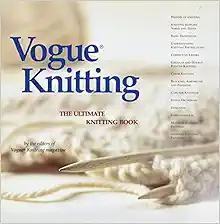
Vogue® Knitting The Ultimate Knitting Book
by Vogue Knitting
“The definitive technical encyclopedia that transforms craft into professional-grade artistry.”
Key Takeaways
- 1Master finishing techniques for a polished, professional look. Invisible seams, precise blocking, and meticulous assembly elevate handmade garments from homemade to couture-level quality.
- 2Consult the comprehensive stitch dictionary for design inspiration. An extensive visual catalog of hundreds of stitch patterns provides a foundational library for texture, cable, and lace creation.
- 3Select the appropriate technique for each specific knitting challenge. Multiple methods for casting on, increasing, and decreasing are presented, each suited to a different structural or aesthetic purpose.
- 4Learn to read and interpret complex knitting charts and abbreviations. The book demystifies standard pattern notation, enabling knitters to confidently execute intricate published designs.
- 5Apply modular design principles to create custom-fitted sweaters. A systematic worksheet guides the knitter through measurements, gauge, and shaping to draft personalized garment patterns.
- 6Diagnose and correct common errors without unraveling entire rows. Clear visual guides show how to pick up dropped stitches and fix mis-crossed cables, preserving hours of work.
Description
Vogue Knitting: The Ultimate Knitting Book positions itself not as a simple primer, but as the canonical technical reference for the serious practitioner. It synthesizes the expertise of more than fifty specialists into a single, visually rich volume that aims to codify the entire discipline. The book’s ambition is encyclopedic, moving from the historical roots of the craft through the granular physics of fiber and tool selection to the execution of highly advanced techniques.
Its pedagogical structure is methodical. Initial chapters establish a foundation with exhaustive treatments of basic techniques—presenting numerous variations for casting on, binding off, increasing, and decreasing, each accompanied by clear illustrations and photographs. This establishes a core philosophy: for every knitting problem, there exists a specific, optimal technical solution. The middle sections delve into colorwork, including Fair Isle and intarsia, specialized applications like circular and double-pointed knitting, and a critical emphasis on finishing. Here, the book’s value becomes most apparent, offering master-level instruction on seaming, blocking, and detailing that transforms construction into fine craftsmanship.
The book culminates in resources for autonomous creation: a substantial stitch dictionary offering hundreds of pattern swatches, and a detailed design chapter focused on sweater construction. This section provides the mathematical frameworks and proportional guidelines for drafting custom-fitted garments. A collection of classic patterns from designers like Oscar de la Renta serves as a practical application of the preceding principles.
As a result, the book’s primary audience is the knitter who has moved beyond following patterns verbatim and seeks to understand the underlying architecture of the craft. It is less a step-by-step tutorial for absolute novices and more a lifelong reference for those committed to achieving technical mastery and developing a deep, analytical understanding of how knitted fabric is conceived, structured, and perfected.
Community Verdict
The knitting community regards this volume as an indispensable, if flawed, cornerstone of the craft library. Its unparalleled breadth and the exceptional clarity of its visual instructions—combining detailed diagrams with lush photography—are universally praised. For knitters progressing beyond basics, it is frequently hailed as the definitive answer book, demystifying complex techniques and finishing methods that elevate work from amateur to professional.
However, a significant and recurring critique challenges its titular claim to being "ultimate." The consensus identifies specific, glaring omissions that undermine its comprehensiveness, particularly the scant treatment of circular knitting and the complete absence of guidance for staples like socks, hats, and mittens. Furthermore, the advanced design section is criticized for confusing instructions and a lack of practical context, while the book’s organization and notoriously poor index actively hinder its utility as a quick-reference tool. The verdict is thus one of qualified reverence: it is an essential, peerless resource for a vast array of techniques, yet it falls short of being the all-encompassing bible it purports to be.
Hot Topics
- 1The book's claim to be 'ultimate' is debated due to major omissions like socks, hats, and mittens.
- 2The poor index and confusing organization frustrate users trying to quickly find specific techniques.
- 3The advanced sweater design section is criticized for unclear instructions and lack of practical guidance.
- 4The stitch dictionary is praised for its breadth but faulted for typos and missing contextual application notes.
- 5The exceptional quality of finishing techniques and professional seaming methods is universally acclaimed.
- 6The treatment of circular and double-pointed needle knitting is considered insufficient for modern projects.
Related Matches
Popular Books

Harry Potter and the Deathly Hallows (Harry Potter, #7)
J.K. Rowling, Mary GrandPre

The Body Keeps the Score: Brain, Mind, and Body in the Healing of Trauma
Bessel A. van der Kolk

The House of Hades (The Heroes of Olympus, #4)
Rick Riordan

Never Split the Difference: Negotiating As If Your Life Depended On It
Chris Voss, Tahl Raz

The Hobbit: Graphic Novel
Chuck Dixon, J.R.R. Tolkien, David Wenzel, Sean Deming

Harry Potter and the Order of the Phoenix (Harry Potter, #5)
J.K. Rowling, Mary GrandPre

We Should All Be Feminists
Chimamanda Ngozi Adichie

Evicted: Poverty and Profit in the American City
Matthew Desmond

A Game of Thrones (A Song of Ice and Fire, #1)
George R.R. Martin

Why We Sleep: Unlocking the Power of Sleep and Dreams
Matthew Walker

Unbroken: A World War II Story of Survival, Resilience, and Redemption
Laura Hillenbrand

A Monster Calls
Patrick Ness, Jim Kay, Siobhan Dowd
Browse by Genres
History
Business
Leadership
Marketing
Management
Innovation
Economics
Productivity
Psychology
Mindset
Communication
Philosophy
Biography
Science
Technology
Society
Health
Parenting
Self-Help
Wealth
Investment
Relationship
Startups
Sales
Money
Fitness
Nutrition
Sleep
Wellness
Spirituality
AI
Future
Nature
Politics
Classics
Sci-Fiction
Fantasy
Thriller
Mystery
Romance
Literary
Historical
Religion
Law
Crime
Arts
Habits
Creativity