
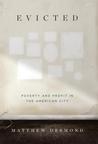
Evicted: Poverty and Profit in the American City
"Exposes how eviction is not a consequence of poverty, but its primary engine in modern America."
- 1Eviction is a cause, not merely a symptom, of deep poverty. Desmond demonstrates how the trauma, displacement, and financial ruin of eviction actively perpetuate and deepen poverty, creating a devastating cycle that traps families for years.
- 2The private rental market systematically profits from human desperation. In the absence of affordable public housing, landlords in impoverished neighborhoods operate a lucrative business model built on extracting exorbitant rent from the most vulnerable, with minimal investment.
- 3Housing instability dismantles every other aspect of life. The constant threat of eviction destroys psychological well-being, disrupts employment, uproots children from schools, and severs community ties, making upward mobility nearly impossible.
- 4Poverty is a relentless, full-time administrative burden. The book reveals how surviving on the edge consumes all mental and emotional energy in navigating bureaucracies, predatory markets, and impossible trade-offs between rent, food, and medicine.
- 5The solution requires a fundamental reimagining of housing as a right. Desmond argues for a universal housing voucher program, positing that direct, widespread subsidy is the most effective and humane policy intervention to break the cycle of eviction and poverty.
Matthew Desmond’s Evicted plunges readers into the heart of Milwaukee’s poorest neighborhoods, using immersive, ethnographic fieldwork to document America’s housing crisis at its most visceral level. The book follows eight families—both Black and white—living on the absolute economic edge, where a single missed rent payment can trigger a cascade of catastrophes. Desmond embeds himself with tenants and landlords alike, constructing a narrative that reads with the urgency of a novel while maintaining rigorous sociological precision.
Through the lives of individuals like Arleen, a single mother evicted just before Christmas, and Scott, a former nurse battling addiction, the book meticulously charts how over 70% of a family’s income can be consumed by substandard housing. This financial hemorrhage leaves nothing for savings, healthcare, or emergencies, locking them in a state of perpetual crisis. Simultaneously, Desmond profiles landlords like Sherrena Tarver, revealing the economic calculations and often grim realities of providing housing in these markets, where profit margins are extracted from profound vulnerability.
The narrative systematically dismantles the myth that eviction is a rare, last-resort outcome. Instead, Desmond establishes it as a commonplace, brutalizing event, especially for Black women, that functions as a primary driver of urban poverty. An eviction record becomes a scarlet letter, banishing families to worse housing in more dangerous neighborhoods, destabilizing children’s education, and foreclosing future opportunities, thus perpetuating the cycle.
Beyond its devastating portrait, Evicted is a work of transformative social science that reorients the entire debate on poverty. It argues that housing instability is not a side effect but a core mechanism of American inequality. The book’s monumental impact lies in its fusion of human storytelling with groundbreaking data, making an irrefutable case for housing as a fundamental human right and proposing concrete, radical policy solutions aimed at the heart of the crisis.
Readers hail the book as a devastating, essential masterpiece that fundamentally altered their understanding of poverty. The immersive, novelistic storytelling is praised for forging profound empathy, making systemic injustice feel intensely personal. Criticisms are minor, occasionally noting the dense sociological data or the emotional weight of the subject matter. The consensus is one of awe at Desmond’s scholarship and a strong belief that the book should be mandatory reading for its moral and political urgency.
- 1The ethical ambiguity of landlords profiting in impoverished markets, dissecting whether they are exploitative predators or simply operating within a broken system.
- 2The book's powerful, novelistic narrative style versus its foundation as rigorous academic sociology, and which aspect resonates more strongly.
- 3Personal identification with Scott's story, which highlights how addiction and misfortune can lead to homelessness regardless of former income or social standing.
- 4The proposed universal housing voucher solution—debating its feasibility, cost, and potential effectiveness compared to other poverty interventions.
- 5The emotional toll of reading such an unflinching account of suffering and systemic failure, with many noting it is necessary but difficult to process.
Radical Markets: Uprooting Capitalism and Democracy for a Just Society
Eric A. Posner, E. Glen Weyl
Breath: The New Science of a Lost Art
James Nestor
The Art of Contrarian Trading
Carl Futia

How to Win Friends & Influence People
Dale Carnegie

Out of Control
Kevin Kelly

Sapiens: A Brief History of Humankind
Yuval Noah Harari
Transformation in Christ
Dietrich Von Hildebrand

The Psychology of Money: Timeless Lessons on Wealth, Greed, and Happiness
Morgan Housel
The Creative Habit
Twyla Tharp, Mark Reiter
The Essays of Warren Buffett: Lessons for Corporate America
Lawrence A. Cunningham, Warren Buffett

Permanent Record
Edward Snowden

Amusing Ourselves to Death: Public Discourse in the Age of Show Business
Neil Postman