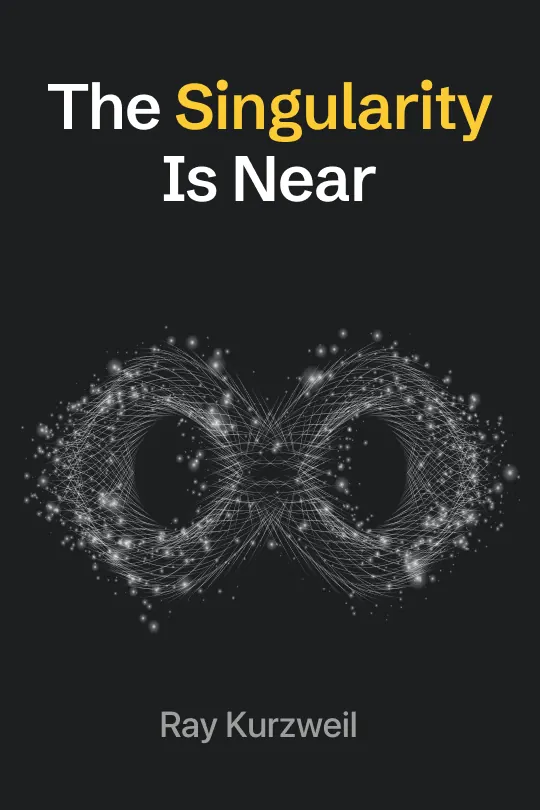
The Singularity is Near
When Humans Transcend Biology
Book Summaries
Hosts: Ethan
Timeline
Summary Preview
Let's start with a simple fact: your brain is a biological organ with hard limits. It processes information at roughly 200 calculations per second per neural circuit. It has a fixed memory capacity. It gets tired. It forgets. It ages. And after about eighty years, it stops working entirely.
This is the problem Ray Kurzweil identifies at the foundation of everything: human biology has a ceiling, and we're already bumping against it.
Think about what your brain can't do. You can't hold a thousand numbers in your head at once. You can't process a library of information in seconds. You can't transfer knowledge directly to another person. Every human who ever lived has had to learn everything from scratch—reading, writing, mathematics, history—one painful lesson at a time. No downloads. No direct neural connections. Just slow, biological learning through a system that evolved for survival on the savanna, not for parsing the complexity of modern civilization.
Kurzweil argues that this is more than an inconvenience. It's an evolutionary dead end. The human brain, for all its remarkable pattern-recognition abilities, is fundamentally limited by its biological substrate. We can't think faster. We can't remember more. We can't process information at the rate technology is producing it. And biological evolution, which takes thousands of generations to make even small changes, can't keep up.
The solution, Kurzweil argues, isn't better education or smarter thinking techniques. It's transcendence. We need to move beyond biology entirely.
This is where the Six Epochs framework comes in. Kurzweil maps the entire history of the universe—and the future—into six distinct stages, each building on the last at an accelerating pace.
**Epoch One** is physics and chemistry. Matter and energy organize into atoms and molecules. Simple structures emerge from chaos. This took billions of years.
**Epoch Two** is life. Carbon-based organisms appear, capable of storing information in DNA and replicating themselves. Evolution begins its slow, patient work of creating complexity from simple building blocks.
**Epoch Three** is the brain. Organisms develop nervous systems, then central processing units that can recognize patterns, learn from experience, and make decisions. This is where intelligence enters the picture.
**Epoch Four** is technology. Humans develop tools, language, writing, and eventually machines that extend their physical and mental capabilities. This epoch is where we are now, but barely.
**Epoch Five** is the merger of human and machine intelligence. This is the Singularity. The boundary between biological and non-biological thinking dissolves. Humans augment their brains with computational power. Machines learn to think like humans, then better. The two become one system.
**Epoch Six** is the universe waking up. Intelligence, now freed from biological limits, expands outward from Earth, reorganizing matter and energy across the cosmos.
Here's the critical insight: we're already in Epoch Five. The transition has begun. Kurzweil wrote this book in 2005, but the pattern was already clear. Every decade, computational power doubles. Every decade, our understanding of the brain deepens. Every decade, the gap between what humans can do naturally and what technology can do artificially narrows.
But here's the uncomfortable truth Kurzweil forces us to confront: our biology isn't just slow—it's obsolete. The human brain evolved to solve problems of survival: finding food, avoiding predators, navigating social groups. It was not designed to process the vast information flows of the 21st century. It was not designed to understand quantum physics or global economics or artificial neural networks. We're running modern software on ancient hardware.
The practical implication is straightforward: if we want to continue advancing—if we want to solve the problems that threaten our existence, understand the universe we inhabit, and push beyond our current limits—we need to upgrade. Not incrementally. Fundamentally.
Kurzweil isn't talking about better study habits or productivity apps. He's talking about rewiring the hardware. Merging with the very technology we've created. Becoming something that isn't quite human anymore, at least not in the biological sense.
This is the core problem the rest of the book addresses. The Six Epochs framework shows us the trajectory we're already on. The question isn't whether we'll merge with technology. The question is whether we'll do it intelligently, with foresight and purpose, or whether we'll stumble into it blindly, unprepared for what it means.
We've entered the fifth epoch. The biological wall is real. And the only way through it is to become something more than biological.
So here's the question that should stay with you as we move forward: If your mind could be freed from the limits of your brain—if you could think faster, remember everything, and access all human knowledge directly—what would you become? And more importantly, would you still be you?
About the Book
Human intelligence has hit a biological wall. Ray Kurzweil maps the inevitable merger of mind and machine through genetics, nanotechnology, and robotics. By 2045, the Singularity will unlock limitless cognition, programmable bodies, and cosmic expansion. This is the practical roadmap to transcending our evolutionary limits and becoming something far greater.
Key Takeaways
Recognize that human biology has a hard ceiling and plan to transcend it through technology.
Your brain is a biological organ with fixed limits on processing speed, memory, and lifespan, and it cannot keep pace with the exponential growth of information. Instead of relying solely on better study habits or productivity hacks, you should actively explore and invest in technologies like brain-computer interfaces, genetic therapies, and nanobots that can augment or replace biological functions.
Apply the Law of Accelerating Returns to anticipate paradigm shifts in your industry.
Technological progress follows an exponential S-curve where each plateau is replaced by a new, higher-performing paradigm (e.g., vinyl → cassette → CD → streaming). To stay ahead, identify which S-curve your current tools or business model are on, and prepare for the next paradigm shift before the current one plateaus.
Reverse-engineer the brain's pattern-recognition architecture to build better AI systems.
The human brain excels at massive parallel processing and pattern recognition, not sequential logic. When designing AI or machine learning systems, prioritize neuromorphic models that replicate the brain's hierarchical, self-organizing structure over traditional rule-based programming to achieve human-level cognition.
Leverage the GNR (Genetics, Nanotechnology, Robotics) convergence as a unified strategy for innovation.
Genetics, nanotechnology, and robotics are not separate fields but a self-accelerating system: genetics decodes biology, nanotechnology builds at the molecular scale, and robotics provides the intelligence to design and control both. Invest in or develop solutions that combine these domains to create exponential breakthroughs in health, manufacturing, and computing.
Deploy programmable nanobots as a platform for proactive health management.
Nanobots can function as a distributed, real-time health monitoring and repair network—delivering drugs to specific cells, repairing DNA, clearing arterial plaque, and destroying pathogens before symptoms appear. Integrate nanobot-based therapies into your personal health regimen to shift from reactive treatment to continuous, preventive maintenance.
Use gene therapy and RNA interference to edit the 'source code' of your biology.
Instead of accepting genetic predispositions to disease or aging, proactively use tools like RNAi to silence harmful genes and viral vectors to deliver corrective genes. This approach transforms medicine from treating symptoms to rewriting the underlying instructions, enabling prevention of inherited conditions and enhancement of normal capabilities.
Adopt a phased upgrade path for your body and mind, from biological augmentation to full digital integration.
Start with Body 2.0 enhancements (respirocytes for oxygen, neurochips for memory, nanobots for immunity) to extend your biological lifespan, then transition to Body 3.0 (foglets for programmable form) and direct brain-cloud interfaces. This staged approach lets you survive long enough to reach the Singularity while gradually shedding biological limitations.
Prepare for the Singularity by preserving your identity as a transferable pattern, not a fixed biological form.
Your consciousness and identity are defined by the pattern of neural connections and memories, not the physical brain itself. Take practical steps to extend your biological health to reach 2045, but also plan to back up and transfer your cognitive pattern to non-biological substrates (e.g., synthetic neocortex, cloud-based intelligence) to achieve indefinite existence and cosmic-scale expansion.
Who Should Listen?
Tech investors and entrepreneurs who want to understand which exponential technologies will reshape every industry before 2050.
Biohackers and longevity enthusiasts actively seeking evidence-based methods to extend their lifespan until radical life extension arrives.
Futurists and science fiction readers who crave a rigorous, data-driven framework for what the next 30 years of human evolution actually looks like.
Ethicists and policy makers who need to grapple with the real risks of self-replicating nanotech and AI before the grey goo scenario becomes possible.