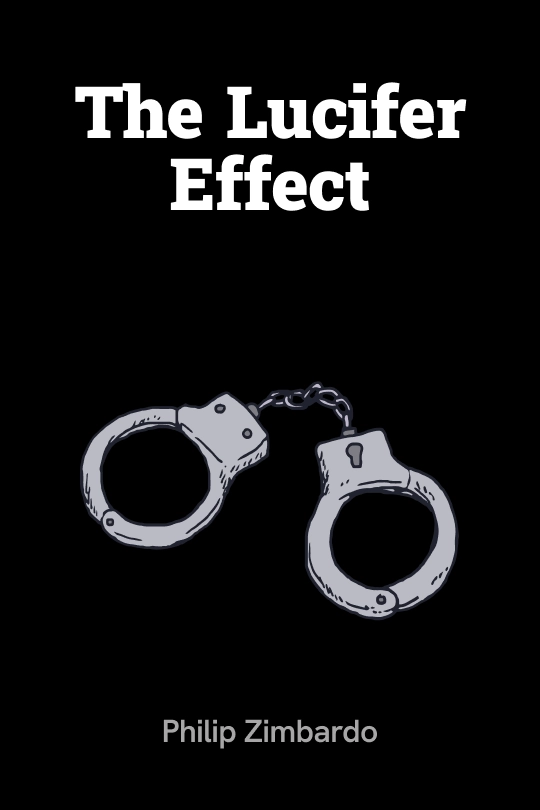
The Lucifer Effect
Understanding How Good People Turn Evil
Book Summaries
Hosts: Ethan
Timeline
Summary Preview
How do ordinary people commit atrocities? This question haunts history. The Holocaust. The Rwandan genocide. The torture at Abu Ghraib. In each case, millions of people—neighbors, friends, soldiers, citizens—participated in horrors they would have condemned just months earlier. Were they all monsters? Were they all secretly evil, hiding their true nature until the right moment arrived?
Philip Zimbardo, the Stanford psychologist who designed one of the most famous experiments in social psychology, offers a different answer. His book *The Lucifer Effect* challenges the comfortable belief that evil lives only in the hearts of bad people. Instead, Zimbardo argues that situational and systemic forces—not inherent character flaws—turn good people into perpetrators of evil.
This is not an excuse. It is an explanation. And it matters deeply, because if we misunderstand the cause of evil, we will never learn to prevent it.
Zimbardo opens the book by confronting a deeply ingrained assumption in Western culture. We want to believe that good people and bad people are fundamentally different. This belief feels reassuring. If evil comes from defective individuals, then the rest of us are safe. We can distance ourselves from perpetrators, label them as monsters, and never ask whether we might do the same under similar circumstances.
But history and psychology tell a different story. Zimbardo points out that in the past century alone, more than fifty million people have been murdered because soldiers and civilians carried out government orders. In Rwanda, Hutus slaughtered friends and neighbors on command, murdering at least 800,000 people in approximately three months. The perpetrators used rape to terrorize and spiritually annihilate women—at least 200,000 women were raped during this atrocity. These were not professional killers. They were ordinary people.
Zimbardo quotes Nicole Bergevin, a lawyer who defended a prominent Hutu offender in her genocide trial. Bergevin said: "When you do murder trials, you realize that we are all susceptible, and you wouldn't even dream you would ever commit this act. But you come to understand that everyone is [susceptible]. It could happen to me, it could happen to my daughter. It could happen to you."
This is the central provocation of *The Lucifer Effect*: you could do terrible things. So could I. So could anyone.
To explain how this happens, Zimbardo distinguishes between two ways of understanding human behavior. The first is dispositional theory, which explains actions through individual character, personality traits, and inner nature. This is the default approach in most societies. When someone does something evil, we ask: What kind of person would do that? We look for something broken inside them.
The second is situational theory, which examines the circumstances surrounding an action. Social psychologists ask: To what extent can an individual's actions be traced to factors outside the actor—to situational variables and environmental processes unique to a given setting? This approach does not deny personal responsibility, but it insists that context matters enormously.
Most people, Zimbardo argues, weigh dispositional factors too heavily and situational factors too lightly when judging others' behavior. This bias has real consequences. It shapes how we punish criminals, how we design institutions, and how we understand ourselves.
To illustrate his theory of evil, Zimbardo offers a powerful analogy. Imagine that most people, most of the time, are moral creatures. But imagine that this morality is like a gearshift that at times gets pushed into neutral. When that happens, morality is disengaged. If the car happens to be on an incline, car and driver move precipitously downhill. It is then the nature of the circumstances that determines outcomes, not the driver's skills or intentions.
This analogy captures something essential about Zimbardo's argument. The driver is not bad. The car is not broken. But on a steep enough hill, with the gears disengaged, movement downhill becomes inevitable. The same person who would drive safely on flat ground becomes a danger on the slope—not because they changed, but because the situation changed.
Zimbardo carries this analysis further. Situations themselves do not arise from nowhere. They are created and shaped by higher-order factors—systems of power. Behind the scenes, a "power elite" arranges the conditions of life and the institutional settings in which most people exist. Sociologist C. Wright Mills, whom Zimbardo quotes, explains that this power elite consists of men whose positions enable them to transcend ordinary environments. They run the big corporations, the machinery of state, the military establishment. Their decisions—and their failures to act—shape society in significant ways.
This is why Zimbardo advocates for a public health model rather than a medical model when addressing evil. The medical model treats the individual perpetrator as if they acted in a vacuum, free of situational and systemic influences. It diagnoses the "sick" person and tries to cure them. The public health model, by contrast, looks at the conditions that allow disease to spread. It asks: What situations breed evil? What systems create those situations? How can we change the environment rather than just treating the symptoms?
Zimbardo is careful to clarify one point. Understanding situational and systemic contributions to any individual's behavior does not excuse the person or absolve them from responsibility. He writes explicitly that perpetrators "must be held responsible and legally accountable for their complicity and crimes." But he insists that situational and systemic causal factors must be accounted for in punishment. The architects of evil systems bear greater responsibility than the foot soldiers who carry out their orders.
The same dynamics that inflame evil can also inspire heroism. This is the deeper, more positive message of the book. If situations can turn good people bad, they can also turn ordinary people into heroes. Zimbardo devotes the final portion of his book to understanding heroism through the same lens: not as a fixed trait possessed by a few extraordinary individuals, but as a potential within everyone, waiting to be activated by the right circumstances.
But before examining heroism, Zimbardo must first show us evil in action. He does this by taking us inside one of the most controversial psychological experiments ever conducted—the Stanford Prison Experiment—and then applying its lessons to the real-world horrors of Abu Ghraib.
The question that opens the book is simple, but its implications are disturbing. If you were placed in a situation designed to transform you—a situation that stripped away your identity, gave you authority over others, and provided permission to act against your normal values—how long would you resist? A day? A week? Or would you, like most people, find yourself moving downhill before you even realized the gear had shifted?
What makes you so sure you would be the exception?
About the Book
In The Lucifer Effect, renowned psychologist Philip Zimbardo dissects how ordinary, good people commit atrocities when placed in corrupt systems. Through the infamous Stanford Prison Experiment and the real-world horrors of Abu Ghraib, he reveals that evil is not a character flaw but a product of situational and systemic forces. This book challenges you to confront your own potential for darkness while offering a path toward heroic resistance.
Key Takeaways
The Line Between Good and Evil Runs Through Every Situation, Not Through Human Nature
Zimbardo's central provocation is that evil is not a fixed trait of 'bad people' but a potential within everyone, activated by powerful situational and systemic forces that can seduce ordinary individuals into committing atrocities.
Morality Is a Gearshift That Can Be Pushed Into Neutral
When moral engagement is disengaged by unfamiliar settings, anonymity, and arbitrary authority, people lose their internal brakes and begin a downhill slide into cruelty—not because they changed, but because the situation changed around them.
Roles Consume Identities Faster Than We Realize
The Stanford Prison Experiment revealed that when people step into roles with clear scripts and no oversight, their original personality dissolves; even an ex-convict with seventeen years of prison experience instantly became an oppressor when placed on a parole board.
The 'No Exit' Lie Is the Most Powerful Prison of All
Once prisoners believed they could not leave—even though the contract said they could—they surrendered all hope and resistance; the belief in entrapment is often more imprisoning than the physical bars themselves.
One Outsider's Refusal to Normalize Evil Can Break the Spell of Any System
Christina Maslach ended the Stanford Prison Experiment not with force or authority, but by refusing to accept the rationalizations everyone inside had normalized; her simple insistence that 'this is wrong' shattered the system's grip on its creator.
Systems of Power Create the Conditions for Evil, and Their Architects Bear the Greatest Responsibility
Zimbardo argues that while foot soldiers must be held accountable, the true culprits are the 'architects'—leaders who design policies, write memos, and remove legal barriers that permit abuse, yet remain untouched by punishment.
Heroism Is Not a Rare Trait but a Latent Potential Awaiting the Right Situation
The same situational forces that produce cruelty can also produce courage; heroism is a voluntary, sacrificial act in service of others, and it can be cultivated by designing systems that reward resistance and teach people to recognize and defy unjust authority.
The Decisive Question Is Whether We Will Design Systems That Create Heroes or Villains
Zimbardo's final call is that we have the power to build environments that bring out the best in people rather than the worst—by fostering mindfulness, personal responsibility, and the 'heroic imagination' that prepares ordinary people to stand against injustice.
Who Should Listen?
A manager or team leader who wants to understand how workplace culture and authority can corrupt even the most ethical employees.
A student of psychology or criminology seeking a deep, case-driven analysis of how situational forces override individual morality.
A social justice activist or human rights advocate looking for a systemic framework to hold institutions accountable for enabling abuse.
Anyone who has ever wondered, 'Would I have acted differently in the Stanford Prison Experiment?' and wants concrete tools to resist peer pressure and unjust authority.