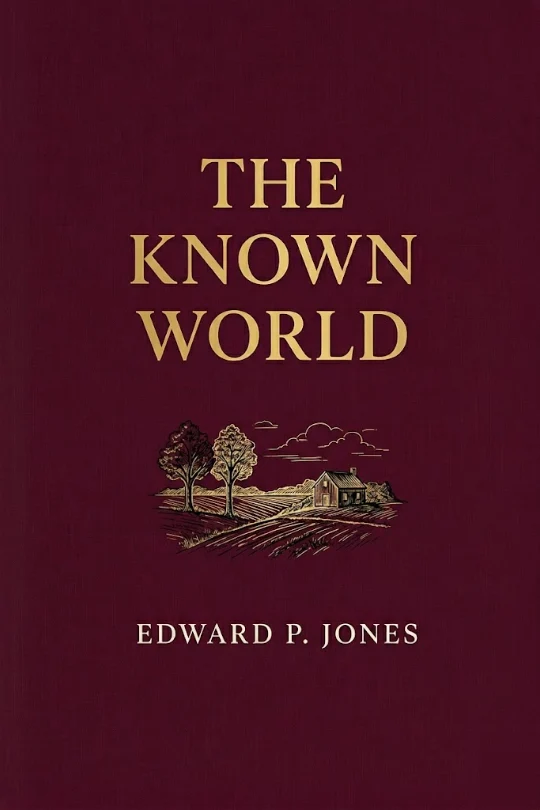
The Known World
Book Summaries
Hosts: Ethan
Timeline
Summary Preview
On a July night in 1855, Henry Townsend died at thirty-one years old. He owned thirty-three slaves and more than fifty acres of land in Manchester County, Virginia. The simple fact of his death would not be remarkable except for one thing: Henry Townsend was a black man.
The novel opens with this stark image. A black slaveowner, lying dead in his bed. His wife Caldonia sits nearby, devastated. Her former teacher Fern Elston keeps vigil. The house slaves move quietly through the rooms. And outside, in the darkness, Moses the overseer walks alone through the fields, eating dirt to taste the earth and understand what the coming season might bring.
This is the world Edward P. Jones builds in *The Known World*—a world where the lines between slave and master, victim and perpetrator, freedom and bondage blur into something far more complicated than simple morality tales might suggest.
Henry Townsend was not an anomaly in Manchester County. The novel tells us directly: there were thirty-four free black families in the county, and eight of those families owned slaves. They all knew one another's business. When the Civil War came, the number of slave-owning black families would drop to five. One of those included a man who, according to the 1860 census, legally owned his own wife, five children, and three grandchildren.
The census taker, the narrator notes with dry precision, had argued with his wife the day he sent his report to Washington. All his arithmetic was wrong because he had failed to carry a one.
This small, almost throwaway detail tells us something essential about how to read this novel. Numbers lie. Records lie. The known world is never quite what it appears to be.
Henry's story does not begin with his death. It begins much earlier, with a slave boy who watched his mother walk away from the plantation where he remained in bondage. Mildred Townsend had been bought free by her husband Augustus, but Henry stayed behind. He was nine years old. His parents visited him on Sundays, his day off, bringing food and comfort. But sometimes Henry failed to show up.
He had found other things to occupy his attention. Specifically, he had found William Robbins.
Robbins was the wealthiest man in Manchester County. He owned more land and more slaves than anyone else. He also kept a black mistress in a two-story house not far from where his white wife and daughter lived—a situation that the narrator notes no one else in the county could have gotten away with. Robbins suffered from epileptic seizures, and when they came, he became disoriented and vulnerable. Henry, still a boy, learned to be there when Robbins needed him. He learned to guide the master home, to protect him, to become indispensable.
"Robbins came to depend on seeing the boy waving from his place in front of the mansion," the narrator tells us. "Came to know that the sight of Henry meant the storm was over and that he was safe from bad men disguised as angels, came to develop a kind of love for the boy, and that love, built up morning after morning, was another reason to up the selling price Mildred and Augustus Townsend would have to pay for their boy."
This is the poison at the heart of the novel. Love itself becomes currency. Affection becomes a commodity. The more Robbins grew to trust Henry, the more valuable Henry became—and the harder it was for his parents to buy his freedom.
When Augustus finally raised enough money to purchase his son, Henry was already changed. He had spent his formative years watching William Robbins wield power. He had learned what it meant to be a master. When he revealed to his parents that he had used his savings to buy his first slave—a man named Moses—Augustus could not contain his fury.
"You mean to tell me you bought a man and he yours now?" Augustus demanded. "You done bought him and you didn't free that man? You own a man, Henry."
Augustus struck his son with one of the walking sticks he carved for a living. Henry grabbed the stick and broke it in two. He left his parents' home and never returned on the same terms. He rode straight to William Robbins's house.
"I know you have it in you to want," Robbins told him. "To want to take hold and pull it in for yourself. Then take it and let the word be damned, Henry."
And Henry did.
The novel does not judge Henry Townsend. It does not excuse him either. It simply shows him: a man who was once a slave, who became a slaveowner, who died at thirty-one with thirty-three human beings listed as his property. It shows how the system of slavery corrupted everyone it touched, even those who had themselves been victims of that same corruption.
Henry had always said he wanted to be a better master than any white man he had ever known. The narrator cuts through this delusion with devastating precision: "He did not understand that the kind of world he wanted to create was doomed before he had even spoke the first syllable of the word master."
The novel moves freely through time. It jumps forward to show the fates of characters long after Henry's death. It jumps backward to reveal how they arrived at the moments that define them. Slaves and slaveowners, free blacks and poor whites, men and women, children and elders—all of them are caught in the same web.
Moses, the overseer, eats dirt to know the earth. He was once torn from a woman he loved, Bessie, and the loss haunts everything he does. After Henry's death, he will begin visiting Caldonia each night, telling her embellished stories about her dead husband. He will become her lover. He will convince himself that he can become master of the plantation. He will be wrong.
Elias, a runaway slave, has part of his ear cut off as punishment. He falls in love with a crippled woman named Celeste. Henry sees their love not as a human bond but as a chain that will keep Elias from running away again. "He had them together," Henry thinks, "bound one strong man to a woman with a twisted leg, and there was not a chain in sight. He could not wait to tell William Robbins."
Augustus, Henry's father, a free black man who carved beautiful walking sticks, will be kidnapped by slave patrollers. The patroller Harvey Travis will eat his free papers, rendering him a slave again with a single act of digestion. Augustus will be sold into bondage in Georgia. He will be shot dead when he refuses to work.
Sheriff John Skiffington does not want to own slaves. He and his wife Winifred are given a nine-year-old girl named Minerva as a wedding present. They keep her, rationalizing that selling her would be worse. John spends his career hunting runaway slaves, believing he can be righteous while enforcing an unrighteous law. "Despite vowing never to own a slave," the narrator tells us, "Skiffington had no trouble doing his job to keep the institution of slavery going, an institution even God himself had sanctioned throughout the Bible."
Fern Elston, a free black teacher who educates the children of wealthy black families, owns slaves herself. She will buy a defiant, educated slave named Jebediah Dickinson, who will correct her spelling of "manumit" and demand his rights. He will change the way she sees the world.
Caldonia, Henry's widow, will inherit the plantation and the slaves. Her mother Maude will urge her to protect her "legacy"—a word that means keeping people in bondage. Maude herself poisoned her husband to prevent him from freeing the slaves. The poison of slavery runs through family bloodlines as surely as arsenic.
And Alice, a slave thought to be insane, will use her supposed madness as a mask. She wanders the plantation at night, mapping every path, every cabin, every possibility for escape. She will lead Moses's wife and child to freedom. In Washington, D.C., she will become an artist named Alice Night, creating tapestries that depict the entire known world of Manchester County from the vantage point of God.
The novel asks a question that resists easy answers. How does a man who was once property come to own property in other human beings? How does the victim become the perpetrator? How does a system so corrupt that it poisons everyone who touches it continue to exist, generation after generation?
There are no simple villains in this story. There are no simple heroes either. There are only people, making choices within the narrow boundaries of the world they know, unable to see beyond the map that has been given to them.
The map that hangs in Sheriff Skiffington's office is titled "The Known World." It is three centuries out of date. North America is too small. Florida does not appear at all. Only South America is labeled as "America." The sheriff keeps it anyway, because moving it would be too difficult, because it has become familiar, because the boundaries it shows—however wrong—are the boundaries he has learned to live within.
What lies beyond the edges of that map? What worlds exist that we cannot see because we have not been taught to look?
About the Book
In 1855 Virginia, Henry Townsend, a former slave, dies owning 33 slaves. Edward P. Jones's Pulitzer Prize-winning novel explores this paradox, tracing how a man once property became a master. Through interconnected lives—slaves, free blacks, and poor whites—it reveals how slavery poisoned everyone it touched, blurring lines between victim and perpetrator in a world where freedom was always fragile.
Key Takeaways
The poison of power corrupts even those who have been poisoned by it.
Henry Townsend, once a slave himself, becomes a slaveowner not despite his suffering but because of it—his education in power under William Robbins teaches him that mastery requires distance, control, and the commodification of love, showing how systems of oppression remake their victims into perpetrators.
Freedom is only as secure as the nearest white man's whim.
Augustus Townsend's thirty years of freedom are erased in an instant when a patroller eats his free papers, proving that legal documents mean nothing without the will to enforce them, and that in a slave society, liberty is a fragile fiction maintained by the consent of the powerful.
Moral compromise begins not with a grand surrender but with a thousand small rationalizations.
Sheriff Skiffington and his wife Winifred vow never to own slaves, yet keep a nine-year-old girl given as a wedding present, convincing themselves that selling her would be worse—a quiet erosion of principle that reveals how good people become complicit in evil through incremental choices.
Love itself becomes a chain when viewed through the lens of ownership.
Henry sees Elias and Celeste's bond not as a human connection but as a tool of control, rejoicing that their love will keep Elias from running away—demonstrating how slavery corrupts even the most sacred human emotions into mechanisms of captivity.
The mask of madness can be the truest form of sight.
Alice, thought to be insane, uses her supposed madness as a cover to map every path to freedom, eventually escaping to create tapestries that show Manchester County as God sees it—revealing that those dismissed as broken often see the world more clearly than those who claim to be sane.
The line between master and slave is a fiction maintained by violence and self-deception.
Fern Elston, a free black teacher who owns slaves, believes her education and light skin make her different from those she owns, but Jebediah Dickinson—a slave who corrects her spelling and demands his rights—forces her to see that the boundary she defends is built on sand and maintained by lies.
Ambition without self-awareness leads to self-destruction.
Moses, the overseer, convinces himself he can become master by telling stories that flatter Caldonia's grief, but his hunger for power blinds him to the truth—that a slave can never become master—and leaves him crippled, alone, and unable to face the light.
The past cannot be undone, but it can be witnessed with truth instead of myth.
Alice Night's tapestries preserve every face of Manchester County—slave and master, living and dead—raised toward God without flattery or excuse, offering a testament that the only way to honor those who suffered is to see them clearly and refuse to look away.
Who Should Listen?
Readers of literary historical fiction who want a morally complex, character-driven exploration of slavery beyond simple good-versus-evil narratives.
History buffs and students of antebellum America seeking a nuanced look at the rarely discussed phenomenon of black slaveholders and the fragility of freedom for free Black people.
Book club members looking for a rich, discussion-worthy novel that examines complicity, power, and moral compromise across racial lines.
Fans of Toni Morrison, Colson Whitehead, or Jesmyn Ward who appreciate lyrical, multi-perspective storytelling about the African American experience.