Book Summaries
Hosts: Clara
Timeline
Summary Preview
On June 23, 1802, a small group of men crawled along a frozen ridge high in the Andes. The ridge was barely two inches wide in places. Below them, nothing but empty air. Above them, the summit of Chimborazo—then believed to be the highest mountain on Earth.
At the front of the group was Alexander von Humboldt, a Prussian naturalist who had already spent three grueling years exploring South America. Now, at 17,000 feet, his body screamed for oxygen. The thin air made every breath a struggle. Ice coated his clothes. The jagged rocks had shredded the soles of his shoes, and his feet bled into the snow.
But Humboldt kept climbing. And as he climbed, he kept working. He pulled out his thermometer, his barometer, his sextant. He measured the blueness of the sky with a device called a cyanometer. He noted which plants grew at each elevation, recording how the vegetation changed as the air grew thinner and colder.
This was not a stunt. This was science—but science unlike anything the world had seen before.
Humboldt wasn't climbing Chimborazo to conquer it. He was climbing to understand something deeper: how nature itself worked as a single, unified system. As he ascended through different climate zones in a single day—from tropical forests at the base to snow and ice at the top—he saw something revolutionary. The plants at each elevation weren't random. They were connected. The temperature, the soil, the air pressure, the altitude—all of it worked together to create the conditions for life.
Nature, Humboldt realized, was not a collection of separate parts. It was one great living organism where everything was connected.
This vision changed everything. It shaped the way we think about ecology, about climate, about the relationship between humans and the natural world. And yet, today, most people have never heard of Alexander von Humboldt.
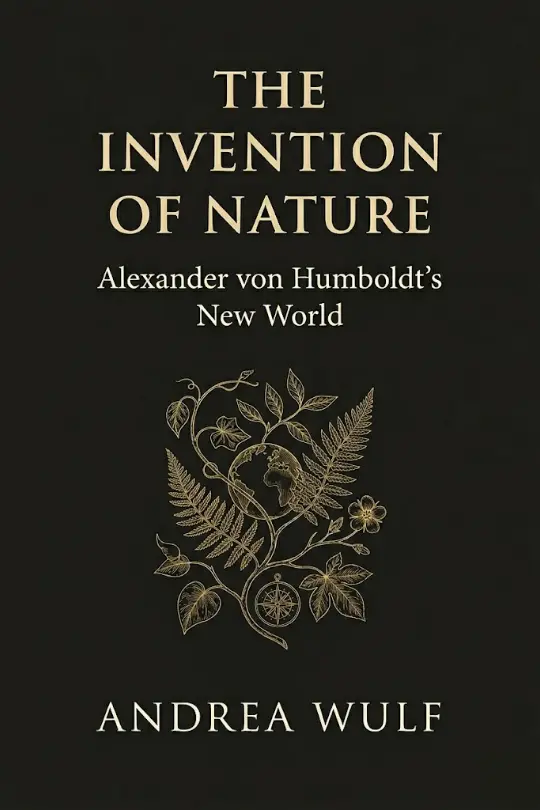
Andrea Wulf's book *The Invention of Nature* sets out to change that. It traces Humboldt's remarkable life—from his difficult childhood in Prussia to his five-year expedition through South America, from his intellectual collaborations with Goethe to his influence on figures like Charles Darwin, Henry David Thoreau, and John Muir. The book argues that Humboldt's ideas didn't just shape modern science—they seeped into our consciousness so completely that we forgot where they came from.
Humboldt saw the Earth as a web. He understood that cutting down a forest in one place could change the climate somewhere else. He warned about human-caused environmental destruction long before anyone had coined the term "climate change." He believed that science and poetry, observation and emotion, were not opposites but partners in understanding the natural world.
The Chimborazo ascent captures all of this in a single, dramatic moment. Here was a man who pushed his body to the edge of survival—not for glory, but for data. Not for conquest, but for connection. He collected information on temperature, pressure, plant life, and geology all at once, because he understood that none of these things existed in isolation.
That's the Humboldtian method: see the whole picture. Don't just catalog species—understand how they relate to each other. Don't just measure temperature—ask how it shapes the landscape and the life it supports.
Wulf's book takes this method and applies it to Humboldt himself. She doesn't just tell us what he did. She shows us how his ideas spread, how they influenced the people who would go on to shape modern environmentalism, and how those ideas remain urgently relevant today.
The Chimborazo climb was a failure in one sense. Humboldt never reached the summit. At 19,413 feet, the team was forced to turn back, just feet from the top. But in every other sense, it was a triumph. The observations Humboldt made on that mountain led directly to his concept of *Naturgemälde*—a "nature painting" that showed how the world's ecosystems were connected across elevation, latitude, and climate.
From that single climb, Humboldt developed a vision of nature that would inspire Darwin's theory of evolution, Thoreau's retreat to Walden Pond, and Muir's fight to preserve America's wilderness. His ideas would shape the birth of ecology as a scientific discipline. They would influence revolutionaries like Simón Bolívar and presidents like Thomas Jefferson.
And then, somehow, Humboldt himself faded from memory.
Why? How did the man who inspired so many become so forgotten? And what happens if we rediscover him now, at a moment when his vision of an interconnected world feels more urgent than ever?
About the Book
Alexander von Humboldt, a visionary naturalist, saw nature as an interconnected living web long before ecology existed. Andrea Wulf's gripping biography traces his daring South American expedition, his influence on Darwin and Thoreau, and his urgent relevance today. A revelatory story of adventure, science, and a lost worldview that could save our planet.
Key Takeaways
Nature Is a Living Web, Not a Dead Aggregate
Humboldt's climb up Chimborazo revealed that nature is not a collection of isolated facts but a unified, living system where climate, geology, and life are deeply interconnected—a vision that laid the foundation for modern ecology and our understanding of climate change.
The Wound of Childhood Can Become the Seed of Genius
Humboldt's cold, controlling upbringing and feelings of inadequacy drove him to seek solace and acceptance in the natural world, transforming his emotional need for connection into a revolutionary scientific method rooted in wonder and belonging.
Science and Poetry Are Partners, Not Opposites
Through his friendship with Goethe, Humboldt learned that rigorous observation and imaginative vision are not contradictory; the deepest understanding of nature requires both the precision of a scientist and the soul of a poet.
Persistence Can Crack the Hardest Doors of Power
After years of rejection by every major empire, Humboldt's relentless charm, preparation, and strategic diplomacy finally convinced the Spanish crown to grant him unprecedented access to its closed colonies—proving that stubborn vision can overcome political impossibility.
To Understand the Whole, You Must Feel the Parts
Humboldt's reckless experiment with electric eels and his willingness to suffer on Chimborazo show that true knowledge demands not just intellectual curiosity but physical immersion—a hands-on, visceral engagement with the world being studied.
Nature's Diversity Is a Blueprint for Human Liberty
Humboldt saw that the same principle of interconnected diversity that made ecosystems resilient could guide human society; he inspired revolutionaries like Simón Bolívar by arguing that political freedom, like ecological balance, depends on variety and mutual support.
A Great Idea Can Fade from Memory by Becoming Too Obvious
Humboldt's vision of an interconnected planet became so deeply absorbed into modern consciousness—influencing Darwin, Thoreau, and environmental science—that we forgot its originator, a paradox that warns us how easily foundational thinkers can be erased.
Rediscovering the Past Is an Act of Survival
In an age of climate crisis, recovering Humboldt's holistic worldview is not mere nostalgia; it is a practical necessity for seeing the full picture of our environmental challenges and finding the courage to mend the fraying web of life.
Who Should Listen?
Environmentalists and climate activists seeking a historical root for modern ecological thinking.
History buffs fascinated by the untold stories of Enlightenment-era explorers and scientists.
Science readers who enjoy biographies of influential but overlooked figures like Humboldt.
Nature lovers and hikers inspired by vivid accounts of the Andes, the Orinoco, and the Amazon.