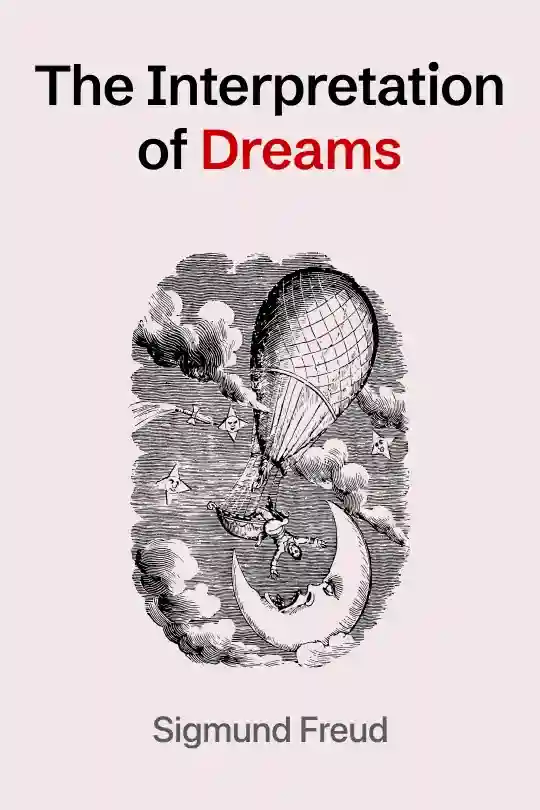
The Interpretation of Dreams
Book Summaries
Hosts: Ethan
Timeline
Summary Preview
For thousands of years, humans have wondered about their dreams. Ancient cultures saw them as messages from gods or demons. Medieval scholars debated whether they could predict the future. Even by the late nineteenth century, most scientists dismissed dreams as random brain activity—meaningless noise produced by a sleeping mind.
Then Sigmund Freud stepped forward with a radical claim.
In the opening pages of *The Interpretation of Dreams*, published in 1899, Freud makes a bold declaration. He writes: "In the following pages I shall demonstrate that there is a psychological technique which makes it possible to interpret dreams, and that on the application of this technique every dream will reveal itself as a psychological structure, full of significance."
Every dream. Not some dreams. Not just the vivid ones or the recurring ones. Every single dream, according to Freud, is meaningful. Each one can be understood. Each one has something to tell us about ourselves.
This was not a modest claim. Freud was essentially telling the scientific world that they had been wrong about dreams for centuries. Dreams were not divine messages, and they were not random neural firings. They were something far more interesting: wish-fulfillments.
The central thesis of *The Interpretation of Dreams* is deceptively simple. When we dream, we are fulfilling unconscious wishes. These are not the ordinary wishes we acknowledge during the day—the desire for a promotion, a vacation, or a new car. These are deeper wishes, often buried so far below conscious awareness that we would deny them if confronted directly. Wishes we might find embarrassing, shameful, or even terrifying.
Freud calls dream interpretation the "via regia"—the royal road—to the unconscious. The phrase appears near the end of the book, but it captures the entire project. Dreams provide direct access to the hidden workings of the mind. They are the highway into our deepest selves.
Consider what Freud is proposing. He is not simply saying that dreams reflect our concerns or process our daily experiences. He is saying that dreams are structured acts of meaning. They have a logic, even when they appear illogical. They have a purpose, even when they seem purposeless. And that purpose is always the same: to fulfill a wish that the conscious mind has rejected.
This idea required Freud to reject both of the dominant views of his time. The ancient view that dreams were supernatural messages was unscientific. But the modern view that dreams were meaningless was equally wrong. Dreams were meaningful in a psychological sense. They were products of the mind, and like all products of the mind, they could be understood through careful analysis.
Freud's technique for understanding dreams would come to be called free association. The patient relaxes, closes their eyes, and reports everything that comes to mind—no matter how trivial, embarrassing, or nonsensical it seems. The key instruction is to renounce all criticism. Do not judge your thoughts. Do not filter them. Just let them flow.
This technique, Freud believed, bypasses the censor that normally blocks unconscious material from reaching awareness. During sleep, that censor relaxes. Dreams slip through. But they slip through in disguise. The manifest content—the actual images and events of the dream—is a distorted version of the latent content—the hidden wish beneath.
Think of it this way. A political dissident in a repressive regime cannot speak openly. So he writes coded messages, using metaphors and symbols that his intended audience will understand but the censors will miss. Dreams work the same way. The unconscious wish is too dangerous to express directly. So the dream-work disguises it, transforming the raw wish into images that can pass through the sleeping mind's relaxed but still active censorship.
This is why dreams often seem strange, fragmented, or nonsensical. The strangeness is not randomness. It is disguise. The fragments are not meaningless. They are coded. And the apparent nonsense contains a coherent message—if you know how to read it.
Freud was aware that his claims would meet resistance. He was asking readers to accept that their own minds were hiding things from them. That their dreams were not what they seemed. That beneath the surface of every night's sleep lay wishes they might not want to acknowledge.
But he was also offering something unprecedented: a method for self-knowledge. If dreams are the royal road to the unconscious, then learning to interpret them is learning to know yourself. Not the self you present to the world, but the self that lives beneath. The self that wants what you have learned not to want. The self that remembers what you have forced yourself to forget.
What kind of wishes are hiding in our dreams? And how can we learn to read the coded messages our sleeping minds produce each night?
About the Book
Sigmund Freud's revolutionary work reveals that dreams are not random nonsense but meaningful wish-fulfillments from the unconscious. Through free association and analysis of distortion, condensation, and displacement, he shows how hidden desires—especially from childhood—shape our dreams. This book offers a practical method for self-knowledge, arguing that dreams protect sleep and mental health by releasing repressed psychic pressure.
Key Takeaways
Every dream is a coded message from the unconscious, not random noise.
Freud argued that dreams are not meaningless neural firings but structured psychological acts, each one a disguised fulfillment of a wish that the conscious mind has rejected, making them the 'royal road' to understanding our deepest selves.
The most disturbing dreams are often the most honest wishes in disguise.
Nightmares and anxiety dreams are not contradictions to wish-fulfillment; they are evidence of powerful censorship, where the manifest content frightens us precisely because the latent wish is so unacceptable that it must be heavily distorted to slip past the mind's internal guard.
Free association is the key that unlocks the dream's personal language.
Because dream symbols are not universal but deeply personal, the only way to decode them is to follow the dreamer's own chain of associations without judgment, allowing the hidden connections between trivial images and buried emotions to surface.
Our deepest wishes are not created in adulthood; they are resurrected from childhood.
The raw material of every dream's latent content originates in infantile experiences and repressed desires from the first years of life, which remain immortal in the unconscious and use recent trivial events as a disguise to re-express themselves.
The dream-work distorts truth through condensation and displacement, not lies.
Condensation compresses multiple thoughts into a single image, while displacement shifts emotional intensity onto trivial details; these are not random errors but the precise mechanisms the mind uses to translate dangerous wishes into acceptable narratives.
The Oedipus complex is a universal dream pattern, not a rare pathology.
Dreams of a same-sex parent's death reveal the universal infantile wish to eliminate a rival for the opposite parent's love, a normal developmental stage that literature and myth have mirrored for millennia, from Sophocles to Shakespeare.
Dreaming is a regression to a childlike mode of thinking, not a failure of logic.
In dreams, the mind regresses from abstract thought to concrete sensory images, returning to the primitive perceptual mode of childhood where wishes were hallucinated as fulfilled, making the dream a fragment of our own psychic history.
The dream is the guardian of sleep and the safety valve of the psyche.
By absorbing both external stimuli and internal repressed wishes, dreams transform potential disruptions into harmless narratives, releasing unconscious pressure to prevent neurotic symptoms and preserving the sleeper's rest and mental health.
Who Should Listen?
Anyone who has ever woken from a vivid or recurring dream and wondered what it truly meant about their hidden desires or fears.
Psychology students or therapists seeking to understand the foundational text of psychoanalysis and its core method for accessing the unconscious.
Individuals struggling with recurring nightmares or anxiety who want a framework for interpreting their inner conflicts and repressed wishes.
Writers, artists, or creatives who wish to explore how the unconscious mind generates symbolic imagery and narrative structure from personal experience.