Book Summaries
Hosts: Ethan
Timeline
Summary Preview
In September 1918, Lieutenant Commander Paul Lewis entered a Philadelphia naval shipyard. Before him lay the bodies of sailors. They had died quickly, violently, and mysteriously. Lewis was one of the best virologists in the world. He had worked with Simon Flexner at the Rockefeller Institute, helped prove polio was a viral disease, and developed a vaccine for it. But now, standing over these corpses, he had to guess.
He guessed influenza. But this was not the influenza anyone had seen before. These men had died too fast, with symptoms too strange. Lewis was right about the diagnosis. He could not have known he was looking at the opening scene of the deadliest pandemic in human history.
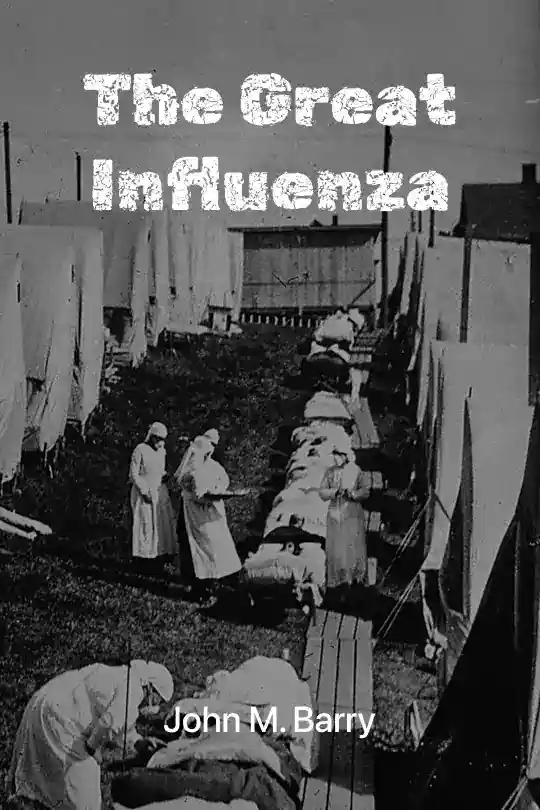
The 1918 influenza pandemic killed more people than the Great War itself. The final death toll remains uncertain, but estimates range from 50 to 100 million people worldwide. In the United States alone, roughly 675,000 people died out of a population of 105 million. Adjusted for today's population, that would be 1.75 million American deaths. In terms of raw mortality, it was worse than the Black Death.
But this book is not just a story of death. It is a story of science at a crossroads. The 1918 pandemic was the first great collision between nature and modern medicine. By the time it struck, American medical science had undergone a revolution. Johns Hopkins University had been founded in 1876, creating the first real research institution in the country. The Rockefeller Institute followed in 1901. William Welch, the first dean of Hopkins, had trained a generation of scientists. Simon Flexner had reformed medical education. American medicine had caught up to Europe. It had created an army of researchers ready to fight disease.
But nature had other plans.
The pandemic exposed both the power and the limits of science. The scientists who fought it were brilliant, dedicated, and courageous. They worked around the clock in overcrowded labs, trying everything they could think of. Some made discoveries that would change the course of biology forever. Others burned out, broke down, or died trying.
The war made everything worse. World War I had created a tinderbox. The government had packed young men into overcrowded training camps. It had censored the press to protect morale. It had shipped troops across the Atlantic in packed vessels. When the virus hit, it exploded through these conditions like a spark through gunpowder.
President Woodrow Wilson made no public statement about the pandemic. He was focused on winning the war. The Committee on Public Information, led by George Creel, suppressed news about the outbreak. Local officials like Wilmer Krusen in Philadelphia denied the danger, allowed a Liberty Loan parade to proceed, and watched as thousands died. The press either stayed silent or lied.
Meanwhile, the scientists raced against time. In New York, William Park and Anna Williams worked at the city health department's laboratory, trying to isolate the cause of the disease. In Philadelphia, Paul Lewis experimented on multiple fronts at once, abandoning the scientific method in desperate attempts to save lives. At the Rockefeller Institute, Oswald Avery worked with painstaking precision, perfecting techniques to find the elusive Pfeiffer's bacillus that everyone believed caused influenza.
None of them succeeded in stopping the pandemic. The virus burned through the population, killed millions, and then faded. It mutated into a less lethal form. People developed immunity. By the spring of 1919, it was over.
But the story did not end there. The pandemic left scars. It left orphans, widows, and widowers. It left a generation traumatized. It left President Wilson, who contracted influenza during the Paris peace negotiations, mentally diminished. He capitulated to French demands for a punitive treaty, a decision that helped set the stage for World War II.
And it left the scientists changed. Avery would go on to discover that DNA carries genetic information, creating the field of molecular biology. Lewis would grow frustrated, move from project to project, and eventually die of yellow fever in Brazil. Their different fates illustrate the different paths science can take: the patient, focused triumph and the romantic, tragic failure.
Paul Lewis stood in that Philadelphia shipyard in September 1918, looking at bodies he could not explain. He had all the tools of modern science at his disposal. He had training from the best institutions in the world. He had colleagues who were among the greatest minds of the generation. But faced with a virus that no one had ever seen, a pathogen that attacked the young and healthy with terrifying speed, he could only guess.
What kind of enemy had nature unleashed? And would the scientists who had built modern American medicine be able to stop it before it consumed the world?
About the Book
In 1918, a mysterious virus killed more people than World War I, striking young adults with terrifying speed. This gripping narrative follows the scientists who raced to stop it—from the obsessive Oswald Avery to the tragic Paul Lewis—while exposing how government censorship and corrupt officials turned a natural disaster into a man-made catastrophe. A haunting lesson for the next pandemic.
Key Takeaways
Truth is the first casualty of crisis, and its loss kills more than any virus.
The pandemic's devastation was amplified not by the virus alone, but by the deliberate suppression of information by leaders like Wilson and Krusen, which destroyed public trust and enabled the disease to spread unchecked.
The greatest scientific breakthroughs come from patience and focus, not frantic genius.
Oswald Avery's methodical, decades-long pursuit of a single question led to the discovery that DNA carries genetic information, while Paul Lewis's brilliant but scattered efforts ended in burnout and tragedy, proving that persistence outlasts raw talent.
Nature's most terrifying weapon is not the pathogen itself, but the body's own overreaction.
The 1918 flu killed the young and healthy through a cytokine storm, where the immune system's desperate overreaction destroyed the lungs it was trying to save, turning the body's defenses into its executioner.
Leadership is measured not by what is said in triumph, but by what is done in terror.
President Wilson's silence and Wilmer Krusen's denial transformed a natural disaster into a man-made catastrophe, while Phoenix's honest leadership and transparent press saved countless lives through simple, truthful public health measures.
History's greatest turning points often hinge on the invisible biology of a single sick man.
Wilson's influenza infection during the Paris peace negotiations weakened his mind and will, causing him to capitulate to punitive demands that seeded German resentment, directly paving the way for World War II.
The infrastructure of science is fragile; it requires not just brilliant generals, but a trained army.
William Welch built an elite generation of American scientists, but when the pandemic struck, there were too few trained researchers to fill the ranks, exposing that institutional excellence without broad capacity is a hollow shield.
A pandemic tests not just our medicine, but our character and our capacity for trust.
The cities that survived best were not the most scientifically advanced, but those where leaders told the truth and citizens trusted each other enough to cooperate, proving that social cohesion is as vital as any vaccine.
The deadliest enemy is not the one you cannot see, but the one you refuse to acknowledge.
From Dr. Loring Miner's ignored warnings to the Liberty Loan parade that became a superspreader event, the refusal to face the truth about the virus allowed it to explode, showing that denial is the most contagious and lethal condition of all.
Who Should Listen?
Public health officials and policymakers who want to understand how leadership failures during the 1918 pandemic directly caused thousands of unnecessary deaths.
History buffs fascinated by untold stories of World War I, including how Woodrow Wilson's bout with influenza shaped the punitive Treaty of Versailles.
Medical and science students interested in the birth of modern virology, from the race to identify the pathogen to Avery's landmark discovery of DNA.
Anyone anxious about future pandemics who wants a clear-eyed, evidence-based warning about the dangers of censorship, distrust, and weak leadership.