Book Summaries
Hosts: Clara
Timeline
Summary Preview
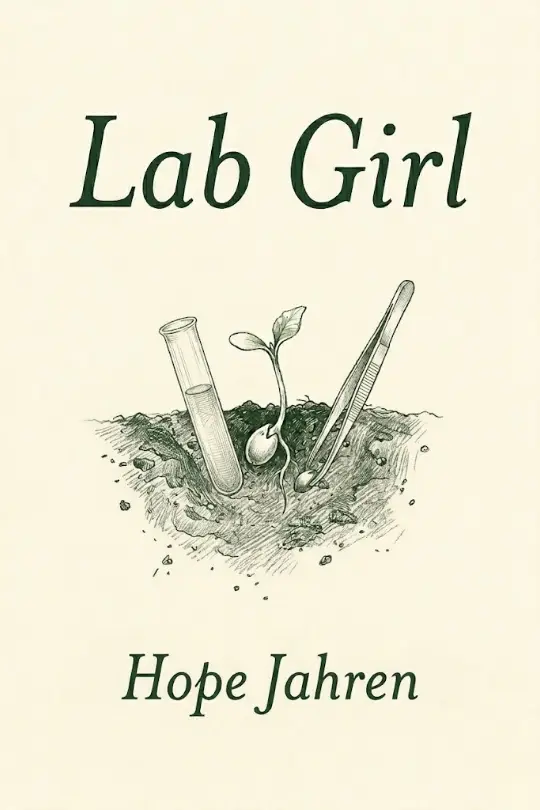
Hope Jahren's *Lab Girl* is not a typical scientific memoir. It's something stranger and more beautiful—a book that swings between two modes: the raw, personal story of a woman building a life in science, and quiet, lyrical meditations on the plants she studies. The chapters alternate. One moment you're inside Jahren's head as she struggles with funding, sexism, and her own mind. The next, you're learning how a seed waits, how a leaf forms, how a tree remembers its childhood. The plants are never metaphors. They're fellow travelers, living things with their own struggles and strategies.
Jahren is a geobiologist, which means she studies the intersection of earth and life—how plants shape the soil, how the soil records climate history, how tiny seeds can reveal ancient temperatures. But the book isn't really about her research. It's about what it takes to do research. The years of rejection. The broken equipment. The nights spent eating Ensure because there's no time for real food. The constant, grinding worry about money.
And yet, Jahren writes about her lab with a kind of reverence. "My lab is like a church," she says, "because it is where I figure out what I believe." That sentence captures the book's core message. Science, for Jahren, wasn't just a career. It was a refuge. A place where she could be herself, even when that self was fragmented, exhausted, or manic. The lab gave her structure when her personal life offered none. It gave her purpose when her mental health spiraled. It gave her a home.
The book unfolds in three parts. Part one traces her childhood in Minnesota—the long, silent winters, the evenings spent in her father's lab, the strange emotional distances of her Scandinavian family. It follows her through college and graduate school, where she meets Bill, the man who becomes her lab partner and closest friend. Part two covers the brutal early years of her career: building a lab from scratch at Georgia Tech, struggling to get funded, battling her own untreated manic-depressive disorder. Part three brings recovery, love, and a hard-won stability. She gets treatment. She marries Clint, a mathematician. She has a son. She moves to Hawaii.
But threaded through all of this are the plant chapters. They're short. They're poetic. They're oddly personal. Jahren describes the blue-tinged spruce from her childhood, the seeds that wait for centuries, the vines that "make it up as they go along." She shows how plants fight, adapt, and persist. How a Sitka willow can defend itself against caterpillars. How a resurrection plant can come back from the dead. These chapters aren't science lessons. They're reflections. They're Jahren's way of saying: Look. We're not so different. We all struggle. We all find a way.
The book's title, *Lab Girl*, is deliberately provocative. Jahren was often dismissed as a "girl" in a male-dominated field. Colleagues underestimated her. Conference attendees ignored her. Department heads treated her pregnant body as an inconvenience. But she owned that label, turned it around. The lab was her space. The lab made her who she was.
What makes the book so compelling is its honesty. Jahren doesn't edit herself. She admits to making terrible decisions. She describes her manic episodes in vivid, unsettling detail. She writes about her mother with a painful clarity. She doesn't pretend to have all the answers. But she keeps going. That's the point.
So here's the question that hangs over the opening pages: How do you build a life when everything—your health, your funding, your relationships, your own mind—keeps threatening to tear it apart?
About the Book
Part memoir, part botanical meditation, Lab Girl alternates between Hope Jahren's struggle to build a life in science—battling sexism, poverty, and bipolar disorder—and lyrical reflections on the plants she studies. From a seed that waited 2,000 years to a radish with a unique personality, Jahren reveals how the natural world mirrors our own resilience. A fierce, honest story of finding home in a laboratory.
Key Takeaways
A lab can be a home when nowhere else feels safe.
Hope Jahren found refuge in her father's lab as a child, and later built her own laboratories as sanctuaries from a cold, silent family life and the chaos of her own mind. Science gave her structure, purpose, and a place where she could belong without explanation.
Waiting is not weakness; it is the quiet work of becoming.
A seed can wait two thousand years for the right conditions to grow, actively preserving its potential against decay. Jahren shows that patience is a form of strength, and that the darkness before growth is not empty—it is preparation.
Discovery is a lonely act that forever separates you from who you were.
When Jahren discovered opal inside a hackberry seed, she was the only person in the universe who knew that secret, and she realized she could never return to the life of the women she had known. True discovery changes you irrevocably, and the price is isolation.
Partnership can be built without a name—soulmate, sibling, accomplice.
Jahren's relationship with Bill defies easy labels; he lived in a van and then in her lab because he believed in her work. Their bond was forged in shared struggle, proving that the deepest partnerships are not romantic but existential.
Mania feels like brilliance, but it is a war you cannot win alone.
Jahren's untreated manic-depressive disorder drove her to drive through a blizzard without tire chains, crashing a van full of students. The episode taught her that the mind can betray you, and that survival requires asking for help.
Even a plant in a Dixie cup has a unique personality worth witnessing.
The radish labeled C-6 grew in strange, self-destructive patterns that no textbook could explain, and its brief life changed Jahren's thinking more than any paper she had read. Every living thing has a story, and attention is the highest form of respect.
Pregnancy can be a war between the body you need and the body you have.
When Jahren had to stop her medication during pregnancy, she spiraled into such severe depression that she tried to knock herself unconscious on a bathroom floor. Her ordeal reveals that motherhood is not always gentle—sometimes it is a brutal fight for survival.
Planting a tree is not an act of charity; it is an act of reciprocity.
Jahren ends her book by asking every reader to plant a tree with their own hands, because for every person, one tree is cut down per year. The final line—'You'll have a tree and it will have you'—transforms environmentalism from guilt into relationship.
Who Should Listen?
Aspiring scientists, especially women, who need to hear an unvarnished account of the grit, rejection, and sacrifice required to build a research career.
Anyone struggling with mental health challenges who wants a story of survival that doesn't sugarcoat the darkness or the path to stability.
Nature lovers and gardeners who are curious about the secret lives of plants—how seeds wait, how trees fight, and how every living thing has a unique story.
Readers of literary memoirs who appreciate poetic prose woven with hard-earned wisdom about work, partnership, and finding belonging in unexpected places.