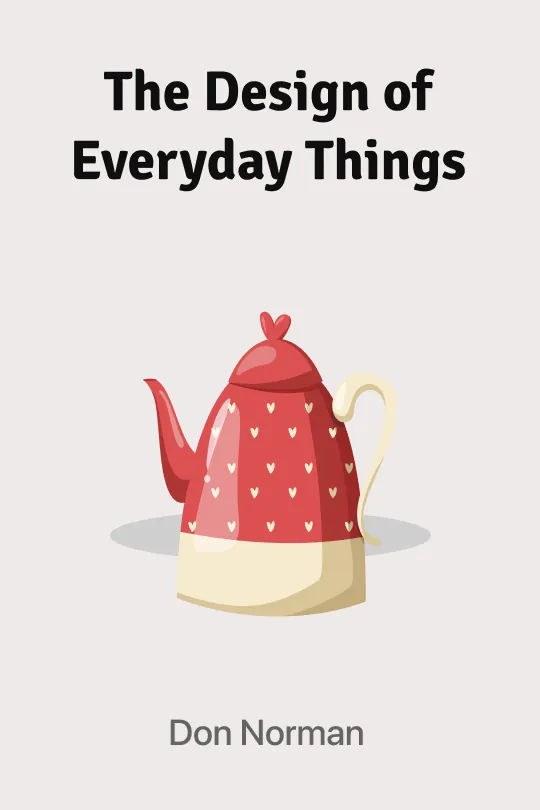
The Design of Everyday Things
Book Summaries
Hosts: Ethan
Timeline
Summary Preview
You approach a door. There's no handle, no push plate, no obvious way to open it. You hesitate. Do you push? Pull? Slide? Maybe it opens automatically? You stand there, looking foolish, while someone behind you waits. This moment of confusion—this tiny failure—isn't your fault. It's bad design.
This is where Donald Norman begins his argument. The problem isn't that people are clumsy or unintelligent. The problem is that everyday objects fail to communicate how they work. That door lacks what Norman calls *discoverability*—the ability to figure out what actions are possible. It also lacks *understanding*—knowing how the thing should be used. When both are missing, even simple tasks become frustrating puzzles.
Norman calls this situation "the paradox of technology." Here's the contradiction: technology has the power to simplify life and make it more enjoyable. But as products become more complex, they often become harder to use. A smartwatch can do dozens of things, yet its tiny screen makes even basic operations difficult. The very features meant to help us end up frustrating us. This paradox drives Norman's central argument: good design must be human-centered.
Human-Centered Design, or HCD, is a philosophy that places user needs, capabilities, and behaviors at the forefront of the design process. It's not about what looks elegant or what makes logical sense to an engineer. It's about what works for the person using the product. Norman insists that machines should adapt to people, not the other way around. "It is the duty of machines and those who design them to understand people," he writes. "It is not our duty to understand the arbitrary, meaningless dictates of machines."
HCD operates across three interconnected areas of design. First, *industrial design* focuses on creating products that optimize function, appearance, and value for both users and manufacturers. Second, *interaction design* draws on psychology, art, and emotion to understand how humans interact with technology. Third, *experience design* centers on user enjoyment—not just whether something works, but whether using it feels good. These three areas must work together. A product that looks beautiful but is impossible to use has failed. A product that works perfectly but feels unpleasant to touch has also failed.
The paradox of technology makes this integration difficult. As products gain more features, they become more capable but also more confusing. Norman points to the humble door as a perfect example. A door has one basic function: to be opened. Yet designers manage to make this simple action mysterious by removing handles and hinges—the very signifiers that tell you what to do. The door's design prioritizes aesthetics over usability. The result? People stand there, confused, blaming themselves for not knowing how to open a door.
This self-blame is a pattern Norman sees everywhere. When products fail us, we assume we're the problem. "I'm not good with technology," people say. "I'm just not mechanical." But Norman argues this is wrong. The problem isn't you. It's the design. Good design makes the correct action obvious. Bad design makes you feel stupid.
So what makes design human-centered? Two qualities matter most: discoverability and understanding. Discoverability means you can figure out what's possible just by looking at the object. A well-designed door shows you where to push or pull. A well-designed faucet shows you which way to turn. Understanding means you can grasp how the object works—not necessarily its internal mechanics, but the relationship between your actions and the results. A good conceptual model, even a simplified one, lets you predict what will happen when you act.
Norman's point is deceptively simple: design should serve people, not the other way around. Yet this principle is violated constantly. Products are built to be cheap, or to look sleek, or to match competitors' features. The user becomes an afterthought. The result is a world full of frustrating doors, confusing remotes, and appliances that require manuals to operate.
The paradox of technology means we can't simply reject complexity. Modern life demands powerful tools. But complexity and confusion are not the same thing. A product can be complex yet understandable. A smartphone has thousands of features, but a well-designed one lets you find what you need without memorizing instructions. The key is human-centered design: starting with people's actual needs and working backward to the technology.
This raises a question that echoes through the rest of Norman's book: If the principles of good design are so clear, why do we keep getting it wrong?
About the Book
Why do we struggle with everyday objects like doors, stoves, and smartphones? Don Norman reveals it's not your fault—it's bad design. This classic guide teaches you the principles of human-centered design: affordances, signifiers, constraints, and feedback. Learn how to spot design flaws, understand the psychology of error, and create products that actually work for people. A must-read for anyone who uses technology or wants to make it better.
Key Takeaways
Bridge the Two Gulfs with Feedforward and Feedback
Good design must bridge the gulf of execution (what users want to do vs. what the product allows) by providing clear feedforward, and the gulf of evaluation (what the product did vs. what users can perceive) by providing immediate, informative feedback to complete the communication loop.
Put Knowledge in the World, Not Just in the Head
Instead of forcing users to memorize instructions or arbitrary mappings, use signifiers, constraints, and natural mappings to make essential information visible in the environment, reducing cognitive load and making products usable even for infrequent tasks.
Use Constraints to Prevent Errors Before They Happen
Leverage physical, cultural, semantic, and logical constraints to limit possible actions, making correct actions obvious and incorrect actions impossible—for example, designing a battery compartment so the battery only fits one way.
Design for Error as Inevitable, Not as User Failure
Use the Five Whys technique to find root causes of errors rather than blaming humans, then implement forcing functions, undo capabilities, and meaningful confirmations to make errors easy to detect and recover from.
Apply the Double Diamond: Find the Right Problem Before Solving It
Resist the urge to jump to solutions; first diverge to discover the real problem through observation, then converge to define it clearly, before diverging again to generate solutions and converging to deliver the best one.
Iterate Through Observation, Ideation, Prototyping, and Testing
Repeat the four-activity cycle—observe users in natural environments, generate many ideas freely, build rough prototypes cheaply, and test with pairs of users while recording everything—to refine your product until it addresses real needs.
Resist Creeping Featurism by Focusing on Core Strengths
Avoid the competitive trap of matching every rival feature; instead, invest in making your product's core capabilities extraordinary and accept being merely 'good enough' elsewhere to maintain usability and clear differentiation.
Balance Competing Priorities by Including All Disciplines Early
Ensure designers, engineers, marketers, and product managers collaborate from the start, surface all genuine constraints explicitly, and seek solutions that satisfy multiple requirements simultaneously rather than trading off usability for other goals.
Who Should Listen?
Product designers and UX professionals who want to move beyond aesthetics and build truly intuitive, user-friendly interfaces.
Engineers and developers who build software or hardware and need a practical framework for understanding why users struggle with their creations.
Entrepreneurs and startup founders who want to avoid the trap of 'creeping featurism' and instead build products people actually buy, use, and enjoy.
Anyone who has ever felt frustrated by a confusing remote, a poorly designed app, or a door that doesn't clearly say 'push' or 'pull'—and wants to understand why.