Book Summaries
Hosts: Clara
Timeline
Summary Preview
Three statements. That's all it takes to plunge you into uncertainty.
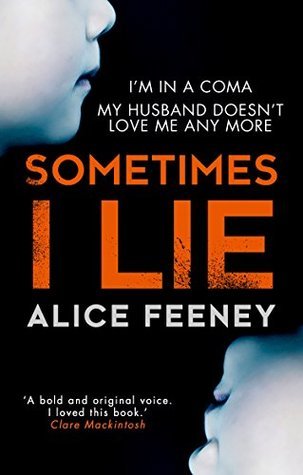
"1. I'm in a coma. 2. My husband doesn't love me anymore. 3. Sometimes I lie."
This is how Alice Feeney's novel *Sometimes I Lie* begins. The narrator, Amber Reynolds, offers these three confessions before the first chapter even starts. And already, the reader faces a problem. How do you trust someone who admits she lies?
Amber is a thirty-something woman lying in a hospital bed on Boxing Day, the day after Christmas. She cannot move. She cannot speak. She can hear, though—fragments of conversations between nurses, her husband Paul, and her sister Claire. Through the antiseptic smells and the steady rhythm of machines, she pieces together the bare facts: she survived a car accident. She's in a coma. And she's terrified.
But Amber's terror isn't just about her physical helplessness. It's about what she suspects. The police think Paul had something to do with the accident. Her husband and sister visit together, and their conversations fuel her paranoia. She remembers finding white wine in the fridge—Claire's drink, not hers. She remembers the sexy lingerie in the closet, three sizes too small for her. She remembers Paul's car parked in Claire's driveway. The pieces seem to fit: her husband doesn't love her anymore. Maybe he never did. Maybe he and Claire are having an affair. Maybe they wanted her gone.
But here's the thing about Amber Reynolds: she tells us all of this. She invites us into her suspicions, her fears, her memories. And then she reminds us, on page one, that she sometimes lies.
This is the central puzzle of the novel. Amber is an unreliable narrator—and not in the subtle, I-might-be-misremembering way. She's upfront about it. She tells us she lies. But if she's telling us she lies, is that itself a lie? Can we believe anything she says? Every confession becomes suspect. Every revelation carries a shadow. The reader becomes a detective, sifting through Amber's words for something solid to hold onto.
The novel's structure mirrors this uncertainty. Chapters jump between three timelines: the weeks after the accident, the days leading up to it, and diary entries from 1991, when Amber was ten and went by her middle name, Taylor. The diary entries feel raw and honest—the unfiltered voice of a child. But whose child? The narrative teases us, letting us assume the diary belongs to Amber before revealing otherwise. Even the past refuses to stay put.
Amber's coma becomes a prison, but also a vantage point. Trapped in her own body, she can only gather clues from what others say around her bed. She learns she was driving Paul's car—a car she never drives. She learns she wasn't wearing her seatbelt—a habit she never breaks. She learns there are marks on her neck that don't match the accident. Each piece of information raises more questions than it answers.
And then there's the little girl in the pink dressing gown. Amber keeps seeing her—a vision, a memory, a ghost. The girl appears in Amber's dreams, standing in the rain, singing a nursery rhyme. She wears a thin gold bracelet. Amber doesn't know who she is, but the girl feels important, like a key she can't quite reach.
The book's title, *Sometimes I Lie*, is both a confession and a warning. It tells us the ground beneath our feet is unstable. It tells us the narrator may be spinning a story, not reporting the truth. And it challenges us to figure out where the lies end and the reality begins.
But here's the question that lingers: if Amber is lying, what is she hiding? And if she's telling the truth, what does that mean about the people around her—the husband who may have tried to kill her, the sister who may have betrayed her, and the ex-boyfriend who just showed up again after ten years?
Because as Amber lies in that hospital bed, unable to move or speak, someone is whispering in her ear. Someone who knows exactly how to keep her in this coma. Someone who has been waiting a long time for this moment.
And that someone is just getting started.
About the Book
Amber Reynolds lies in a coma, aware but unable to move, as she pieces together fragments of conversation from her husband and sister. She admits she sometimes lies, making every revelation suspect. Jumping between the present, the week before her accident, and childhood diaries, this psychological thriller forces you to question everything—including whether the victim is really the one in danger.
Key Takeaways
The truth we tell about ourselves is the most dangerous lie of all.
Amber's opening confession—'Sometimes I lie'—creates a paradox where every statement becomes suspect, revealing that self-awareness can be the ultimate camouflage for manipulation, and that the most profound truths are often hidden in plain sight.
Love that demands ownership is not love—it is imprisonment.
Claire's twisted devotion, which leads her to murder Amber's parents and attempt to kill her unborn child, demonstrates that when love becomes a cage built from jealousy and control, it transforms into a poison that destroys both the beloved and the one who claims to love.
Helplessness can be the sharpest lens through which to see the truth.
Trapped in her coma, Amber can only listen—and in that forced stillness, she pieces together the betrayals that her active life allowed her to ignore, suggesting that sometimes we need to be stripped of all power to finally see what has been in front of us all along.
The past is not a memory—it is a predator that learns to walk on two legs.
Edward's decade-long surveillance and Claire's twenty-year manipulation show that unresolved history doesn't fade; it waits, grows patient, and eventually returns wearing a familiar smile, ready to collect what it believes it is owed.
Justice and revenge wear the same clothes, but they dance to different music.
Amber's calculated poisoning and arson are framed as liberation, yet the final bracelet suggests that the line between righteous retribution and becoming the monster you hunted is thinner than a safety pin—and just as easily broken.
We are all unreliable narrators of our own lives, especially to ourselves.
The novel's structure—diaries, coma visions, fragmented memories—forces the reader to question not just Amber's account, but the very nature of self-storytelling, reminding us that the person we trust least should often be the one in the mirror.
Some bonds are forged in fire, and some are forged by setting the fire.
Claire and Amber's relationship, born from a childhood arson that killed Amber's parents, illustrates that the deepest connections are sometimes built on shared destruction, and that trauma can bind people more tightly than love ever could.
Closure is a luxury the past never grants—it only loans, and always with interest.
The final image of the gold bracelet, returned with a changed engraving, shatters Amber's hard-won peace, proving that even when we burn every bridge and bury every ghost, the past finds a way to tap us on the shoulder and remind us that the story is never really over.
Who Should Listen?
Fans of twisty psychological thrillers like *Gone Girl* or *The Girl on the Train* who love unreliable narrators and shocking final reveals.
Readers who enjoy piecing together complex puzzles and being left with an ambiguous, haunting ending that refuses to offer easy answers.
Anyone fascinated by toxic sibling dynamics and the question of how far someone will go to keep the person they love from leaving.
Listeners who appreciate a fast-paced, bingeable audiobook with short chapters and multiple timelines that keep them guessing until the very last moment.