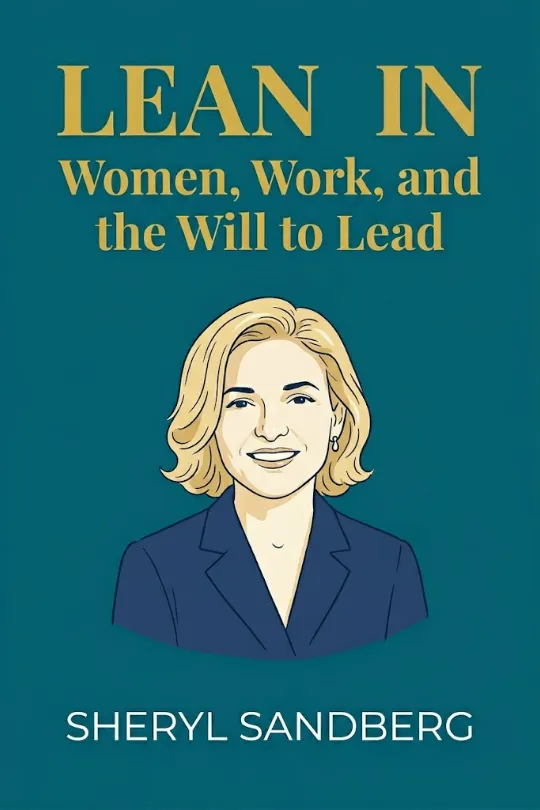
Lean In
Women, Work, and the Will to Lead
Book Summaries
Hosts: Clara
Timeline
Summary Preview
In the summer of 2004, Sheryl Sandberg was pregnant with her first child and working at Google. The campus was massive, and she had to walk across an enormous parking lot every day. Her feet ached. Her back hurt. And she noticed something strange: other companies had reserved parking spots for expectant mothers. Google did not.
When she finally raised the issue with her boss, Sergey Brin, he was genuinely surprised. It had simply never occurred to him. Within days, pregnant women at Google had designated parking. The problem wasn't malice. It was invisibility.
That parking lot story captures something essential about where we stand today. Women have made enormous progress over the past fifty years. In the United States, women became half of all college graduates by the early 1980s. They now earn more degrees than men. They fill more entry-level jobs. By many measures, the feminist revolution should be complete.
But it's not.
Here's the blunt truth: men still run the world. Of 195 independent countries, only 17 are led by women. Women hold just 20 percent of parliamentary seats globally. In corporate America, only 21 of the Fortune 500 CEOs are women. Women hold about 14 percent of executive officer positions and 17 percent of board seats. For women of color, the numbers are even worse—just 4 percent of top corporate jobs, 3 percent of board seats, 5 percent of congressional seats.
The revolution has stalled.
Sandberg argues that two kinds of barriers keep women from leadership positions. The first are external barriers: discrimination, lack of affordable child care, sexual harassment, rigid work schedules, and the persistent wage gap where women earn about 77 cents for every dollar a man earns. These are real, and they matter.
But there's a second category that receives far less attention: internal barriers.
These are the ways women hold themselves back—not because they lack talent or ambition, but because they've absorbed the sexist messages that surround them from childhood. Messages that say it's wrong to be outspoken, aggressive, or more powerful than men. Messages that tie a woman's worth to her appearance and agreeableness rather than her achievements. Messages that make ambition feel unfeminine.
Sandberg calls this "internalizing the revolution." The external fight for equality must continue, but women also need to recognize the ways they limit themselves. The key question is not just what society is doing wrong—it's what women are doing to themselves without even realizing it.
The evidence for these internal barriers is everywhere. Research shows that girls are praised for being pretty, boys for being smart. Teachers call on boys more frequently and ask them harder questions. When boys call out answers, teachers listen. When girls do the same, they're told to raise their hands. By the time girls reach the professional world, they've learned a dangerous lesson: speaking up is for men.
This creates what psychologists call "stereotype threat"—the fear of confirming negative stereotypes about your group. When women see images of unhappy, overworked professional mothers in popular culture, they unconsciously pattern their own expectations on those models. They start to believe that leadership is incompatible with a happy life, so they pull back before they've even begun.
The result is what Sandberg calls the "leadership ambition gap." Women don't lack ambition. But their ambition is shaped and constrained by cultural expectations. They learn to want what society says they should want, which often means prioritizing family over career, being nice over being powerful, and fitting in over standing out.
Sandberg recalls being called "bossy" as a young girl. The label stuck. Even now, as one of the most powerful women in business, she admits there's still a part of her that feels it was unseemly for a little girl to be thought of as domineering. That's how deep these messages go.
The internal barriers take many forms. Fear of not being liked. Fear of making the wrong choice. Fear of drawing negative attention. Fear of overreaching. Fear of being judged. Fear of failure. And what Sandberg calls the "holy trinity of fear": the fear of being a bad mother, a bad wife, and a bad daughter.
These fears are not irrational. Women who assert themselves do face real consequences—the likeability penalty, the double bind, the suspicion that they're abandoning their families. But the fears become paralyzing when they're never examined. When women make decisions based on what they're afraid might happen rather than what's actually happening, they give up ground they haven't even fought for.
The practical starting point is a question. At Facebook, there's a poster that reads: "What would you do if you weren't afraid?"
It's a simple question, but it cuts to the heart of the problem. Most women can name something they've avoided—a promotion they didn't apply for, a meeting where they stayed silent, a negotiation they didn't start, a risk they didn't take—because they were afraid of how it would look, what people would think, or whether they'd fail.
The framework Sandberg offers is straightforward: recognize the difference between external and internal barriers, and start by addressing the ones you can control. The external barriers won't disappear overnight. But the internal ones—the self-doubt, the fear, the tendency to pull back—those you can begin to dismantle right now.
The revolution stalled because women stopped pushing. Not because they stopped caring, but because they started accommodating. They internalized the idea that equality had been achieved, that the remaining problems were personal rather than structural, and that asking for more was somehow greedy or ungrateful.
Sandberg argues the opposite: the revolution needs to be reignited, and the first step is internal. Women need to recognize the ways they've been shaped by a culture that still doesn't fully support female ambition. They need to stop apologizing for wanting power and influence. They need to lean in before they've been invited.
The parking lot at Google wasn't fixed because the company was sexist. It was fixed because one woman spoke up. But she only spoke up because she was in a position to do so—and she only got into that position because she'd been leaning in for years.
So here's the question that sets everything in motion: What would you do if you weren't afraid? And more importantly, what are you going to do about it starting tomorrow?
About the Book
Sheryl Sandberg reveals the internal barriers that hold women back more than any external obstacle. Drawing on research and personal stories, she offers practical strategies to overcome self-doubt, navigate the likeability-competence double bind, build authentic partnerships, and pursue a career without sacrificing family. A call to lean in before you're invited.
Key Takeaways
Recognize and dismantle internal barriers before tackling external ones.
While external barriers like discrimination and lack of childcare are real, the most immediate progress comes from addressing internal barriers like self-doubt, fear, and the tendency to pull back. Ask yourself 'What would I do if I weren't afraid?' and start acting on that answer today.
Sit at the table and apply for roles even when you don't meet every qualification.
Women often underestimate their abilities and wait for permission, while men apply when they meet 60% of qualifications. Challenge impostor syndrome by applying anyway, keeping your hand up in meetings, and acting confident even when you don't feel it.
Navigate the likeability-competence double bind by framing assertiveness as communal.
Competent women are often penalized for being 'pushy,' while men are rewarded. When negotiating or asserting yourself, frame your request as benefiting others (e.g., 'I want fair pay for my contributions') and use humor or prefacing statements to soften the delivery.
Pursue a 'jungle gym' career path instead of a linear ladder.
Careers are nonlinear, and women should embrace lateral moves, demotions for growth potential, and risk-taking. Use an 18-month plan to focus on skill-building, and always ask if a role is on a 'rocket ship' that will pull you upward even if the title is lower.
Build mentorship through working relationships, not cold requests for advice.
The best mentorships arise naturally from solving real problems together. Instead of asking for a mentor, do excellent work, bring specific problems to senior people, and seek sponsors who will advocate for you—not just advisors who give vague encouragement.
Don't leave before you leave—keep your foot on the gas until you actually need to scale back.
Many women prematurely decline promotions or stretch assignments based on hypothetical future family plans. Postpone career sacrifices until you have real information, and lean in more before children to build the seniority and leverage that will give you flexibility later.
Make your partner a real partner by avoiding maternal gatekeeping and advocating for paternity leave.
Even in dual-career couples, women do significantly more childcare and housework. Let your partner learn through trial and error, advocate for paternity leave to build their caregiving skills, and ensure they carry the mental load—not just 'help' when asked.
Manage guilt and set hard boundaries instead of chasing the myth of 'having it all.'
Time and energy are finite, so perfection across work and home is impossible. Set non-negotiable boundaries on work hours, prioritize results over face time, and accept imperfection—cut corners where you can, and don't let guilt drive your decisions.
Who Should Listen?
A mid-career professional woman who consistently meets job qualifications but hesitates to apply for promotions because she doesn't feel ready.
A new mother who is quietly scaling back her career ambitions years before her children are born, assuming she can't have both family and leadership.
A female entrepreneur or executive who faces the likeability penalty when asserting herself in negotiations and needs strategies to be heard without being resented.
A male partner or husband of a high-achieving woman who wants to understand how to build a truly equal domestic partnership that supports both careers.