
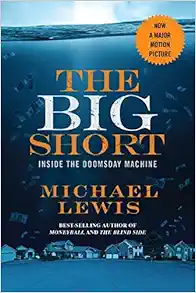
The Big Short: Inside the Doomsday Machine
by Michael Lewis
“A forensic autopsy of the 2008 financial crisis, revealing how Wall Street’s willful blindness and perverse incentives built a doomsday machine.”
Key Takeaways
- 1Complexity is often a deliberate cloak for risk. Wall Street engineered impenetrable financial instruments like CDOs and credit default swaps not to manage risk, but to obscure it, allowing the system to metastasize unchecked.
- 2Incentive structures dictate behavior, not ethics. When commissions and bonuses are tied to volume rather than quality, the system naturally selects for reckless, short-term profit over long-term stability.
- 3The ratings agencies were compromised gatekeepers. Moody’s and S&P, paid by the banks whose products they rated, bestowed AAA ratings on toxic mortgage bonds, providing a false veneer of safety to the entire market.
- 4True insight requires intellectual independence. The few who foresaw the crash were outsiders and eccentrics willing to question the herd mentality and perform the tedious, granular analysis others avoided.
- 5Privatized gains and socialized losses corrupt capitalism. The crisis crystallized a system where banks pocketed enormous profits from risky bets, then transferred catastrophic losses to taxpayers via government bailouts.
- 6A crisis of stupidity can be as destructive as one of malice. While outright fraud existed, the collapse was equally fueled by a staggering, systemic failure of comprehension among those who built and traded the instruments.
Description
Michael Lewis’s *The Big Short* dissects the origins and catastrophic unraveling of the 2008 financial crisis, not through dry economic theory, but via the gripping narratives of the idiosyncratic investors who saw it coming. The book traces the invention and rampant proliferation of the subprime mortgage bond, a financial innovation that began by bundling home loans but evolved into a labyrinth of collateralized debt obligations (CDOs) and credit default swaps. These instruments became so complex that even the CEOs of major investment banks failed to grasp their inherent toxicity, relying blindly on the flawed AAA ratings bestowed by compromised agencies.
Lewis anchors the story in a handful of prescient outsiders: the obsessive, Asperger’s-afflicted Dr. Michael Burry; the perpetually outraged hedge fund manager Steve Eisman; and the scrappy, novice duo of Charlie Ledley and Jamie Mai. Each, in their own way, conducted the granular, contrarian analysis that revealed the entire edifice was built on mortgages destined to fail. Their realization that the U.S. housing market was a speculative bubble propped up by bad loans led them to a radical act: betting against the market through credit default swaps, essentially purchasing insurance on bonds they believed would default.
The narrative follows their fraught journey as they place these ‘big short’ bets and then endure years of doubt and hostility from a financial establishment incapable of believing its own core assumptions could be wrong. Lewis meticulously details the perverse incentives: mortgage brokers were paid for volume, not quality; Wall Street desks profited from manufacturing and moving bonds, not holding them; and ratings agencies collected fees from the very banks whose products they blessed.
Ultimately, the book serves as a masterclass in institutional failure and the perils of unchecked financial engineering. It exposes a system where opacity replaced transparency, short-term greed overwhelmed long-term prudence, and the line between staggering incompetence and outright fraud became hopelessly blurred. *The Big Short* is essential reading for anyone seeking to understand not just what happened in 2008, but the enduring vulnerabilities within modern finance.
Community Verdict
The reader consensus elevates *The Big Short* as the definitive popular explanation of the 2008 crisis, praised for transforming abstruse financial concepts into a compelling, character-driven narrative. Readers express profound admiration for Lewis’s ability to demystify complex instruments like CDOs and credit default swaps, making the arcane mechanics of the crash accessible and even thrilling. The book is celebrated not just for its explanatory power, but for its moral clarity and righteous indignation, channeling widespread fury at the greed, stupidity, and systemic corruption it exposes.
However, a significant contingent notes the inherent difficulty of the subject matter, admitting that portions of the text remain challenging despite Lewis’s efforts. Some critique the narrative for glorifying the ‘outsiders’ who profited from the collapse, questioning whether their bets, however prescient, were ethically distinct from the system they condemned. The overwhelming sentiment is one of educated outrage—readers finish the book with a clearer understanding of the crisis, but also with a deepened skepticism toward financial institutions and a pessimistic view that the underlying problems remain unresolved.
Hot Topics
- 1The staggering incompetence and willful ignorance of Wall Street professionals who failed to understand the toxic products they created and sold.
- 2The profound moral outrage directed at the ‘privatized gains, socialized losses’ model exemplified by the government bailouts of the very banks that caused the crisis.
- 3The crucial, corrupt role of ratings agencies like Moody’s and S&P in blessing doomed mortgage bonds with AAA ratings for profit.
- 4The ethical ambiguity surrounding the ‘heroes’ of the story—the investors who foresaw the crash and profited immensely by betting against the economy.
- 5The accessibility of Lewis’s explanation, with debates over whether the book fully demystifies complex instruments like CDOs and credit default swaps for the layperson.
- 6The lingering fear and certainty that the structural flaws and perverse incentives exposed in the book remain largely unchanged, setting the stage for a future crisis.
Related Matches







Popular Books

One Direction: Who We Are: Our Official Autobiography
One Direction
Tea Time for the Traditionally Built
Alexander McCall Smith
The Limpopo Academy of Private Detection
Alexander McCall Smith
O. Winston Link: Life Along the Line: A Photographic Portrait of America's Last Great Steam Railroad
Tony Reevy, O. Winston Link, Conway Link, Scott Lothes
Radio Silence
Alice Oseman
War Songs: Metaphors In Clay And Poetry From The Vietnam Experience
Grady Harp

The War of Art: Break Through the Blocks & Win Your Inner Creative Battles
Steven Pressfield, Robert McKee
Dead Wake: The Last Crossing of the Lusitania
Erik Larson
A Court of Mist and Fury (A Court of Thorns and Roses, #2)
Sarah J. Maas

The Campaigns of Napoleon
David G. Chandler
The Lessons of History
Will Durant, Ariel Durant
Going Clear: Scientology, Hollywood, and the Prison of Belief
Lawrence Wright
Browse by Genres
History
Business
Leadership
Marketing
Management
Innovation
Economics
Productivity
Psychology
Mindset
Communication
Philosophy
Biography
Science
Technology
Society
Health
Parenting
Self-Help
Wealth
Investment
Relationship
Startups
Sales
Money
Fitness
Nutrition
Sleep
Wellness
Spirituality
AI
Future
Nature
Politics
Classics
Sci-Fiction
Fantasy
Thriller
Mystery
Romance
Literary
Historical
Religion
Law
Crime
Arts
Habits
Creativity