Book Summaries
Hosts: Ethan
Timeline
Summary Preview
On July 24, 1984, Allen Lafferty came home from work to find his wife and baby daughter murdered. Brenda Lafferty, 24, and 15-month-old Erica had been killed with brutal efficiency. The scene was so violent that even seasoned police officers struggled to process what they saw.
Allen didn't need detectives to tell him who was responsible. He told law enforcement immediately: his brothers, Ron and Dan Lafferty.
What made this case different from other family murders was the explanation the killers would later give. Ron and Dan didn't claim they acted out of rage or jealousy. They said God had commanded them. The murders, they insisted, were an act of religious duty—a blood atonement required by divine revelation.
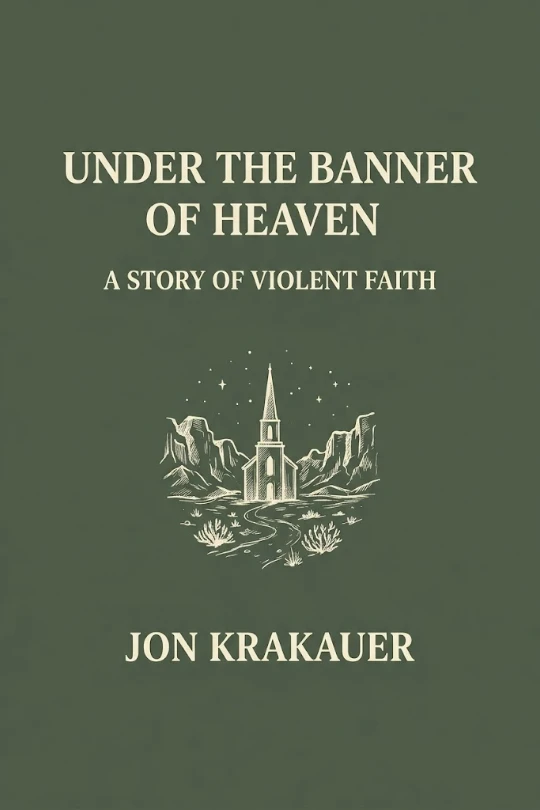
Jon Krakauer opens *Under the Banner of Heaven* with this shocking crime to pose a disturbing question: How could devout, seemingly normal men commit such a horrific act and feel completely justified? The answer, he argues, requires understanding not just the Lafferty brothers but the faith that shaped them.
The Lafferty brothers were Mormons. But they weren't the kind of Mormons you'd find at a neighborhood church potluck. They had embraced fundamentalist Mormonism—a radical version of the faith that rejects the mainstream Church of Jesus Christ of Latter-Day Saints as too soft, too compromised. The fundamentalists believed they were returning to the pure teachings of Joseph Smith, the religion's founder, including practices the modern LDS church had abandoned: polygamy, blood atonement, and direct revelation from God.
Krakauer weaves two stories together. One follows the Lafferty brothers' descent into extremism, from respected community members to cold-blooded killers. The other traces Mormon history itself, from Joseph Smith's visions in the 1820s to the isolated fundamentalist communities that still thrive in Utah and Arizona today. His argument is unsettling: the line between mainstream faith and violent extremism is thinner than most people want to believe.
The book's title comes from a quote by John Taylor, an early Mormon leader who declared that when government conflicts with God's commands, true believers must stand "under the banner of heaven" against earthly authority. For Ron and Dan Lafferty, this wasn't just rhetoric. It was a license to kill.
After the murders, Dan Lafferty showed no remorse. He slept peacefully that night. He told investigators he had committed no crime—he had simply obeyed God. Ron, meanwhile, attempted suicide in jail and later tried to strangle Dan with a towel through prison bars, claiming a new revelation that his brother should die.
The question at the heart of Krakauer's investigation is one that has no easy answer: When does religious devotion cross the line into something dangerous? And if faith itself is irrational, as Krakauer suggests, then what separates the believer in the pew from the believer with a knife?
About the Book
In 1984, two Mormon fundamentalist brothers murdered their sister-in-law and her baby, claiming God commanded it. Jon Krakauer weaves their chilling story with the history of Mormonism, from Joseph Smith’s radical revelations to modern-day extremists. This is a gripping exploration of how devout faith can justify the unthinkable—and a haunting question: where is the line between belief and delusion?
Key Takeaways
Faith's Nonrational Foundation Blurs the Line Between Devotion and Delusion
Krakauer argues that all religious belief is fundamentally nonrational, making the difference between a mainstream believer and a religious extremist a matter of degree, not kind—as demonstrated when Ron Lafferty's sincere belief in divine revelation was deemed both a valid expression of faith and a symptom of insanity in court.
Certainty Can Be More Dangerous Than Doubt
The Lafferty brothers' absolute certainty that they were following God's will allowed them to commit murder without remorse, while DeLoy Bateman's willingness to embrace questions over answers, though painful, ultimately set him free from a system that demanded unquestioning obedience.
The Echo Chamber of Validation Fuels Extremist Escalation
Prophet Onias's School of the Prophets created a self-reinforcing cycle where every revelation was affirmed and every doubt dismissed, demonstrating how communities designed to validate divine experiences can inadvertently authorize violence by removing all mechanisms for critical pushback.
Resistance to Tyranny Can Be an Act of Profound Courage
Brenda Lafferty used her intelligence and scriptural knowledge to challenge the patriarchal extremism of her brothers-in-law, paying with her life for her refusal to 'Keep Sweet'—proving that standing up to authoritarian faith systems requires extraordinary bravery even when it seems futile.
Theology Creates the Conditions for Violence Long Before the Violence Occurs
The Mountain Meadows Massacre and the Lafferty murders were not isolated incidents but logical outcomes of a faith that taught God's laws supersede man's laws, showing that violent extremism is often the natural conclusion of doctrines planted generations earlier.
Leaving a High-Control Faith Can Be a Lifelong Psychological Battle
DeLoy Bateman physically escaped the FLDS community but still wore the required underwear and struggled with ingrained beliefs about race and gender, illustrating that the psychological chains of fundamentalism persist long after the physical ones are broken.
Personal Revelation Without Accountability Becomes a License for Atrocity
When Dan and Ron Lafferty believed they could receive direct commands from God, they lost all external moral reference points, culminating in a prison attempt where Dan willingly let Ron strangle him because a 'revelation' commanded it—demonstrating the terrifying power of unaccountable divine authority.
The Comfort of Community Can Trap People in Systems That Harm Them
Debbie Palmer endured rape, forced marriage, and abuse within the FLDS because the community offered certainty and belonging, highlighting how the human need for connection can keep people imprisoned in destructive faith systems that control every aspect of their lives.
Who Should Listen?
True crime readers fascinated by the psychology behind religiously motivated murders.
Mormons or ex-Mormons seeking a deeper, critical understanding of their faith’s history and fundamentalist offshoots.
Sociology and religious studies students interested in how charismatic leaders and closed communities enable extremism.
Anyone who has questioned why intelligent, devout people commit violent acts in God’s name and wants a nuanced, narrative-driven answer.