
Book Summaries
Hosts: Clara
Timeline
Summary Preview
The Parlement of Toulouse was moments from delivering its verdict. After months of testimony, divided witnesses, and sleepless deliberation, the Criminal Chamber had reached its conclusion. The man calling himself Martin Guerre was about to be acquitted. His accusers—Pierre Guerre, the uncle, and Bertrande de Rols, the wife—would face charges of false accusation. The imposter had won.
Then the door opened.
A man entered the chamber. He walked with difficulty, relying on a crutch. Where his left leg should have been, there was a wooden peg. He said his name was Martin Guerre.
The courtroom fell silent. The imposter, who moments earlier had been on the verge of freedom, now faced the man whose life he had stolen. The real Martin Guerre had returned.
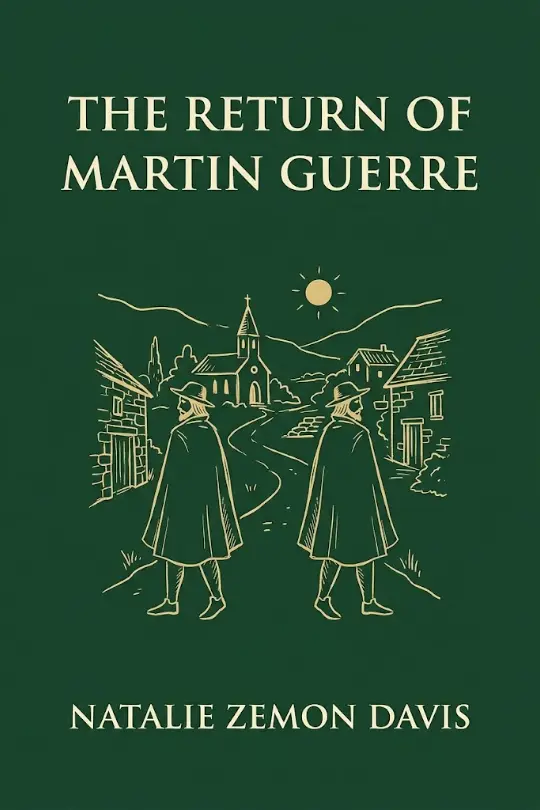
This is the story Natalie Zemon Davis set out to reconstruct in her book *The Return of Martin Guerre*. It's a story of identity and deception, of a clever peasant who convinced an entire village—including a wife, four sisters, and a community of neighbors—that he was someone else. And it's a story that raises a question that has haunted historians for centuries: how was such a brazen imposture possible in sixteenth-century France?
Davis faced a unique challenge as a historian. The peasants who lived through these events left almost no written records. More than ninety percent of them couldn't write. Diaries, letters, personal accounts—these simply didn't exist. What remained were court documents: legal records, witness testimony, and two published accounts of the trial.
The first was *Arrest Memorable*, written by Jean de Coras, the judge who presided over the case. The second was *Histoire Admirable*, a news account by Guillaume Le Sueur. These two texts formed the backbone of everything Davis could know for certain. But they also posed problems. Coras, for all his learning, had his own biases. He was a Protestant humanist who saw something of himself in the clever imposter. His account exaggerated some details, omitted others, and shaped the story to fit his own views. Le Sueur's version followed the conventions of popular news writing, turning the case into entertainment.
So Davis did something unusual. She combined rigorous research with what she called "informed invention"—filling the gaps in the historical record with reasonable speculation about what must have happened. She imagined conversations that left no trace in the documents. She reconstructed emotions that no one recorded. She gave voice to people whose lives had been reduced to legal transcripts.
This approach made some historians uncomfortable. But Davis was upfront about it. "What I offer you here," she wrote, "is in part my invention, but held tightly in check by the voices of the past."
The story itself was legendary even in its own time. A man named Martin Guerre had disappeared from his village in 1548, leaving behind his wife Bertrande de Rols and their infant son. Eight years later, a man claiming to be Martin returned. He knew intimate details of Martin's past. He was welcomed by Martin's four sisters. He was accepted by the uncle Pierre. And Bertrande took him back as her husband.
For three years, the new Martin lived as Martin Guerre. He ran the family farm. He fathered two daughters with Bertrande. He seemed to be settling into the life that the real Martin had abandoned. Then he made a mistake. He tried to sell family land, violating Basque custom and angering his uncle Pierre. The quarrel escalated. Pierre began spreading rumors that the new Martin was a fraud. A passing soldier claimed the real Martin had a wooden leg. The new Martin was arrested and put on trial.
The case was a legal nightmare. In a world without photographs, fingerprints, or birth certificates, how did you prove who someone was? Witnesses were divided. Some swore the new Martin was the real one. Others pointed out physical differences—the shape of his legs, the presence of warts, the number of teeth. The new Martin's perfect recall of past events nearly convinced the judges. But then the real Martin appeared.
Davis's book is more than a retelling of this dramatic story. It's an exploration of how identity worked in a world where names could be changed, where families could reinvent themselves, and where a clever man could steal another's life. The Daguerre family had changed their name to Guerre when they moved from the Basque country to Languedoc. They adopted local customs, learned a new language, and reshaped their appearance to fit in. This kind of identity-shaping was common. Davis argues that Arnaud du Tilh's imposture was an extreme version of something that happened all the time.
But it wasn't just about identity. It was about desire. Davis makes a controversial argument: Bertrande de Rols knew the new Martin was not her husband. She accepted him anyway. She found in him the passion and partnership she had never experienced with the real Martin. Their invented marriage was happier than her real one. And when the trial began, Bertrande played a dangerous double game—appearing as the deceived wife while secretly hoping the imposter would be acquitted.
This argument challenges the traditional version of the story, where Bertrande is an innocent victim. Davis doesn't reject the evidence. She reinterprets it. She points to details that Coras recorded but didn't fully explain: the intimate memories the new Martin recalled, the ease with which Bertrande accepted him, the happiness of their life together. She builds a case not just for Bertrande's complicity, but for her agency—a woman using the limited tools available to seize a better life.
The book ends with a mystery that can never be fully solved. What happened to Bertrande and Martin after the trial? Did they reconcile? Did they find a way to live together after everything that had happened? Davis imagines an armistice, a mutual forgiveness born of shared shame. But she admits that this is speculation. The historical record is silent.
What remains is the story itself—a story that has survived wars, religious upheavals, and centuries of retelling. It endures because it resists simple answers. Who is the hero? Who is the villain? The real Martin, who abandoned his family and returned only when his identity was threatened? The imposter, who brought happiness to a woman trapped in a bad marriage? The wife, who chose deception over loneliness? The uncle, who may have been motivated by greed as much as by justice?
Davis doesn't tell us what to think. She presents the evidence, offers her interpretations, and leaves room for doubt. The story of Martin Guerre, she writes, "retains a stubborn vitality." It refuses to be reduced to a moral lesson or a historical curiosity.
So we return to the courtroom. The man with the wooden leg stands before the judges. The imposter watches him, calculating his next move. Bertrande weeps. The family embraces the returning husband. And the question hangs in the air: how could this have happened? How could an entire village be fooled for three years? How could a wife share her bed with a stranger and call him husband?
The answers are not simple. They involve love and shame, poverty and desire, the fluid boundaries of identity in a world without documents. And they raise another question, one that Davis leaves for us to answer: if given the chance to escape your own life and become someone else, would you take it?
About the Book
In 16th-century France, a peasant named Martin Guerre vanished, leaving behind his wife and infant son. Years later, a stranger arrived, claiming to be him—and was accepted by everyone, including the wife. Natalie Zemon Davis unravels this true story of identity, deception, and desire, exploring how an entire village could be fooled and why a woman might choose a lie over loneliness.
Key Takeaways
Identity is a performance, not a fixed truth.
In a world without documents or photographs, the story of Martin Guerre reveals that identity is negotiated daily through memory, behavior, and community acceptance—a lesson that resonates in our own age of curated online selves and shifting social roles.
The stories we tell about the past are shaped by the storyteller's own life.
Judge Coras saw himself in the clever imposter, just as historian Davis sees herself in Bertrande, reminding us that every historical account is a blend of evidence and personal bias, and that honesty about our own perspective is the closest we can come to truth.
Desire can be a more powerful force than truth.
Bertrande de Rols likely knew the imposter was not her husband, yet she chose him anyway because he offered the passion, partnership, and respect that her real marriage never provided—a profound reminder that human longing often overrides cold facts.
Freedom sometimes requires living a lie.
In a patriarchal society that gave women no legal rights, Bertrande's only path to happiness was through silent complicity in a fraud, illustrating how systems of oppression can force people to choose between authenticity and survival.
Certainty is a dangerous illusion in matters of justice.
Montaigne's critique of the trial warns that human reason is a 'lame' instrument, and that judges—and all of us—must act even when we cannot know the full truth, making humility and skepticism essential to fair judgment.
The greatest betrayals often begin with the deepest wounds.
Martin Guerre did not flee because he was a villain, but because years of public humiliation over his impotence had broken his sense of manhood, showing that the seeds of abandonment and deception are often planted in unhealed shame.
A story's power lies in its refusal to offer easy answers.
The Martin Guerre legend has survived four centuries because it resists moral clarity—the hero is also a deserter, the villain is also a loving husband, and the victim may have been a willing accomplice—leaving each generation to find its own meaning.
History is not what happened, but what we can imagine happened.
Davis's method of 'informed invention' acknowledges that the historian's craft is partly creative, filling silence with reasonable speculation—a reminder that the past is not a fixed monument but a living conversation between evidence and empathy.
Who Should Listen?
History buffs fascinated by true crime stories from the pre-modern world where identity was proven without photographs or documents.
Readers who love courtroom dramas and moral puzzles where no one is entirely innocent or guilty.
Anyone interested in gender roles and women's agency in patriarchal societies, especially how Bertrande de Rols navigated her impossible situation.
Writers and storytellers who want to see how a historian blends rigorous research with informed imagination to bring the past to life.