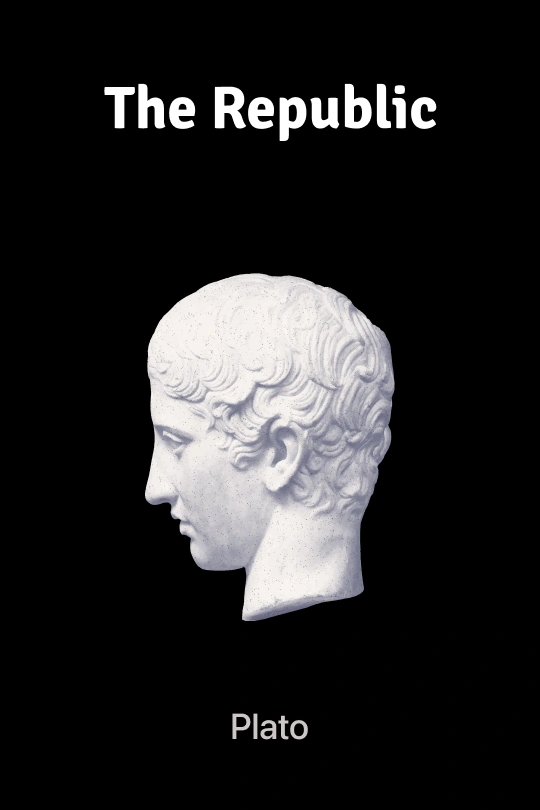
The Republic
Book Summaries
Hosts: Ethan
Timeline
Summary Preview
The story begins on a quiet evening in ancient Athens. Socrates is walking home from a religious festival at Piraeus, the city's seaport, when a young man named Polemarchus spots him. "Socrates, you're just in time," he calls out. "You must come to my house and join us."
What starts as a casual invitation turns into one of the most famous conversations in Western philosophy. Socrates follows Polemarchus home, where several others have gathered—Polemarchus's elderly father Cephalus, his brothers Glaucon and Adeimantus, and a fiery stranger named Thrasymachus. They settle in for what will become a night-long debate that has echoed through the centuries.
The conversation begins gently enough. Cephalus, now in his old age, reflects on life. Socrates asks him what he considers the greatest benefit of his wealth. Cephalus answers simply: it allows him to pay back anyone he owes, and to make amends for any wrongs he has committed. This frees him from fear and anxiety about death.
But Socrates pounces on this definition. "Is morality really just about paying your debts?" he asks. "What if a friend lent you weapons when he was sane, and then goes mad and demands them back? Would it be right to return them?"
This small crack in Cephalus's comfortable view opens into a chasm. Polemarchus takes up his father's argument, offering a more refined definition: morality is the art of giving benefit to friends and harm to enemies. It sounds reasonable enough. It's how most people think—help those close to you, punish those who oppose you.
Socrates dismantles this too. First, he points out, this definition would justify stealing if it helped your friends. Second, we often mistake who our true friends and enemies are. People we think are good may be bad, and vice versa. Third—and this cuts deeper—harming anyone, even an enemy, makes them worse. How can making someone worse ever be a moral act?
Then Thrasymachus explodes. He's been listening to Socrates' questions with growing frustration. "Stop this nonsense!" he shouts. "You never answer anything yourself. You just keep asking questions and tearing apart everyone else's answers."
Thrasymachus has his own theory, and it's brutally simple. Morality, he says, is nothing but the advantage of the stronger. Those in power—rulers, the wealthy, the influential—create laws and moral codes to serve their own interests. They call it "justice" or "morality" to make people obey. But really, it's just a tool for controlling the weak. The truly powerful person doesn't bother with morality. They take what they want.
To prove his point, Thrasymachus points to dictators. They have total freedom to do whatever pleases them. They murder, steal, and enslave without consequence. And they're happy—far happier than the moral person who restrains themselves out of fear or weakness.
Socrates pushes back with two arguments. First, he says, moral people have greater expertise in living well. Just as a skilled musician produces better music, a moral person produces a better life. Second, immorality is ineffective. Immoral people clash with themselves and with others. They can only accomplish things to the extent that they cooperate, which means acting morally.
But even Socrates seems unsatisfied with these answers. He admits at the end of the first chapter: "We still haven't determined what morality actually is."
Then Glaucon and Adeimantus step forward. They're Plato's brothers, and they're not convinced either. But they're not hostile like Thrasymachus. They genuinely want to understand. So they sharpen the question.
Glaucon speaks first. He summarizes the cynical view clearly: people are only moral because they're too weak to be immoral. They make a social contract—"I won't harm you if you don't harm me"—and call it morality. But really, it's just self-preservation. Given the chance to act without consequences, anyone would choose immorality.
Adeimantus adds another layer. Even the rewards people seek from morality are suspect, he says. Parents and teachers praise morality not for its own sake, but for the reputation it brings. "Be good," they say, "and people will respect you, reward you, give you power." But this means the appearance of goodness matters more than actual goodness. A clever person can be completely immoral while pretending to be virtuous.
The brothers issue a clear challenge: Don't tell us about external rewards. Don't tell us about reputation, wealth, or social standing. Prove that morality itself—independent of all consequences—makes a person happier than immorality. Prove that even someone wearing the ring of invisibility, who could commit any crime without being caught, would still choose to be moral.
This is the central question of *The Republic*. Not "what is morality?" in the abstract, but "is a moral life its own reward?" Does being good make you happy, regardless of what anyone else thinks or does?
Socrates realizes he needs a new approach. His earlier arguments about expertise and effectiveness haven't landed. They appeal to external benefits—being more successful in life, avoiding conflict—not to the intrinsic value of morality. He needs to show what happens inside a person when they choose good or evil, not what rewards or punishments follow from outside.
To do this, he proposes a clever strategy. "Suppose," he says, "we were short-sighted and had to read small letters from far away. Then someone noticed the same letters written in larger size on a larger surface. We'd read the larger letters first, and that would help us understand the smaller ones."
The larger letters, Socrates explains, are the ideal city. The smaller letters are the human soul. By examining how justice and morality work in a whole society—on a grand scale—he hopes to see how they work in an individual person.
So begins an extraordinary journey. Socrates will build an imaginary city from the ground up, exploring its education, its laws, its art, and its rulers. He will discuss the nature of knowledge and truth, the structure of the human mind, and the ultimate source of goodness. He will descend into dark caves and ascend to bright suns. And all of it serves one purpose: to answer Glaucon's challenge.
But before that journey begins, one question hangs in the air: Can Socrates actually prove that morality is worth pursuing for its own sake? Or will Thrasymachus's cynical vision—that power and pleasure are the only real goods—win the day?
About the Book
In ancient Athens, Socrates is challenged to prove that a moral life is worth living for its own sake—even with a ring of invisibility that lets you get away with anything. To answer, he builds an imaginary city, explores the human soul, and tells the famous Allegory of the Cave. A timeless inquiry into justice, power, and what makes life worth living.
Key Takeaways
True morality is the harmony of the soul, not a social contract.
Socrates argues that justice is not merely a bargain struck by the weak to avoid harm, but the natural state of a well-ordered soul where reason governs passion and desire, creating inner peace and true happiness.
The philosopher's burden is to return to the cave.
Those who have glimpsed ultimate truth and goodness have a moral obligation to descend back into the world of shadows and illusions to guide others, even at the cost of their own comfort and safety.
Power without wisdom is the seed of tyranny.
The descent from aristocracy to tyranny mirrors the soul's fall from reason to lust, showing that unchecked desire for power, honor, or wealth inevitably corrupts both the individual and the state.
Art that stirs emotion without truth weakens the rational soul.
Poetry and representational art appeal directly to our passions and desires, training the soul to indulge in grief, fear, or lust rather than exercising the rational self-control necessary for a just life.
The greatest freedom is self-mastery, not the absence of restraint.
Democracy's unlimited freedom leads to chaos and ultimately tyranny, because a soul ruled by fleeting desires is never truly free—only the soul governed by reason achieves genuine autonomy.
Every soul chooses its own destiny; the gods are blameless.
In the Myth of Er, souls choose their next lives based on the wisdom or folly gained from past existence, placing the responsibility for happiness squarely on our own capacity for philosophical understanding.
The noble lie reveals a deeper truth about human nature.
The myth of the metals is not merely political propaganda but a metaphor for the internal hierarchy every person must establish, where the 'gold' of reason must rule the 'silver' of passion and the 'bronze' of desire.
Morality is its own reward, even when invisible.
Glaucon's challenge of the Ring of Gyges proves that true justice must be valuable for its own sake, not for reputation or reward—the harmonious soul is happier than the tyrant even when no one is watching.
Who Should Listen?
Anyone who has ever questioned whether being 'good' truly pays off in a world that often rewards the ruthless.
Leaders, managers, or politicians wrestling with the tension between idealistic principles and practical power.
Students or teachers of philosophy looking for a clear, story-driven entry point into Plato's most famous dialogue.
Creative professionals—writers, artists, or filmmakers—who want to understand Plato's controversial critique of art and storytelling.