
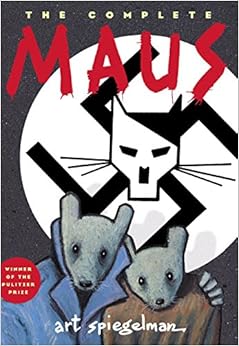
“A father's harrowing survival in Auschwitz, rendered in stark animal allegory, exposes the inherited trauma of the Holocaust.”
Key Takeaways
- 1Survival is a brutal calculus of luck and resourcefulness. Vladek's endurance in Auschwitz was not a moral triumph but a grim combination of chance, linguistic skill, bribery, and relentless pragmatism.
- 2Trauma echoes destructively through subsequent generations. The psychological scars of the Holocaust manifest in the survivors' children as guilt, anxiety, and fractured familial relationships.
- 3Dehumanizing propaganda can be subverted through artistic reclamation. Spiegelman appropriates Nazi imagery of Jews as vermin, using the mouse metaphor to critique the absurdity of racial categorization.
- 4Historical testimony is inherently fragmented and subjective. The narrative is consciously constructed from Vladek's flawed memory and Art's editorial mediation, rejecting a singular, authoritative history.
- 5The graphic novel form can articulate the unspeakable. The stark, black-and-white visuals and animal allegory create necessary distance, making the Holocaust's horrors palpable yet bearable.
- 6No one emerges from atrocity morally unscathed. The book refuses hero worship, depicting Jews, Poles, and Germans in a complex moral landscape of collaboration, betrayal, and self-preservation.
Description
Art Spiegelman’s *The Complete Maus* is a monumental work of graphic literature that operates on two inextricable levels: it is the biographical account of his father Vladek’s experiences as a Polish Jew before, during, and after the Holocaust, and it is a metafictional chronicle of the strained, guilt-laden process of gathering that testimony. The narrative toggles between 1970s New York, where an aging, miserly Vladek reluctantly recounts his past to his artist son, and the escalating horrors of 1930s and 40s Poland, from the invasion of the Nazis to the gates of Auschwitz.
Spiegelman employs a radical visual metaphor, depicting Jews as mice, Nazis as cats, Poles as pigs, and Americans as dogs. This device, far from simplifying the narrative, creates a critical layer of abstraction. It simultaneously references the dehumanizing propaganda of the Third Reich and allows the reader to engage with the story’s profound emotional weight without being overwhelmed by hyper-realistic human suffering. The core of Vladek’s tale is one of astonishing, almost absurd survival—a saga of hiding places, forged documents, black-market trades, and the sheer, capricious luck required to navigate the death camps.
The book is equally concerned with the aftermath of survival. It delves into the psychological wreckage borne by Vladek, whose trauma manifests in obsessive frugality, hypochondria, and a difficult personality that strains his relationship with his son. Art himself becomes a central character, wrestling with the guilt of profiting from his family’s tragedy, the shadow of a brother who perished, and the impossible burden of representing an event that defies representation.
As a whole, *Maus* stands as a seminal pillar of both Holocaust literature and the graphic novel medium. It demonstrates the form’s unique capacity for historical witness, psychological depth, and formal innovation. Its unflinching exploration of memory, guilt, and the transmission of trauma across generations secures its status as an indispensable and enduring contemporary classic.
Community Verdict
The critical consensus hails *Maus* as a profound and essential masterpiece, uniquely powerful in its use of the graphic novel medium to grapple with the Holocaust. Readers are universally moved by the raw, unvarnished humanity of Vladek Spiegelman—a survivor portrayed with all his flaws, resourcefulness, and haunting trauma. The animal allegory is widely praised for its intellectual and emotional efficacy, creating a necessary buffer that paradoxically makes the historical horrors more accessible and their impact more devastating.
While a minority find the black-and-white artwork aesthetically simplistic or occasionally confusing for distinguishing characters, most argue that its starkness perfectly complements the grim narrative. The book’s structural genius—interweaving Vladek’s past with Art’s fraught present—is celebrated for illuminating the intergenerational legacy of trauma. The community verdict is clear: this is not merely a great comic, but a landmark work of literature that forever expands the possibilities of its form.
Hot Topics
- 1The effectiveness and meaning of the animal allegory, with mice as Jews and cats as Nazis, as either a brilliant subversion of propaganda or an oversimplification.
- 2The complex, often frustrating father-son relationship between Art and Vladek, and its portrayal as a consequence of Holocaust trauma.
- 3The book's metafictional layer, where Art Spiegelman interrogates his own guilt and the ethics of creating art from familial suffering.
- 4Vladek Spiegelman's characterization as a deeply flawed, unheroic, yet profoundly resourceful survivor, challenging saintly victim narratives.
- 5The graphic novel's unique ability to convey the horrors of the Holocaust through its stark visual language and narrative pacing.
- 6Discussions on survivor's guilt and the psychological inheritance of trauma by the children of Holocaust survivors.
Related Matches






Popular Books

The Big Short: Inside the Doomsday Machine
Michael Lewis
Radio Silence
Alice Oseman
Dead Wake: The Last Crossing of the Lusitania
Erik Larson

The Lessons of History
Will Durant, Ariel Durant

Going Clear: Scientology, Hollywood, and the Prison of Belief
Lawrence Wright
A Court of Mist and Fury (A Court of Thorns and Roses, #2)
Sarah J. Maas

The War of Art: Break Through the Blocks & Win Your Inner Creative Battles
Steven Pressfield, Robert McKee
The Limpopo Academy of Private Detection
Alexander McCall Smith

One Direction: Who We Are: Our Official Autobiography
One Direction

The Campaigns of Napoleon
David G. Chandler

Tea Time for the Traditionally Built
Alexander McCall Smith

War Songs: Metaphors In Clay And Poetry From The Vietnam Experience
Grady Harp
Browse by Genres
History
Business
Leadership
Marketing
Management
Innovation
Economics
Productivity
Psychology
Mindset
Communication
Philosophy
Biography
Science
Technology
Society
Health
Parenting
Self-Help
Wealth
Investment
Relationship
Startups
Sales
Money
Fitness
Nutrition
Sleep
Wellness
Spirituality
AI
Future
Nature
Politics
Classics
Sci-Fiction
Fantasy
Thriller
Mystery
Romance
Literary
Historical
Religion
Law
Crime
Arts
Habits
Creativity