
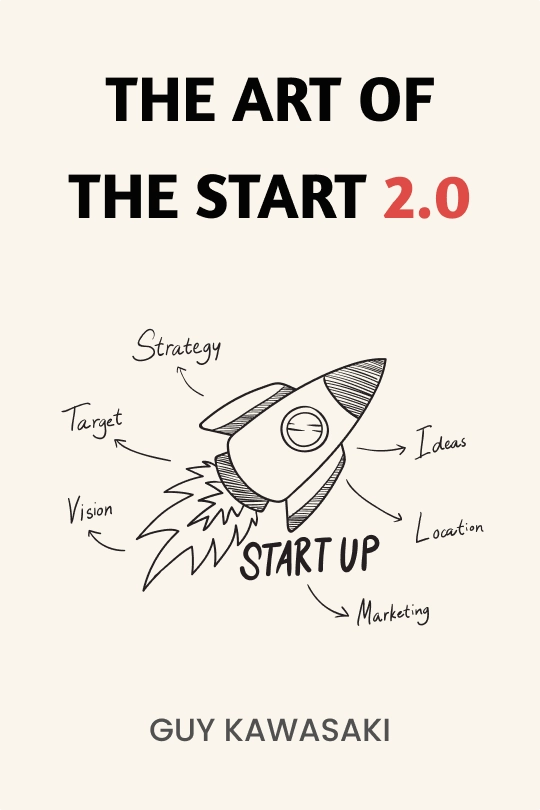
The Art of the Start: The Time-Tested, Battle-Hardened Guide for Anyone Starting Anything
"A pragmatic manifesto for launching ventures by prioritizing action, meaning, and evangelism over exhaustive planning."
Nook Talks
- 1[object Object]
- 2[object Object]
- 3[object Object]
- 4[object Object]
- 5[object Object]
- 6[object Object]
- 7[object Object]
- 8[object Object]
Guy Kawasaki’s The Art of the Start dismantles the mythology of entrepreneurial genesis, replacing it with a battle-hardened, action-oriented framework. It is not a theoretical treatise but a field manual for turning any inspired idea—be it a tech startup, a non-profit, or an internal corporate venture—into operational reality. Kawasaki argues that the traditional obsession with exhaustive business plans is often a form of productive procrastination, a delay that allows competitors to move first or market windows to close.
At its heart, the book advocates for a philosophy of purposeful action. Kawasaki introduces foundational concepts like “making meaning,” which posits that ventures built on a genuine desire to improve the world possess an inherent motivational advantage. This purpose is then distilled into a “mantra”—a concise, evocative phrase—rather than a bloated mission statement. The methodology is pragmatic, covering the essential mechanics of launching: defining a simple business model, crafting resonant positioning, mastering the art of the pitch to “catalyze fantasy,” and the critical practice of bootstrapping, which emphasizes shipping a functional product to gather real user feedback over endless internal refinement.
The guide extends beyond launch into the challenges of building an organization. Kawasaki provides shrewd advice on recruiting, advising founders to hire individuals they’d be happy to encounter socially, and on forming strategic partnerships based on financial logic rather than vanity. He demystifies fundraising for those who require it, while consistently privileging capital efficiency. The approach is holistic, also addressing how to manage a board, foster a community of evangelists, and brand with authenticity.
The Art of the Start occupies a unique space as both a motivational call to arms and a tactical playbook. Its legacy lies in its enduring relevance for “anyone starting anything,” from first-time founders to corporate intrapreneurs. Kawasaki synthesizes lessons from his tenure at Apple, where he helped turn customers into evangelists, and his venture capital experience, offering not abstract theory but proven, iterative steps for navigating the chaotic, artful journey of bringing something new into the world.
The consensus positions this book as an essential, pragmatic antidote to academic business theory. Readers consistently praise its actionable, no-nonsense advice—particularly the emphasis on launching quickly and making meaning—which they find directly applicable to real-world startups and internal projects. Criticisms are minor, often noting that some examples feel dated, but this is overwhelmingly overshadowed by the value derived from its concise, entertaining, and highly functional guidance. It is celebrated as a foundational text that cuts through paralysis and prioritizes execution.
- 1The practical superiority of Kawasaki's 'make meaning' and 'mantra' concepts over traditional, verbose mission statements.
- 2Debate on the relevance of the book's specific examples and case studies for modern tech startups versus its timeless philosophical principles.
- 3The value of the bootstrapping and 'ship then fix' methodology versus more cautious, planning-heavy approaches to product development.

Stumbling on Happiness
Daniel Gilbert

The Norwegian Method
Brad Culp

Breakthrough: The Quest for Life-Changing Medicines
Dr William Pao
Bad Samaritans
Ha-Joon Chang

The Almanack of Naval Ravikant
Naval Ravikant, Eric Jorgenson

Sapiens: A Brief History of Humankind
Yuval Noah Harari

The Fifth Discipline
Peter M. Senge

Breath: The New Science of a Lost Art
James Nestor

The Psychology of Money: Timeless Lessons on Wealth, Greed, and Happiness
Morgan Housel

The Intelligent Investor
Benjamin Graham
The Crash Course
Chris Martenson

Out of Control
Kevin Kelly