
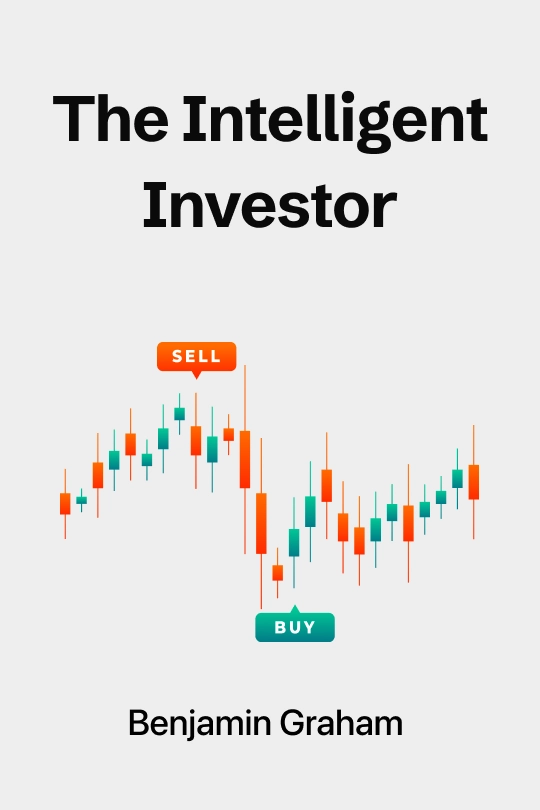
The Intelligent Investor
"A rigorous defense of value investing, providing the intellectual armor to navigate market psychology and build durable wealth."
Nook Talks
- 1Distinguish investment from speculation with a margin of safety. Investment is an operation based on thorough analysis, promising safety of principal and an adequate return. The margin of safety—buying at a price significantly below intrinsic value—is the central concept that protects against errors in calculation or market downturns.
- 2Analyze a company as a business owner, not a stock trader. Fundamental analysis of financial statements—balance sheets, income statements—is paramount. The intelligent investor seeks to understand the underlying business's true worth, its earnings power, and its assets, independent of its fluctuating market price.
- 3Master your own psychology to defeat Mr. Market's manic-depressive offers. The market is personified as a obliging but emotionally unstable partner named Mr. Market. Success requires the discipline to ignore his daily quotes of euphoria or despair, buying when he is pessimistic and selling when he is irrationally exuberant.
- 4Adopt a defensive, unemotional strategy for the enterprising and passive alike. Graham outlines clear strategies for both the defensive (passive) investor, favoring diversified, low-maintenance portfolios, and the enterprising investor willing to do the hard analytical work. Both require a framework that eliminates emotional decision-making.
- 5Prioritize the preservation of capital over the pursuit of spectacular gains. The primary aim is to avoid permanent loss. This conservative principle shifts focus from beating the market to participating in it wisely, ensuring survival and compounding returns over the long term.
- 6Understand that future security prices are inherently unpredictable. Graham dismisses forecasting and technical analysis as speculative. Since precise future prices cannot be known, the investor must rely on the measurable facts of a business's current condition and its historical performance.
First published in 1949, Benjamin Graham's The Intelligent Investor established the philosophical and analytical bedrock of modern value investing. It transcends mere stock-picking advice to articulate a comprehensive theory of finance that separates the disciplined investor from the reckless speculator. The book’s enduring power lies in its psychological framework, most famously illustrated by the parable of "Mr. Market," a metaphorical business partner whose daily offers are driven by whim and emotion rather than reason.
Graham meticulously outlines the principles of security analysis, teaching readers how to scrutinize balance sheets and income statements to ascertain a company's intrinsic value. The core commandment is to always invest with a "margin of safety"—purchasing a security at a price sufficiently below its calculated worth to provide a buffer against error or adversity. He provides concrete strategies for both the defensive investor, who seeks a sound, low-effort portfolio, and the enterprising investor, who is willing to engage in deeper analysis to uncover undervalued opportunities.
This revised edition preserves Graham's original text as sacred scripture while layering it with essential contemporary commentary. Financial journalist Jason Zweig annotates each chapter, drawing lucid parallels between Graham's 20th-century examples and 21st-century financial debacles, from the dot-com bubble to the 2008 crisis. The volume concludes with a poignant and insightful essay by Warren Buffett, Graham's most famous disciple, who credits this book as the source of his investment worldview.
More than a manual, The Intelligent Investor is a treatise on temperament. It argues that successful investing is less a test of intellect than of character, requiring patience, humility, and the fortitude to be contrarian. Its target audience spans from the novice seeking a sober financial education to the professional portfolio manager in need of a philosophical anchor. Its legacy is not a specific formula but a durable mindset for building wealth across generations, making it arguably the most important book ever written on the subject.
The consensus venerates this as the indispensable, foundational text for serious investing, the "bible" of the field. Readers universally praise its timeless wisdom on value investing and market psychology, with particular commendation for Jason Zweig's modern annotations. The primary criticism is its formidable density and dry, textbook-like prose, which demands significant effort and financial literacy, rendering it inaccessible to casual dabblers. It is respected more as a masterclass than an easy guide.
- 1The book's demanding, textbook-like density and whether its effort-to-practical-return ratio is justified for the modern retail investor.
- 2The indispensable value of Jason Zweig's contemporary commentary in bridging Graham's original principles to today's market realities.
- 3Debating the practical applicability of Graham's detailed security analysis in an era of algorithmic trading and index funds.
- 4The revered status of the "Mr. Market" allegory as a masterclass in managing investment psychology and emotional discipline.

The Artist's Way
Julia Cameron
The Essays of Warren Buffett: Lessons for Corporate America
Lawrence A. Cunningham, Warren Buffett

Sapiens: A Brief History of Humankind
Yuval Noah Harari

Chip War: The Quest to Dominate the World's Most Critical Technology
Chris Miller

Breath: The New Science of a Lost Art
James Nestor

The Road to Financial Freedom
Bodo Schäfer

The Norwegian Method
Brad Culp
Age of Ambition: Chasing Fortune, Truth, and Faith in the New China
Evan Osnos
Boom: Bubbles and the End of Stagnation
Byrne Hobart
The Art of Contrarian Trading
Carl Futia
Transformation in Christ
Dietrich Von Hildebrand
The Crash Course
Chris Martenson