
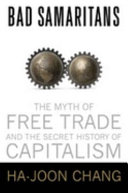
Bad Samaritans
"The path to national wealth is paved not by free trade, but by strategic protectionism and intellectual piracy."
- 1Protectionism is the historical engine of industrial development. Every modern economic superpower, from Britain to the United States to South Korea, built its industrial base behind high tariff walls and state subsidies, directly contradicting the free-trade dogma they now enforce on others.
- 2Intellectual property rights often hinder, rather than help, developing nations. Strict patent and copyright regimes, presented as essential for innovation, historically stifle latecomers who need to reverse-engineer and adapt existing technologies to launch their own industries and catch up.
- 3Privatization and deregulation can prematurely de-industrialize a nation. Forcing developing countries to privatize state-owned enterprises and open their financial markets often leads to lower GDP growth and de-industrialization, as it strips them of tools for strategic economic steering.
- 4The 'free market' is a political construct, not a natural state. So-called free markets are carefully managed creations that require extensive state intervention to establish property rights, regulate competition, and provide infrastructure, debunking the myth of a self-regulating system.
- 5Development policy must be context-specific, not ideologically uniform. Effective economic policy cannot be a one-size-fits-all prescription from the IMF or World Bank; it must account for a nation's specific institutional history, technological capabilities, and political realities.
In 'Bad Samaritans,' Cambridge economist Ha-Joon Chang launches a frontal assault on the orthodox narrative of globalization and free trade. He argues that the prosperous West has effectively 'kicked away the ladder' it used to climb to wealth, now compelling developing nations to adopt policies of open markets and deregulation that it never used during its own ascent. The book positions itself as a contrarian history, challenging the fairy tale of neoliberal development propagated by institutions like the WTO and thinkers like Thomas Friedman.
Chang meticulously dismantles this orthodoxy by examining the actual historical record of today's rich nations. He demonstrates that strategic protectionism, state-led industrial policy, and the deliberate infringement of intellectual property were standard practice for Britain, the United States, Germany, and his native South Korea. The book delves into case studies, showing how tariffs nurtured infant industries and how state-owned enterprises played crucial roles in technological leaps. It contrasts this historical reality with the damaging results of the 'Washington Consensus' policies imposed on Latin America, Africa, and post-Soviet economies.
The narrative further critiques sacred cows like the absolute sanctity of patents, arguing they slow technological diffusion, and challenges the dogma of inflation targeting and capital account liberalization. Chang employs a lucid, often witty style, using accessible analogies—like comparing developed countries to 'Bad Samaritans' who refuse to lend the ladder they themselves used—to make complex economic arguments clear to a general audience.
Ultimately, the book is a manifesto for policy space and intellectual honesty in development economics. It is targeted at readers skeptical of globalization's promised benefits, students of political economy, and policymakers in the developing world. Chang's work insists that economic development is not a mechanistic process governed by universal rules, but a political journey that requires tools currently denied to the global poor.
The readership celebrates Chang's accessible demolition of free-market dogma, praising his use of historical fact over abstract theory as profoundly eye-opening. Critics, while few, occasionally find his tone overly polemical or argue he oversimplifies complex adversaries. The consensus is that the book serves as an essential, persuasive corrective to mainstream economic narratives, valued for its clarity and contrarian punch.
- 1The historical hypocrisy of now-developed nations using protectionist policies they now deny to others.
- 2The validity of Chang's 'kicking away the ladder' analogy as a critique of modern trade policy.
- 3Debates on whether state-led industrial policy or free markets are more effective for long-term development.
- 4The ethical and practical implications of advocating for weaker intellectual property rights in poor countries.

Breakthrough: The Quest for Life-Changing Medicines
Dr William Pao

Permanent Record
Edward Snowden

How to Win Friends & Influence People
Dale Carnegie

Sapiens: A Brief History of Humankind
Yuval Noah Harari

The Art of Contrarian Trading
Carl Futia

The Artist's Way
Julia Cameron

Chip War: The Quest to Dominate the World's Most Critical Technology
Chris Miller

Breath: The New Science of a Lost Art
James Nestor

Just Listen: Discover the Secret to Getting Through to Absolutely Anyone
Mark Goulston
The Crash Course
Chris Martenson

Stumbling on Happiness
Daniel Gilbert

The Psychology of Money: Timeless Lessons on Wealth, Greed, and Happiness
Morgan Housel