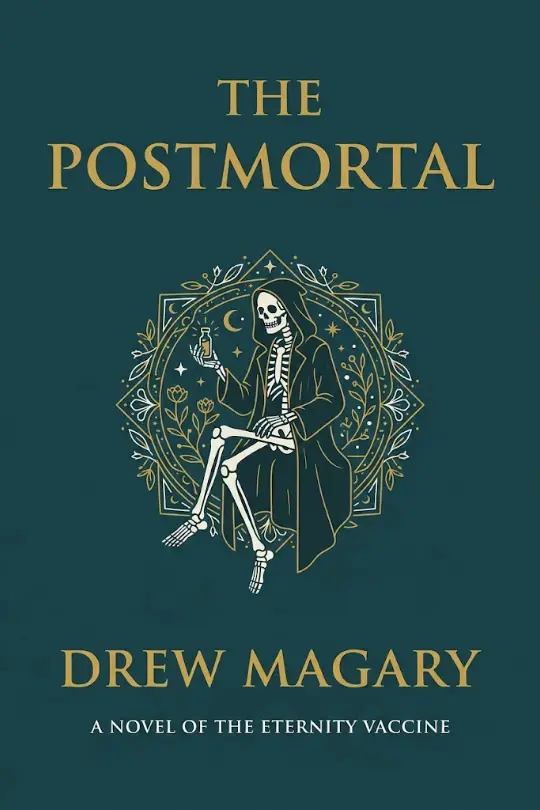
The Postmortal
Book Summaries
Hosts: Ethan
Timeline
Summary Preview
The document begins with a warning. It comes from a government agency called the Department of Containment, part of the United North American Territories. The text you're about to hear, they explain, is a collection of blog posts and journal entries discovered after a catastrophic collapse of society. The servers that held them were destroyed, making verification nearly impossible. But the writing is so thorough, so detailed, that the Department considers it reliable evidence. Their conclusion is stark: the cure for aging must never again be legalized.
This is the frame for Drew Magary's novel *The Postmortal*. What follows is the story of one man's life across sixty years, told in his own words. And from the very beginning, we know how it ends. The cure that promised eternal youth became a disaster. The question is not *if* things fall apart, but *how*.
The novel follows John Farrell from 2019 to 2079. In June of 2019, John is a lawyer in New York City. He's twenty-nine years old. And he's about to do something that will change everything.
John visits a doctor who offers an illegal procedure: a genetic therapy that stops aging. It's not immortality, the doctor warns him. People can still die from injury, illness, or violence. The cure only prevents the body from growing old. John doesn't care about the fine print. He feels a primal fear of death, a raw compulsion that bypasses all logic. He wants the cure, and he wants it now.
The world around him is already fracturing over this very question. Protests erupt everywhere. Some people call the cure a miracle. Others call it a sin against God and nature. The Pope declares that anyone who takes the cure will be damned to Hell. Anti-cure groups grow violent. Doctors who administer the treatment are killed. The tension builds toward a breaking point.
John gets his injection. Two weeks later, he walks his roommate Katy to the same doctor's apartment building. Katy is excited. She wants the cure too. But as they approach, John spots a beautiful blonde woman on the street. He chases after her. Moments later, the doctor's apartment building explodes. Katy is killed.
This single event haunts John for decades. He becomes obsessed with finding the blonde woman, convinced she was involved in the bombing. He chases blondes on the street, always thinking he's found her, always being wrong. The guilt of Katy's death never leaves him.
Meanwhile, the world changes fast. The President legalizes the cure. Suddenly everyone can have it. And everything starts to break.
What happens when people stop aging? What happens when "forever" becomes a real possibility? Magary walks us through the consequences step by step. Marriages dissolve. Couples realize that "till death do us part" now means something terrifyingly different. A new kind of marriage appears: the cycle marriage, where couples commit for a set number of years and then automatically separate unless they choose to renew. People become hyper-individualistic. They stockpile supplies. They focus on themselves.
John's own relationships suffer. His partner Sonia wants to marry him, but he can't commit to five hundred years together. The fear of aging that once drove people into marriage is gone. Without it, what's left? They break up. Sonia has his son, David, and raises him with another man.
John's father takes the cure too, but he regrets it. He misses John's mother, who died before the cure was available. He feels trapped in a body that won't age, watching the world decay around him. When he gets pancreatic cancer, he refuses treatment. He wants to die.
The violence escalates. In China, the government tattoos citizens with their birthdates to identify who has taken the cure illegally. John's friend Chan sends a desperate email describing how officials took his newborn son and returned him with the date tattooed on his body. Chan and his wife are arrested. John can't help them.
Back in America, John is attacked by a group called the Greenies. They're anti-cure terrorists. They cut his birthdate into his arm with a knife. The scar stays with him, a permanent reminder of what he is. He develops post-traumatic stress. He starts carrying a gun.
And then he meets Alison, his first love from middle school. They reconnect. They plan a future together. For a moment, it seems like John might find happiness. But when a Greenie threatens them, John beats the man with his gun. Alison is terrified by his violence. She runs into the street and is hit by a truck. She dies.
This is the pattern of John's life. Every time he reaches for connection, something takes it away. Every time he tries to escape his past, it catches up. He flees the country. He disappears for thirty years. And when he returns, he becomes an end specialist consultant. He helps people die on their own terms.
The job exposes him to the worst of a collapsing world. Riots. Cannibalism. Government-sanctioned killings. His son David joins the Church of Man, a religion that worships humanity and rejects violence. David tries to save his father. He asks the church to protect John during a Greenie attack. But then David, Sonia, and her husband are killed in a bombing.
John is consumed by grief and rage. He becomes a hard end specialist, a government-sanctioned killer. His first target is the blonde woman from the elevator, the one he's been hunting for fifty years. Her name is Solara Beck.
But when he finds her, everything changes. She's not a terrorist. She was a victim. She was forced to be a lookout by an abusive boyfriend. She's been running her whole life, just like John. He spares her. He helps her fake her death. They fall in love.
The world doesn't give them time to enjoy it. Nuclear war breaks out. John and Solara flee through a mob of desperate people. John is stabbed. He gets Solara to a Church of Man compound, where she receives medical care for her pregnancy. They marry. And then John prepares to die.
He finally accepts it. Death is inevitable. The cure didn't save him from that. It only gave him more time to lose the people he loved.
The Department of Containment's warning echoes through the entire story. The cure for aging seemed like a miracle. It turned into a curse. It didn't eliminate death. It just made life longer, harder, and more lonely.
The question Magary leaves us with is simple and devastating: What would we become if we never had to die?
About the Book
In a world where aging has been cured, John Farrell's sixty-year blog chronicles the unforeseen collapse of society. From the moment he takes the illegal cure, his life unravels through violence, loss, and moral decay. Framed as a discovered warning from a future government, this is a haunting exploration of what happens when forever becomes a curse.
Key Takeaways
Immortality Without Meaning Is Its Own Kind of Prison
The cure for aging did not eliminate death or suffering; it only stretched life into an endless corridor of loss and monotony, proving that the fear of death is not the same as the love of life.
The Social Contract Dies When We Stop Needing Each Other
When aging no longer forces interdependence, marriage dissolves into temporary contracts, communities fragment into stockpiling individuals, and the collective good becomes an abstraction no one is willing to sacrifice for.
Violence Breeds Only More Violence, Never Justice
John's decades-long hunt for revenge transforms him into the very thing he hunts, and each act of violence—from beating a Greenie to becoming a government killer—only deepens the spiral of loss and guilt.
Redemption Is Possible Only When We Stop Running
After fifty years of chasing a ghost, John finally finds peace not by killing Solara but by seeing her as a fellow victim, proving that forgiveness—of others and of oneself—is the only true escape from the past.
Love Becomes the Only Anchor in a World Without End
In a society where nothing is permanent and everyone is focused on self-preservation, John's final act of love—sacrificing his life so Solara and their child can live—becomes the only meaningful defiance against the void.
The Fear of Death Can Be More Destructive Than Death Itself
John's primal compulsion to avoid aging leads him to make choices that cost him everyone he loves, revealing that the desperate attempt to escape mortality often causes more suffering than accepting it.
Every System of Control Eventually Turns to Violence
From China tattooing infants to the Greenies carving birthdates into skin to the government's Senior Management Program, every attempt to manage the postmortal population devolves into marking, branding, and killing.
The Only True Immortality Is the Love We Leave Behind
John's story survives not because of the cure that kept his body young, but because of the blog posts, the confessions, and the child he fathered—proving that legacy is not measured in years but in the connections we forge.
Who Should Listen?
Readers who loved dystopian novels like 'Station Eleven' or 'The Road' and want a thought-provoking take on immortality's dark side.
Fans of character-driven science fiction who enjoy following one flawed protagonist's moral journey across decades.
Anyone fascinated by the ethical and social implications of life extension technology and its potential to unravel human bonds.
Listeners who appreciate a narrative framed as found documents, with a mystery that unfolds across a collapsing world.