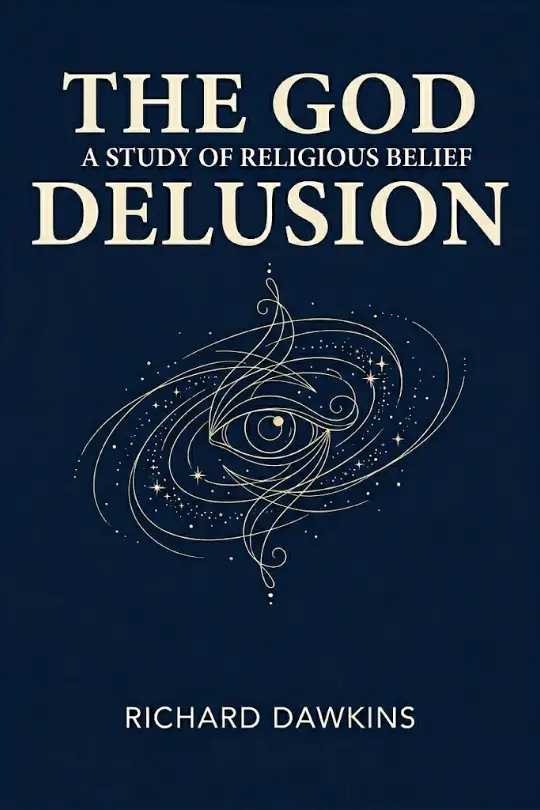
The God Delusion
Book Summaries
Hosts: Ethan
Timeline
Summary Preview
Richard Dawkins wrote *The God Delusion* with a specific audience in mind. Not the devout believers who would never pick up his book. Not the philosophers who would debate its finer points. He wrote for people sitting in pews on Sunday mornings, feeling a quiet unease they couldn't name. People who had been raised in religious households, taught to believe, and who now wondered if there might be another way.
The book opens with a simple assurance: atheism is viable. It is not a bleak, empty philosophy reserved for bitter intellectuals. It can be fulfilling. It can be joyful. And Dawkins intends to prove it.
He outlines four aims for the book. First, to raise awareness that atheism exists as a legitimate worldview. Second, to show the power of Darwinian natural selection as an explanation for life's complexity. Third, to argue that religious belief persists not because it's true, but because of sociocultural factors and childhood indoctrination. Fourth, to challenge the practice of labeling children with their parents' religion.
But the book's true starting point comes from a television documentary Dawkins once presented. During that project, he saw an advertisement that depicted a world without religion. The image stayed with him. He invites readers to imagine it too: a world free from the negative impacts of religious belief. No holy wars. No blasphemy laws. No children taught to fear eternal damnation. No religious opposition to science, to LGBTQ+ rights, to women's autonomy.
What would that world look like?
This question animates the entire book. Dawkins isn't content to simply argue that God doesn't exist. He wants to show that belief in God is not just false, but harmful. That religion has caused immense suffering throughout history. That even moderate religious belief creates a climate where extremism can flourish.
He acknowledges his tone will be provocative. He knows he'll be called strident, aggressive, even hateful. But he points out a strange double standard: we accept harsh criticism of political ideologies, of economic systems, of scientific theories. Yet religion gets a special pass. Criticize someone's faith, and you're accused of attacking their identity. Dawkins rejects this. Religious beliefs, he argues, should be subject to the same scrutiny as any other ideas. Perhaps more scrutiny, given the power they hold over people's lives.
The book is structured as a systematic dismantling. First, Dawkins defines what he calls the "God Hypothesis" – the claim that a supernatural intelligence designed and created the universe. He treats this as a scientific hypothesis, testable and falsifiable. Then he examines the traditional arguments for God's existence: the cosmological argument, the teleological argument, the ontological argument. One by one, he shows their logical flaws.
Next comes his central argument: that the complexity of a designer makes God highly improbable. The very reasoning theists use to argue for a creator – that life is too complex to have arisen by chance – actually works against them. A divine designer would have to be even more complex than what it designed. Natural selection, with its gradual accumulation of small changes, offers a far more plausible explanation.
From there, Dawkins explores the psychological roots of religion. Why do humans across cultures and throughout history believe in gods? He proposes that religion is a by-product of cognitive traits that evolved for other purposes. Our tendency to detect patterns, to infer agency, to trust authority figures – all useful for survival, but all prone to misfire. Religion, he suggests, is that misfire.
The book then tackles morality. Dawkins argues that we don't need God to be good. Altruism, cooperation, and moral intuition can all be explained through evolutionary mechanisms: kin selection, reciprocal altruism, reputation-building. Studies show that people across cultures share similar moral instincts regardless of their religious beliefs. Secular societies, in fact, often have lower crime rates than religious ones.
He turns to the Bible itself, arguing that if taken literally, it promotes a moral system any civilized person would find objectionable. The Old Testament is filled with genocide, misogyny, and brutality. The New Testament's concept of atonement for original sin strikes him as morally repugnant. Modern morality, he insists, has evolved independently of scripture, shaped by reason and empathy rather than divine command.
The book's later chapters focus on the harms of religion: how it undermines science, fosters intolerance, enables extremism. Dawkins is particularly concerned with childhood indoctrination. Labeling children with their parents' religion, he argues, is a form of mental abuse. Children are too young to hold genuine religious beliefs. They should be allowed to develop their own worldview when they're mature enough to think critically.
Finally, Dawkins addresses the question of what replaces religion. He argues that science, art, human relationships, and love of the natural world can fill the psychological roles traditionally attributed to religion. The sense of awe and wonder that believers find in worship can be found in contemplating the universe. The comfort of prayer can be found in human connection. The inspiration of scripture can be found in literature and music.
He ends with a call for atheist pride. Atheists, he says, should be open about their beliefs. They should refuse to be marginalized. He draws a parallel to the gay rights movement: fifty years ago, being openly gay was unthinkable for many. Today, society has transformed. The same could happen for atheism.
The book is confrontational by design. Dawkins doesn't apologize for his tone. He believes the stakes are too high for politeness. Religion, in his view, is not a harmless personal quirk. It's a powerful force that has caused immense suffering and continues to hold back human progress. It deserves to be criticized, vigorously and without apology.
But the book is also an invitation. To those who have doubts about their faith, who feel trapped by their upbringing, who wonder if there's another way to live: Dawkins offers a vision of a life guided by reason and evidence, free from the fear and guilt that religion so often imposes. It's a life that can be just as meaningful, just as moral, just as filled with wonder as any religious existence.
The question Dawkins leaves us with is simple and profound: If you could imagine a world without religion – without holy wars, without childhood indoctrination, without faith-based opposition to science and human rights – would that world be better or worse than the one we live in now?
About the Book
Richard Dawkins systematically dismantles the God Hypothesis, arguing that belief in a supernatural creator is not only unsupported by evidence but also harmful. Blending evolutionary biology, philosophy, and psychology, he exposes the flaws in traditional arguments for God, explores religion as an evolutionary by-product, and offers a compelling vision of a fulfilling, secular life guided by reason and wonder.
Key Takeaways
The Burden of Proof Belongs to the Believer
Dawkins shifts the burden of proof from atheists to theists, arguing that extraordinary claims about a supernatural creator require extraordinary evidence, and that the absence of such evidence makes atheism the more rational default position.
Complexity Does Not Require a Designer—It Requires an Explanation
The argument from design is flipped on its head: any designer capable of creating the universe would be even more complex than what it designed, making God astronomically improbable, while natural selection offers a gradual, evidence-based mechanism for building complexity from simplicity.
Religion Is a Cognitive Misfire, Not a Divine Revelation
Religious belief persists not because it is true, but because it is a by-product of otherwise useful cognitive traits—like pattern detection and childhood trust in authority—that misfire in ways that make human brains vulnerable to supernatural ideas.
True Morality Emerges from Empathy and Reason, Not Divine Command
Acting morally out of fear of divine punishment is not genuine goodness but self-interest; real morality is rooted in evolutionary mechanisms like kin selection and reciprocal altruism, and secular societies often demonstrate lower crime rates than religious ones.
The Bible Is a Moral Mirror of Its Time, Not a Timeless Guide
When modern readers are horrified by biblical stories of genocide, misogyny, and brutality, they are applying a secular moral zeitgeist that has evolved through reason and empathy—not from scripture, which has remained unchanged and often morally regressive.
Moderate Religion Provides Cover for Extremism
By teaching that faith—belief without evidence—is a virtue, moderate religion creates a cultural climate where extremism can flourish, because the same uncritical acceptance of dogma that sends a child to church can also send a suicide bomber to a marketplace.
Labeling Children with a Religion Is a Form of Mental Abuse
Children are too young to consent to religious beliefs, and indoctrinating them with fear of hell or unquestioning dogma inflicts psychological harm that can last a lifetime, robbing them of the right to develop their own worldview through critical thinking.
Science Offers a Deeper, More Liberating Wonder Than Religion
Science does not diminish awe—it amplifies it by tearing away the limited perceptual 'burka' of our evolved senses, revealing a universe of quantum strangeness and cosmic immensity that offers inspiration, consolation, and meaning far richer than any religious promise.
Who Should Listen?
A person raised in a religious household who now questions their faith and seeks a rational, evidence-based alternative worldview.
A science enthusiast or student of evolutionary biology curious about how natural selection and the anthropic principle challenge the design argument.
A parent or educator concerned about childhood religious indoctrination and looking for arguments to support teaching critical thinking over faith.
A secular individual who wants a confident, articulate defense of atheism to counter religious claims in debates or everyday conversations.