
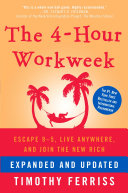
The 4-Hour Workweek
"Escape the deferred-life plan by automating income and designing a lifestyle of mobility and time abundance."
- 1[object Object]
- 2[object Object]
- 3[object Object]
- 4[object Object]
- 5[object Object]
- 6[object Object]
The 4-Hour Workweek dismantles the foundational premise of the modern career—the deferred-life plan—and proposes a radical alternative it terms the New Rich (NR). This subculture prioritizes time and mobility over traditional markers of success, using geographic arbitrage, outsourcing, and automation to design a life of luxury and adventure in the present, not a distant, uncertain retirement. Ferriss argues that the industrial-era model of trading time for money is obsolete in a globally connected economy, where income can be decoupled from physical presence and linear effort.
At its core, the book is a tactical manual built on two pillars: elimination and automation. Ferriss introduces the DEAL framework: Definition, Elimination, Automation, and Liberation. The Elimination phase applies the Pareto Principle (80/20 rule) and a rigorous low-information diet to strip away non-essential tasks and inputs. Automation focuses on creating an automated income stream, or 'muse'—a simplified, internet-based business designed to generate cash flow with minimal ongoing management, often through drop-shipping, affiliate marketing, or digital products.
The Liberation phase provides concrete strategies for negotiating remote work arrangements, training employers to value performance over physical presence, or strategically exiting unchangeable situations. It details the logistics of the 'mini-retirement,' advocating for extended international travel not as a vacation but as a life-integrated sabbatical. Ferriss supplies specific resources, from websites for finding virtual assistants to methods for securing deep discounts on airfare and lodging, transforming the theoretical into the actionable.
More than a productivity hack, the book is a philosophical treatise on redefining personal ambition. It confronts the existential void that can follow the removal of a conventional work identity, urging readers to cultivate purpose and passion beyond professional titles. Its enduring legacy lies in popularizing the concepts of lifestyle design, geoarbitrage, and the digital nomad archetype, challenging an entire generation to question the default script of a life spent in a cubicle waiting for freedom to begin.
The readership is sharply polarized between converts who found it life-changing and skeptics who dismiss it as unrealistic or ethically dubious. Enthusiasts praise its actionable blueprint for escaping the 9-to-5 grind, crediting its concrete steps on outsourcing, automation, and travel hacking for providing tangible liberation. Critics, however, frequently label its methods as applicable only to a narrow slice of single, tech-savvy entrepreneurs, arguing that its principles falter for those with familial obligations or in non-digital professions. A recurring critique centers on the perceived privilege and glossing over of execution risk.
- 1The feasibility of the '4-hour' premise for individuals with families, mortgages, or non-internet-based careers.
- 2Ethical debates surrounding the outsourcing of personal and business tasks to low-wage overseas virtual assistants.
- 3Whether the book promotes a meaningful life of passion or a self-centered, hedonistic pursuit of leisure.
- 4The long-term sustainability of automated 'muse' businesses in increasingly competitive online markets.
- 5The perceived gap between the inspirational, life-changing anecdotes and the hard, unglamorous work of implementation.
The Essays of Warren Buffett: Lessons for Corporate America
Lawrence A. Cunningham, Warren Buffett
Blueprints: How mathematics shapes creativity
Marcus du Sautoy
Transformation in Christ
Dietrich Von Hildebrand
Bad Samaritans
Ha-Joon Chang

Code: The Hidden Language of Computer Hardware and Software
Charles Petzold
The Crash Course
Chris Martenson

Breakthrough: The Quest for Life-Changing Medicines
Dr William Pao
The Norwegian Method
Brad Culp
The Art of Contrarian Trading
Carl Futia
Chip War: The Quest to Dominate the World's Most Critical Technology
Chris Miller

The Intelligent Investor
Benjamin Graham

The Road to Financial Freedom
Bodo Schäfer