
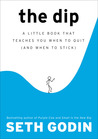
The Dip: A Little Book That Teaches You When to Quit
"Strategic quitting is the essential discipline for achieving exceptional, market-dominating success."
- 1Distinguish between a strategic Dip and a hopeless Cul-de-Sac. A Dip is a temporary barrier to mastery, while a Cul-de-Sac is a permanent dead end. Success requires the discernment to persevere through the former and the courage to abandon the latter without guilt.
- 2Seek out and conquer the Dip to achieve market dominance. The most significant rewards are reserved for those who become number one in their niche. The Dip, as the difficult journey to that position, is the primary filter that creates scarcity and value.
- 3Quit fast, quit often, and quit strategically. Prolific quitting of wrong pursuits liberates resources for the right ones. This is not failure but a proactive strategy to avoid mediocrity and channel energy into endeavors with a viable path to excellence.
- 4Define your quitting criteria before you begin any endeavor. Establishing clear, pre-defined conditions for withdrawal prevents emotional decision-making in the midst of struggle. This creates a rational framework for evaluating persistence, separating grit from stubbornness.
- 5Reject the cult of busyness and diversified effort. Success is not a product of multitasking across many fields but of obsessive focus in one. The model is the woodpecker hammering a single tree, not one pecking randomly at the entire forest.
Seth Godin's The Dip dismantles the conventional wisdom that perseverance is an unconditional virtue. It posits a more nuanced, strategic framework for achievement, arguing that the real differentiator between success and mediocrity is not just hard work, but the wisdom to know when to double down and when to walk away. The book introduces a simple but powerful taxonomy for the challenges we face: the Dip, a temporary setback on the path to mastery that rewards those who push through; the Cul-de-Sac, a dead-end endeavor that will never improve; and the Cliff, a pursuit that leads to disaster.
Godin's core argument is that winners actively seek out worthy Dips—the difficult barriers that scare off competitors—because they understand that these are the gatekeepers to becoming the best in the world. In any competitive field, the rewards are disproportionately skewed toward the number one player. Therefore, the goal is not merely to participate, but to identify a viable niche, commit to conquering its specific Dip, and emerge as the undisputed leader. This requires brutal honesty in assessing whether one's current struggle is a Dip worth enduring or a Cul-de-Sac demanding a swift exit.
The book provides practical heuristics for this assessment. It advocates for pre-commitment strategies, such as writing down your quitting conditions in advance, to circumvent the sunk cost fallacy. It champions focused obsession over scattered diversification, arguing that being exceptional at one thing is infinitely more valuable than being average at many. Godin applies this logic beyond business to careers, relationships, and hobbies, framing strategic quitting as a essential skill for personal and professional efficacy.
Ultimately, The Dip is a manifesto for intentional effort. It targets entrepreneurs, creatives, and any professional feeling stuck in a plateau. Its lasting impact lies in reframing quitting not as a shameful act of failure, but as a disciplined, strategic tool for clearing the path to genuine, exceptional success. It is a concise, provocative read that challenges readers to audit their commitments and redirect their energy with purposeful rigor.
The consensus views this as a potent, paradigm-shifting idea trapped in a disappointingly slim volume. Readers widely praise its core premise—the strategic value of quitting—as intellectually liberating and practically useful for auditing life and business pursuits. However, a significant contingent criticizes the execution, finding the central metaphor stretched too thin over 80 pages, resulting in a feeling of an extended blog post rather than a fully realized book. The repetitive style and perceived lack of depth leave some feeling the concept, while brilliant, was underwritten.
- 1The tension between the book's powerful, liberating core idea and its execution as a perceived overpriced pamphlet.
- 2Debate over the practical application of the Dip/Cul-de-Sac framework to complex real-world careers and long-term projects.
- 3Discussion of the book's value as a motivational tool versus its substance as a strategic guide, often highlighted by its brevity.

Chip War: The Quest to Dominate the World's Most Critical Technology
Chris Miller

Transformation in Christ
Dietrich Von Hildebrand

Breath: The New Science of a Lost Art
James Nestor
The Crash Course
Chris Martenson
The Norwegian Method
Brad Culp
Boom: Bubbles and the End of Stagnation
Byrne Hobart
The Creative Habit
Twyla Tharp, Mark Reiter

Bad Samaritans
Ha-Joon Chang

The Intelligent Investor
Benjamin Graham

The Road to Financial Freedom
Bodo Schäfer

The Artist's Way
Julia Cameron

The Psychology of Money: Timeless Lessons on Wealth, Greed, and Happiness
Morgan Housel