
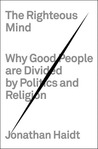
The Righteous Mind: Why Good People are Divided by Politics and Religion
"Morality binds and blinds, revealing how gut feelings, not reason, forge our political and religious tribes."
- 1Intuition leads, reason follows as a lawyer. Moral judgments originate from rapid, gut-level intuitions. Conscious reasoning acts as a post-hoc lawyer, constructing justifications for positions already emotionally determined, rather than serving as an impartial judge.
- 2Morality extends beyond harm and fairness. The moral palate includes six foundational foundations: Care/Harm, Fairness/Cheating, Loyalty/Betrayal, Authority/Subversion, Sanctity/Degradation, and Liberty/Oppression. Political differences stem from varying sensitivities to these intuitive ethics.
- 3We are 90% chimp, 10% bee. Human nature evolved for both individual competition (the chimp) and groupish, hive-like cooperation (the bee). Religion and politics are adaptations that facilitate this ultrasociality, binding groups together through shared sacred values.
- 4Liberals operate with a narrower moral matrix. Political liberals primarily valorize the Care and Fairness foundations, often to the exclusion of Loyalty, Authority, and Sanctity. This constrained palette makes liberal arguments morally incomprehensible to many conservatives.
- 5Morality binds and blinds. Our moral frameworks are the glue of cooperation within groups, but they also create echo chambers and demonization of outsiders. Understanding this dynamic is the first step toward depolarizing discourse.
- 6Seek to understand, not to win. Productive political dialogue requires stepping outside one's own moral matrix. The goal is not to refute but to comprehend the moral intuitions of others, recognizing that each side grasps part of a complex truth.
In The Righteous Mind, social psychologist Jonathan Haidt dismantles the Enlightenment-era myth of the rational individual, presenting instead a compelling portrait of the intuitive, tribal, and emotionally-driven foundations of human morality. Drawing from twenty-five years of research in moral psychology, anthropology, and evolutionary theory, Haidt argues that our moral reasoning is not a search for truth but a skillfully wielded tool for social persuasion and post-hoc justification. The book positions itself at the fraught intersection of America's culture wars, offering a scientific framework to explain the seemingly intractable divisions between liberals, conservatives, and libertarians.
Haidt introduces the central metaphor of the mind as a rider (conscious reasoning) on an elephant (intuitive emotion), where the rider serves the elephant's pre-formed judgments. He grounds this in provocative moral dumbfounding experiments, where subjects condemn harmless taboo violations but cannot articulate coherent reasons for their revulsion. From this foundation, he builds his Moral Foundations Theory, proposing six innate moral taste receptors: Care/Harm, Fairness/Cheating, Loyalty/Betrayal, Authority/Subversion, Sanctity/Degradation, and Liberty/Oppression. These foundations, developed through human evolution, form the intuitive bedrock upon which diverse moral matrices are constructed.
The analysis then scales from the individual to the societal, exploring how these moral intuitions undergird religion and politics. Haidt advances the provocative thesis that human nature is “90% chimp, 10% bee”—evolved not just for individual competition but also for groupish, hive-like cooperation. Religion, far from being a mere parasitic meme, is framed as a cultural adaptation that solves the problem of large-scale cooperation by creating sacred, binding values that suppress selfishness and promote trust within the group. This groupishness, however, comes with the curse of tribalism, blinding us to the virtues of other moral communities.
Ultimately, The Righteous Mind is a work of intellectual bridge-building. It provides liberals with a map to understand the moral psychology of conservatives, who draw upon a broader set of moral foundations. For conservatives, it offers a scientific validation of their intuitions about loyalty, authority, and sanctity. The book’s lasting impact lies in its transformative plea: to move beyond moralistic condemnation and toward a more empathetic, pluralistic understanding of our political adversaries, recognizing that morality’s purpose is not just to perceive truth but to bind collectives and enable civilization.
The consensus hails this as a transformative, paradigm-shifting work that provides an essential framework for understanding political polarization. Readers consistently praise its intellectual depth, accessible presentation of complex research, and its capacity to foster empathy across ideological lines. A recurring critique notes that the later sections on religion and politics feel somewhat less rigorous than the foundational psychological chapters, and some liberals express discomfort with the book's sympathetic portrayal of conservative moral foundations. Nonetheless, it is widely regarded as indispensable reading for navigating modern discourse.
- 1The 'rider and elephant' metaphor for intuition versus reason, and its profound implications for self-knowledge and debate.
- 2Moral Foundations Theory and the debate over whether liberals truly have a 'narrower' moral palate than conservatives.
- 3The provocative defense of religion's evolutionary role in fostering large-scale human cooperation and social cohesion.
- 4The application of Haidt's ideas to current political polarization and whether it offers practical solutions or merely elegant diagnosis.

Permanent Record
Edward Snowden

Out of Control
Kevin Kelly
The Norwegian Method
Brad Culp
Transformation in Christ
Dietrich Von Hildebrand
The Crash Course
Chris Martenson
The Artist's Way
Julia Cameron

The Art of Contrarian Trading
Carl Futia
Boom: Bubbles and the End of Stagnation
Byrne Hobart
Breakthrough: The Quest for Life-Changing Medicines
Dr William Pao

Code: The Hidden Language of Computer Hardware and Software
Charles Petzold
Sapiens: A Brief History of Humankind
Yuval Noah Harari

Bad Samaritans
Ha-Joon Chang