
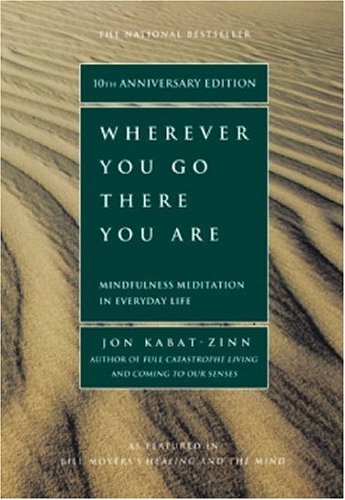
Wherever You Go, There You Are: Mindfulness Meditation in Everyday Life
"Reclaim the richness of your present moment by cultivating a non-judgmental, deliberate awareness in daily life."
Nook Talks
- 1Practice voluntary simplicity to declutter the mind. By intentionally reducing life's noise and unnecessary complexity, one creates the mental space required for awareness to arise, shifting focus from having and doing to simply being.
- 2Master the art of non-doing as a form of deep rest. Non-doing is not laziness but a conscious suspension of striving and agenda, allowing the mind to settle into its natural state of wakefulness without the pressure of achievement.
- 3Anchor your awareness in the sensations of the breath. The breath serves as a universal, always-available focal point to return to the present, training the mind to observe its wanderings without judgment and gently guiding it back.
- 4Accept mental activity without attempting to suppress it. Calmness emerges not from forcefully quieting the mind's waves but from changing one's relationship to them, observing thoughts and emotions with detachment as they pass.
- 5Appreciate each moment as its own complete universe. Mindfulness reframes ordinary moments—washing dishes, walking, waiting—as opportunities for full engagement, revealing the profound depth hidden within the seemingly mundane.
- 6Cultivate a beginner's mind to encounter freshness daily. Approaching familiar routines and sensations as if for the first time strips away habitual blindness, reopening a sense of wonder and possibility in everyday experience.
Jon Kabat-Zinn’s seminal work demystifies mindfulness, presenting it not as an esoteric spiritual practice but as a fundamental human capacity for present-moment awareness. The book strips away cultural and religious ornamentation to reveal a simple, accessible path for cultivating attention and intention in the midst of ordinary life. It positions mindfulness as a radical act of reclamation—a way to step out of the autopilot of habitual thinking and reactive emotion to inhabit one’s life more fully.
Structured as a series of concise reflections and guided practices, the book introduces core principles like "non-doing," "voluntary simplicity," and "the beginner’s mind." Kabat-Zinn meticulously dismantles the common misconception that meditation is about emptying the mind or achieving a blank state of bliss. Instead, he frames it as a process of befriending one’s experience, learning to observe the constant flow of thoughts and sensations with a gentle, non-judgmental curiosity. The methodology is grounded in the body, often using the breath as a primary anchor to tether awareness to the here and now.
The work emphasizes integration over isolation, offering ways to weave mindfulness into daily activities like eating, walking, and even driving. It provides practical instructions for formal sitting meditation while arguing that the ultimate practice is life itself. Kabat-Zinn’s approach is deeply humanistic, acknowledging the challenges of distraction and resistance while affirming that each moment offers a new opportunity to begin again.
Wherever You Go, There You Are has served as a gateway for millions into the world of contemplative practice. Its enduring significance lies in its elegant translation of ancient wisdom into a secular, psychological, and profoundly practical framework. The book speaks directly to anyone feeling fragmented by modern busyness, offering not an escape from life’s pressures but a way to meet them with greater stability, clarity, and compassion.
The consensus positions this book as an essential, gentle introduction for mindfulness novices, praised for its accessible language and demystification of meditation. Readers consistently value its practical, secular approach and the tangible exercises that translate theory into daily life. A recurring critique notes the prose can feel repetitive or overly simplistic for those already familiar with contemplative practices, leaving some seasoned practitioners desiring more advanced depth. Overall, it is celebrated as a compassionate and effective primer that delivers on its promise to make mindfulness feel attainable.
- 1The book's effectiveness for absolute beginners versus its perceived lack of depth for experienced meditators.
- 2Discussions around the practicality of exercises like 'non-doing' and 'voluntary simplicity' in a fast-paced modern life.
- 3The value of Kabat-Zinn's secular approach in making mindfulness accessible outside of religious contexts.

Breakthrough: The Quest for Life-Changing Medicines
Dr William Pao

Just Listen: Discover the Secret to Getting Through to Absolutely Anyone
Mark Goulston
The Norwegian Method
Brad Culp

The Intelligent Investor
Benjamin Graham

The Essays of Warren Buffett: Lessons for Corporate America
Lawrence A. Cunningham, Warren Buffett

How to Win Friends & Influence People
Dale Carnegie

Chip War: The Quest to Dominate the World's Most Critical Technology
Chris Miller

The Art of Contrarian Trading
Carl Futia
Stumbling on Happiness
Daniel Gilbert
The Crash Course
Chris Martenson

The Almanack of Naval Ravikant
Naval Ravikant, Eric Jorgenson
Transformation in Christ
Dietrich Von Hildebrand