
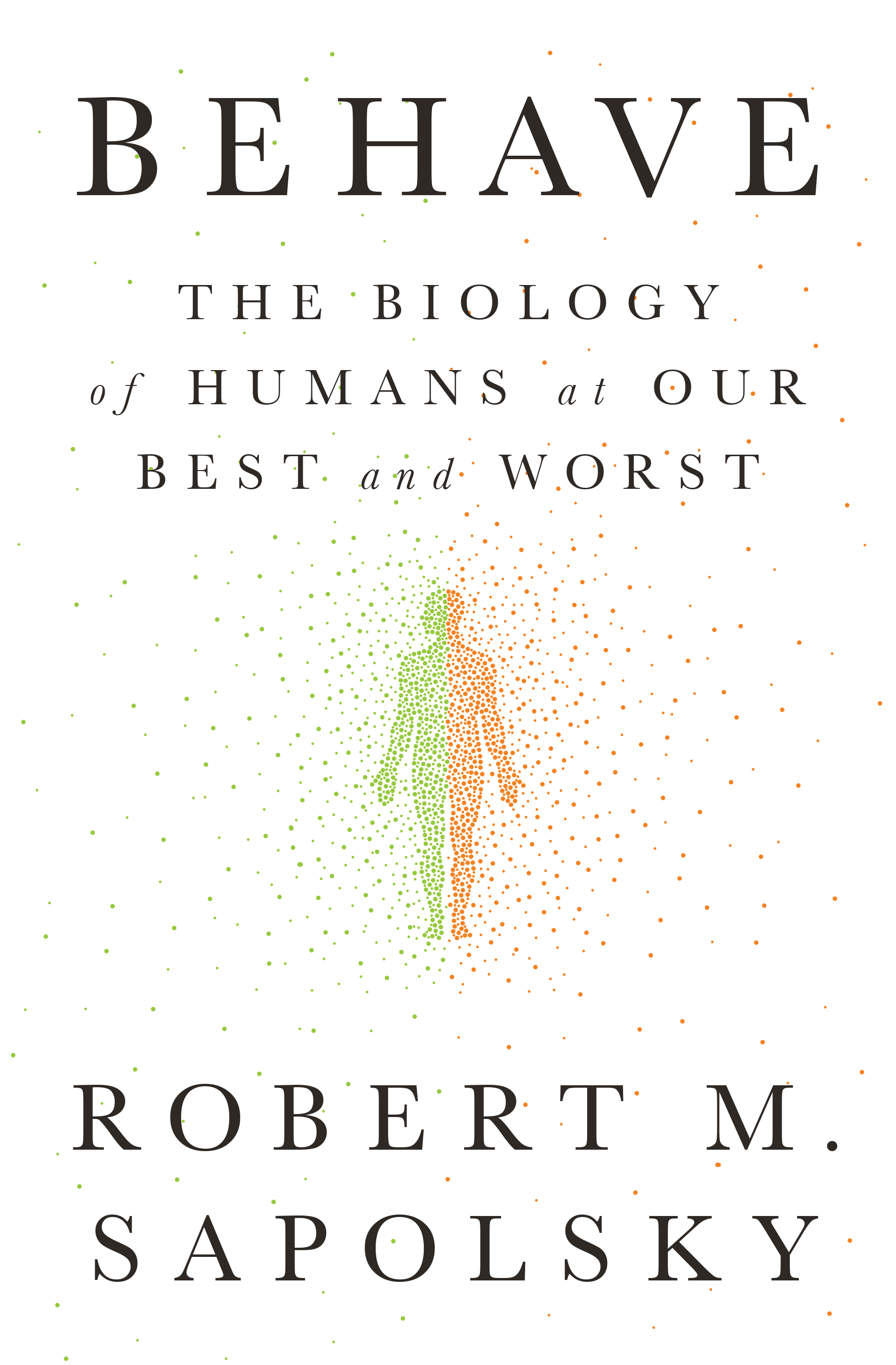
Behave
"A monumental synthesis of biology and behavior that dismantles the illusion of free will to explain our noblest and basest acts."
- 1Behavior is a cascade of biological events across time. Every action is the final output of a sequence spanning milliseconds (neural firing) to millennia (evolutionary pressures). Understanding behavior requires examining this entire temporal hierarchy, not just the conscious moment of decision.
- 2Biology shapes our moral and legal foundations. Our concepts of culpability, justice, and free will are neurologically naive. The brain's deterministic machinery, shaped by genes and environment, challenges the very premise of blame and retributive punishment.
- 3Tribalism and us-versus-them thinking are biological defaults. Neural circuitry and endocrinology predispose us to categorize, favor in-groups, and distrust out-groups. This hardwiring explains everything from implicit bias to large-scale conflict, operating beneath conscious awareness.
- 4Context is the ultimate determinant of action. Hormones, childhood experience, cultural norms, and evolutionary history form the contextual lattice that determines how a stimulus is processed. Identical neural hardware produces vastly different outputs based on this background.
- 5The brain is an organ of integration, not isolation. It is impossible to separate neuroscience from endocrinology, psychology, sociology, or anthropology. Sapolsky's interdisciplinary approach demonstrates that siloed explanations for human behavior are inherently incomplete and misleading.
- 6Our best and worst selves share a common biological origin. The same neural systems that foster empathy, cooperation, and love can be co-opted for cruelty, hierarchy, and war. The biology is not moral; it is a tool whose expression depends on context and regulation.
Robert Sapolsky's Behave is nothing less than an attempt to construct a complete science of human behavior, weaving together disparate disciplines into a coherent narrative that spans from the split-second before an action to the evolutionary pressures of millions of years ago. It begins with a deceptively simple question—why did that person just do that?—and proceeds to unpack it through a series of ever-widening temporal frames, a methodological reverse-engineering of the human condition.
Sapolsky first anchors us in the immediate neurobiology: the flash of amygdala activity, the dance of neurotransmitters like dopamine and serotonin in the precise second before behavior manifests. He then steps back to consider the sensory stimuli that triggered that neural cascade, and further back to the hormonal milieu—cortisol, testosterone, oxytocin—that hours or days earlier primed the nervous system's sensitivity. The analysis expands to encompass the slower forces of neural plasticity, how the brain's very structure has been shaped by the preceding months and years of experience, adolescence, and fetal development.
The book's grand synthesis truly emerges as Sapolsky pushes beyond the individual. He explores how our genetic makeup interacts with these life experiences, then vaults to the scale of culture, examining how millennia-old ecological pressures forged the social norms that now guide our actions. Finally, he reaches the foundational layer of deep evolutionary history, tracing the origins of our sociality, aggression, and morality in our primate ancestry and beyond. This multi-level interdisciplinary approach dissolves artificial boundaries between nature and nurture.
Behave ultimately uses this synthesized framework to grapple with humanity's most profound and contentious issues: tribalism, xenophobia, hierarchy, morality, and the possibility of free will. It is a work of heroic scholarly integration aimed at the intellectually curious reader willing to engage with complex material. Its legacy is a new, humbling, and deeply contextualized lens through which to view every human act, challenging our most cherished notions of autonomy, responsibility, and what it means to be good.
The consensus hails Behave as a towering, intellectually transformative masterpiece, though its density is frequently noted. Readers are awed by Sapolsky's unparalleled synthesis of complex fields and his witty, humane prose that makes daunting science accessible. The primary critique is not of content but of scope: some find the sheer volume of information overwhelming, requiring slow, deliberate reading. It is universally respected, but best suited for an audience with prior interest or stamina for rigorous, interdisciplinary science.
- 1The book's challenging density and length, with debates on its accessibility for a general audience versus science enthusiasts.
- 2The profound implications of its biological determinism for concepts of free will, moral responsibility, and legal culpability.
- 3Sapolsky's interdisciplinary synthesis, praised for connecting neuroscience, endocrinology, anthropology, and evolutionary biology.

The Intelligent Investor
Benjamin Graham
The Psychology of Money: Timeless Lessons on Wealth, Greed, and Happiness
Morgan Housel
Radical Markets: Uprooting Capitalism and Democracy for a Just Society
Eric A. Posner, E. Glen Weyl

Transformation in Christ
Dietrich Von Hildebrand
Breath: The New Science of a Lost Art
James Nestor

The Almanack of Naval Ravikant
Naval Ravikant, Eric Jorgenson

Bad Samaritans
Ha-Joon Chang
The Crash Course
Chris Martenson
Out of Control
Kevin Kelly

Amusing Ourselves to Death: Public Discourse in the Age of Show Business
Neil Postman
Outliers: The Story of Success
Malcolm Gladwell

Chip War: The Quest to Dominate the World's Most Critical Technology
Chris Miller