
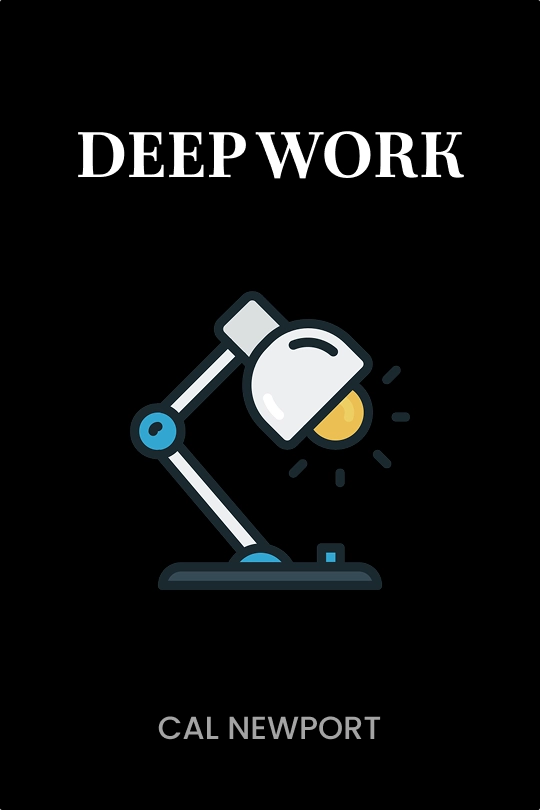
Deep Work: Rules for Focused Success in a Distracted World
"Reclaim your cognitive capacity by mastering the rare skill of intense, undistracted concentration to produce work of exceptional quality and value."
Nook Talks
- 1[object Object]
- 2[object Object]
- 3[object Object]
- 4[object Object]
- 5[object Object]
- 6[object Object]
In an economy that increasingly rewards the ability to quickly master complex systems and produce rare, valuable output, Cal Newport identifies a fundamental crisis: the near-extinction of the capacity for sustained, undistracted concentration. Deep Work posits that the skill of focusing without diversion on a cognitively demanding task is not merely a pleasant productivity hack but a core professional competency that separates high achievers from the perpetually busy. Newport frames deep work as a superpower in the twenty-first century precisely because it has become so scarce, systematically sacrificed at the altar of hyper-connectivity and the fragmented, reactive workflows of modern knowledge work.
The book is architecturally divided into a compelling thesis and a practical methodology. The first half builds a rigorous, multi-faceted argument for deep work's value, drawing from neurological, psychological, and economic principles. Newport demonstrates that deep work enables faster skill acquisition and the production of output at an elite level of quality and quantity. He contrasts this with "shallow work"—non-cognitively demanding, logistical tasks performed in a state of distraction—which, while feeling productive, generates little new value and permanently reduces one's capacity for depth.
Newport then transitions into a tactical training regimen, structured around four core rules: Work Deeply, Embrace Boredom, Quit Social Media, and Drain the Shallows. These rules translate philosophy into actionable habit, advocating for strategies like time-blocking, grand rituals (inspired by figures like Carl Jung and his stone tower), deliberate practice of concentration, and a ruthless audit of digital tools. The regimen is designed to rewire one's habits and environment to systematically support focused effort, often prescribing counter-intuitive measures like scheduling downtime and cultivating a purposeful disconnection from the frenetic pace of online life.
Ultimately, Deep Work is more than a productivity manual; it is a philosophical treatise on craftsmanship in a distracted age. It argues that the focused life is not just more productive, but more meaningful, offering a path to true fulfillment through the mastery of a demanding skill. The book is essential reading for knowledge workers, students, creators, and anyone who senses a gap between their potential and their fragmented daily output, providing both the intellectual justification and the practical blueprint for reclaiming their cognitive sovereignty.
The reader consensus positions Deep Work as a transformative, paradigm-shifting text, particularly for those in technical, creative, or academic fields. Reviews celebrate its actionable, no-nonsense advice—especially the rules for quitting social media and scheduling—as genuinely life-altering, leading to measurable gains in output and clarity. A recurring critique, however, notes a perceived rigidity in Newport's prescriptions; some find the "all-or-nothing" approach to digital tools impractical for certain professional or social contexts, and a minority desire more flexibility in applying the core principles.
- 1The practicality and necessity of completely quitting social media versus adopting a more nuanced, disciplined approach to its use.
- 2The feasibility of implementing rigid time-blocking and fixed-schedule productivity within demanding, collaborative, or client-service professions.
- 3Debates on whether the book's principles are primarily suited for academics, writers, and programmers versus those in managerial or highly reactive roles.
The Crash Course
Chris Martenson
The Creative Habit
Twyla Tharp, Mark Reiter

Transformation in Christ
Dietrich Von Hildebrand
The Intelligent Investor
Benjamin Graham

Out of Control
Kevin Kelly
Blueprints: How mathematics shapes creativity
Marcus du Sautoy
The Almanack of Naval Ravikant
Naval Ravikant, Eric Jorgenson
Bad Samaritans
Ha-Joon Chang

Permanent Record
Edward Snowden

The Road to Financial Freedom
Bodo Schäfer
Chip War: The Quest to Dominate the World's Most Critical Technology
Chris Miller

Just Listen: Discover the Secret to Getting Through to Absolutely Anyone
Mark Goulston