
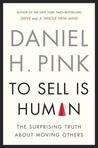
To Sell Is Human: The Surprising Truth About Moving Others
"Master the art of non-sales selling by replacing manipulation with attunement, clarity, and service."
- 1Recognize that everyone is now in the persuasion business. The modern economy has transformed most professions into forms of non-sales selling, where influencing others is a fundamental daily task, not a specialized role.
- 2Replace 'Always Be Closing' with Attunement, Buoyancy, and Clarity. Effective persuasion requires understanding others' perspectives (attunement), resilience against rejection (buoyancy), and the ability to curate and simplify problems (clarity).
- 3Cultivate buoyancy to navigate the ocean of rejection. Success in moving others demands emotional resilience. Employ interrogative self-talk before an encounter and positive attribution after setbacks to maintain momentum.
- 4Frame your message with clarity to make it irresistible. Persuasion hinges not on accessing more information, but on curating the right information and framing problems in novel, actionable ways that others can grasp.
- 5Master the six modern successors to the elevator pitch. Effective pitches—be they one-word, Twitter-length, or narrative—must be purposeful, succinct, and designed to invite collaboration rather than merely announce a position.
- 6Adopt a servant-selling mindset for lasting influence. The most effective persuasion serves the other party's interests first. This ethical approach builds trust and achieves better, more sustainable outcomes than transactional tactics.
Daniel H. Pink’s To Sell Is Human dismantles the archaic notion that sales is a distinct profession practiced by a charismatic few. In its place, he constructs a compelling thesis for the 21st century: persuasion is the new foundational literacy. While one in nine Americans holds a formal sales job, Pink argues through rigorous labor analysis that the other eight are engaged in “non-sales selling”—the daily work of pitching ideas, influencing colleagues, and motivating teams. We are all, in essence, in the moving-others business, operating in a transformed landscape where information parity has shifted power from buyer to seller, demanding transparency and service over manipulation.
Pink anchors his framework in a trove of social science, introducing the new ABCs of persuasion: Attunement, Buoyancy, and Clarity. Attunement involves harnessing perspective-taking and strategic mimicry to reduce power distances and achieve harmony. Buoyancy addresses the central challenge of rejection, prescribing a regimen of interrogative self-talk, balanced positivity, and explanatory style to stay afloat. Clarity, perhaps the most critical skill in an information-saturated age, is the art of problem-finding and curating meaning from noise, moving beyond mere problem-solving.
The book then translates this mindset into practical skill. Pink outlines the architecture of effective pitches, presenting six modern formats that replace the monolithic elevator pitch. He explores the improvisational principles of “Yes, and...” to maintain conversational momentum and introduces a behavioral toolkit for fostering change, emphasizing the strategic power of offering an “off-ramp.” Throughout, the methodology is evidence-based, drawing from fields as diverse as behavioral economics, psychology, and organizational theory.
To Sell Is Human is ultimately a work of profound professional and personal reframing. It targets not just the traditional salesperson, but educators, entrepreneurs, healthcare workers, and anyone whose success depends on the cooperation of others. Its legacy is a humanistic, ethically grounded philosophy of influence that rejects the slick caricature of sales in favor of a more authentic, service-oriented practice—transforming a necessary act of economics into an exercise in shared problem-solving and human connection.
Readers widely praise the book's revelatory premise that everyone is engaged in persuasion, finding its human-centric framework both refreshing and immediately applicable. The synthesis of social science research with practical tools—particularly the new ABCs and pitch formulas—is celebrated for its intellectual rigor and utility. A common critique, however, notes a degree of conceptual repetition from Pink's earlier works and finds some examples overly simplistic for seasoned practitioners. The consensus positions it as an essential, accessible primer for rethinking influence in the modern age.
- 1The revolutionary concept of 'non-sales selling' and its validation for professionals outside traditional sales roles.
- 2Practical utility of the Attunement, Buoyancy, Clarity (ABC) framework versus perceived simplicity of the concepts.
- 3Effectiveness and memorability of the six modern pitch templates for real-world application.
- 4The ethical emphasis on 'servant-selling' as a corrective to manipulative, old-school sales tactics.

The Intelligent Investor
Benjamin Graham

Chip War: The Quest to Dominate the World's Most Critical Technology
Chris Miller
Breath: The New Science of a Lost Art
James Nestor

Bad Samaritans
Ha-Joon Chang

The Essays of Warren Buffett: Lessons for Corporate America
Lawrence A. Cunningham, Warren Buffett

Out of Control
Kevin Kelly

Code: The Hidden Language of Computer Hardware and Software
Charles Petzold
The Crash Course
Chris Martenson

The Artist's Way
Julia Cameron

Transformation in Christ
Dietrich Von Hildebrand

Just Listen: Discover the Secret to Getting Through to Absolutely Anyone
Mark Goulston
The Creative Habit
Twyla Tharp, Mark Reiter