
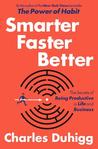
Smarter Faster Better: The Secrets of Being Productive in Life and Business
"Transform your output by mastering the cognitive systems that govern motivation, focus, and decision-making."
- 1Cultivate a bias toward action to unlock creativity. Productivity begins with motion, not just planning. Initiating any action, however small, creates momentum and cognitive engagement that makes subsequent creative and analytical work possible.
- 2Visualize specific processes, not just outcomes. Mental rehearsal of the steps required to succeed builds neural pathways and prepares the mind for obstacles, making goal achievement more likely than simply fantasizing about the end result.
- 3Build teams that foster psychological safety. Drawing from Google's Project Aristotle, the highest-performing teams are not those with the smartest individuals, but those where members feel safe to take risks and voice ideas without fear of embarrassment.
- 4Embrace mental models to manage complexity. Creating internal narratives or frameworks for incoming information allows the brain to process data more efficiently, leading to better forecasting and decision-making under pressure.
- 5Seek control by interpreting challenges productively. Productivity is fueled by an internal locus of control. Transforming a demanding task into a personal choice, rather than an imposition, activates motivation and sustained engagement.
- 6Implement disciplined decision-making processes. Systematizing how choices are made—through probabilistic thinking or pre-defined criteria—reduces cognitive fatigue and yields more consistent, high-quality outcomes than relying on intuition alone.
In Smarter Faster Better, Pulitzer Prize-winning journalist Charles Duhigg moves beyond the terrain of habit formation to dissect the architecture of productivity itself. The book argues that true efficiency is not about working longer hours or employing new gadgets, but about fundamentally reshaping how we manage our attention, make decisions, and motivate ourselves. It posits that productivity is a learnable skill, rooted in specific cognitive processes that can be understood and harnessed.
Duhigg structures his investigation around eight core concepts that underpin effective performance: motivation, teams, focus, goal setting, managing others, decision making, innovation, and absorbing data. Each chapter blends cutting-edge neuroscience and psychology with vivid narrative case studies, from the cockpit of a crashing Qantas Airbus to the writers' room of Saturday Night Live. The research demonstrates, for instance, how creating a sense of agency—even an illusory one—can ignite motivation, or how the most successful teams at Google were distinguished not by IQ but by norms of psychological safety.
The methodology hinges on translating abstract scientific findings into concrete mental disciplines. Readers learn why visualizing the steps of a process is more effective than visualizing success, how to construct 'mental models' to manage information overload, and why forcing teams to debate and disagree can catalyze innovation. The book provides a toolkit for moving from being merely busy to being genuinely productive by managing the systems of thought that precede action.
Smarter Faster Better serves as an essential text for managers, entrepreneurs, and any knowledge worker seeking a scientific foundation for achievement. It builds upon the behavioral framework of Duhigg's earlier work, The Power of Habit, by addressing the higher-order cognitive functions that determine how effectively we deploy our energy and intellect in an increasingly complex world.
The critical consensus positions this as a worthwhile but somewhat fragmented successor to The Power of Habit. Readers praise its research-backed, actionable insights—particularly on team dynamics and motivation—and find its real-world case studies compelling. A significant contingent, however, finds the book less cohesive than its predecessor, perceiving it as a collection of strong but loosely connected essays rather than a unified thesis. The material is deemed highly valuable for managers and those seeking practical frameworks, even if the overall narrative arc feels less transformative.
- 1The comparative value and cohesion of this book versus the author's seminal work, The Power of Habit.
- 2The practical application of Google's Project Aristotle findings on psychological safety within teams.
- 3The efficacy of specific techniques like process visualization and cultivating a 'bias toward action'.

The Road to Financial Freedom
Bodo Schäfer
Boom: Bubbles and the End of Stagnation
Byrne Hobart

Out of Control
Kevin Kelly

The Intelligent Investor
Benjamin Graham
The Crash Course
Chris Martenson

Transformation in Christ
Dietrich Von Hildebrand

Permanent Record
Edward Snowden

Breath: The New Science of a Lost Art
James Nestor
Blueprints: How mathematics shapes creativity
Marcus du Sautoy

The Artist's Way
Julia Cameron
Bad Samaritans
Ha-Joon Chang

Chip War: The Quest to Dominate the World's Most Critical Technology
Chris Miller