
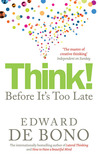
Think!: Before It's Too Late
"Transcend argument-based thinking to creatively solve problems that conventional logic cannot address."
- 1Recognize argument as an inadequate thinking system. Argument merely refines existing ideas; it cannot generate new ones. Our adversarial thinking culture, rooted in Greek philosophy, excels at criticism but fails at construction, leaving complex modern problems unsolved.
- 2Deliberately cultivate creative thinking as a skill. Creativity is not a mystical talent but a learnable operational skill. It requires specific tools and frameworks—like Lateral Thinking—to systematically move beyond established patterns and generate novel concepts.
- 3Establish formal structures for new idea generation. Organizations and societies need dedicated departments or roles focused solely on creative thinking. This institutionalizes the production of alternatives, preventing stagnation and moving beyond the limitations of reactive problem-solving.
- 4Apply creative design to conflict resolution. Moving beyond adversarial argument requires designing forward-looking solutions that satisfy all parties. This shifts focus from proving blame to constructing outcomes, transforming conflicts from zero-sum games into collaborative design projects.
- 5Overcome the complacency of information availability. Easy access to information fosters intellectual laziness, replacing active thinking with passive searching. True thinking involves processing, connecting, and creating beyond what a search engine can retrieve, demanding disciplined cognitive effort.
Edward de Bono presents a urgent manifesto on the profound limitations of humanity's dominant thinking systems. He argues that our global crises—from political conflicts to environmental collapse—are not merely failures of will or morality, but failures of thought itself. The book traces the historical roots of our "argument culture" to the Greek tradition of Socrates, Plato, and Aristotle, a system brilliant for analysis and criticism but fundamentally barren when it comes to design, creation, and proactive problem-solving. This adversarial model, now amplified by legal and political institutions, traps us in a cycle of proving points rather than building solutions.
De Bono meticulously dismantles the notion that argument is the pinnacle of intelligence, proposing instead that it is merely one tool—and an inadequate one for the novel challenges of the modern world. He introduces the core concept of "operacy": the skill of effective action, which requires moving beyond knowing to doing, and beyond criticism to construction. The book serves as a gateway to his broader canon of thinking techniques, notably Lateral Thinking, which provides deliberate methods for escaping perceptual prisons and generating alternative ideas. He contrasts the passive, reactive nature of judgment with the active, generative process of design thinking.
The final sections outline a pragmatic program for cognitive change, advocating for the formal teaching of thinking as a skill in education and the establishment of dedicated creative departments within organizations. De Bono envisions a shift from a culture obsessed with "being right" to one committed to "getting it right," where the focus is on designing forward rather than arguing about the past. The book is aimed at leaders, educators, and any individual who senses that our collective thinking is failing to meet the complexity of our times, offering not just critique but a concrete methodology for building a more generative and effective intelligence.
Readers acknowledge the book's vital core premise—that our thinking systems are fundamentally flawed—but are sharply divided on its execution. Many find it a repetitive and self-promotional summary of de Bono's earlier work, criticizing an irritatingly circular writing style and a tone that borders on egotistical. Yet, even frustrated reviewers concede the undeniable utility of his frameworks, particularly the application of creative thinking to conflict resolution and organizational structure, which compels them to recommend it despite its stylistic flaws.
- 1Frustration with the author's repetitive, self-congratulatory writing style and constant references to his own work.
- 2Agreement with the central thesis on the poverty of argument-based thinking and the need for creative alternatives.
- 3Debate over whether the book offers new insights or merely recycles the author's established concepts.
- 4Appreciation for the practical application of creative thinking to organizational design and conflict resolution.

Just Listen: Discover the Secret to Getting Through to Absolutely Anyone
Mark Goulston
Boom: Bubbles and the End of Stagnation
Byrne Hobart
The Norwegian Method
Brad Culp
Chip War: The Quest to Dominate the World's Most Critical Technology
Chris Miller
The Creative Habit
Twyla Tharp, Mark Reiter
The Psychology of Money: Timeless Lessons on Wealth, Greed, and Happiness
Morgan Housel
How to Win Friends & Influence People
Dale Carnegie

Transformation in Christ
Dietrich Von Hildebrand

The Intelligent Investor
Benjamin Graham

Code: The Hidden Language of Computer Hardware and Software
Charles Petzold
The Crash Course
Chris Martenson

Out of Control
Kevin Kelly