
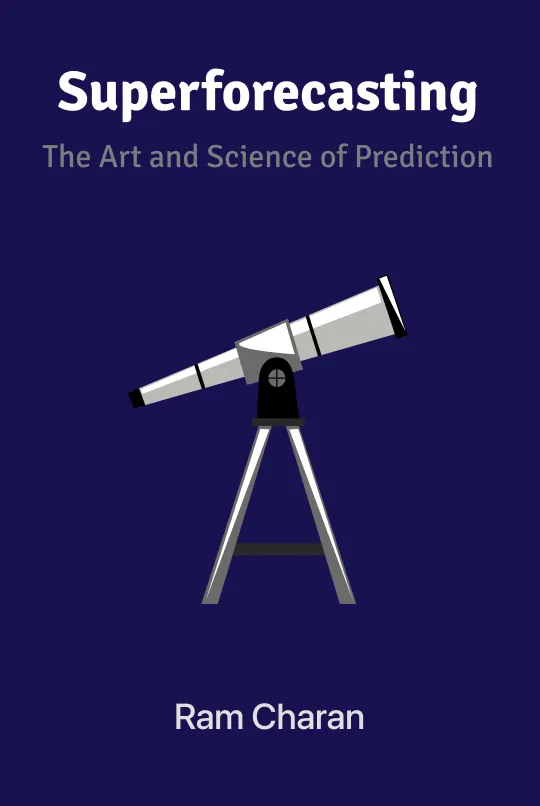
Superforecasting: The Art and Science of Predictio
"Master the evidence-based, probabilistic thinking that transforms ordinary people into elite predictors of global events."
- 1Think in probabilities, not certainties. Superforecasters reject binary yes/no predictions. They assign nuanced likelihoods, continuously updating their estimates as new information emerges, which dramatically improves accuracy over time.
- 2Decompose complex questions into knowable components. Break a vague forecast into smaller, researchable parts. This 'Fermi-izing' process replaces overwhelming uncertainty with a series of tractable, evidence-based judgments.
- 3Aggregate diverse perspectives through structured teamwork. The best forecasts emerge from collaborative teams where dissent is encouraged. This 'superteaming' counters individual bias and refines collective judgment beyond any single expert's capability.
- 4Relentlessly track your performance to calibrate judgment. Maintaining detailed scorecards of past predictions is non-negotiable. This empirical feedback loop is the only way to identify personal biases and improve forecasting skill.
- 5Cultivate a growth mindset and intellectual humility. Superforecasting is a learnable skill, not an innate talent. It requires the willingness to admit errors, change your mind, and see beliefs as hypotheses to be tested.
In a world drowning in punditry and failed prophecies, Philip Tetlock’s landmark research revealed a sobering truth: most expert predictions are barely more accurate than random chance. Superforecasting emerges from the ashes of this failure, chronicling a decade-long quest to isolate and understand the rare individuals who demonstrably can see further into the future. The narrative is built upon the Good Judgment Project, a massive forecasting tournament that pitted thousands of ordinary volunteers against intelligence agencies and prediction markets.
The book meticulously dissects the habits of the top performers—the 'superforecasters.' It argues that superior prediction is not a mystical gift but a rigorous discipline. The methodology hinges on 'Fermi-izing' problems—breaking vast questions into manageable, researchable components—and thinking in fine-grained probabilities. This process demands an outsider's view, actively seeking information that contradicts initial assumptions and synthesizing insights from wildly different domains.
Tetlock and Gardner contrast this agile, evidence-based approach with the cognitive failures behind historic debacles like the Bay of Pigs, while also analyzing forecasting successes such as the raid on Osama bin Laden's compound. They demonstrate how superforecasters operate like 'foxes' who know many things, integrating diverse perspectives, rather than 'hedgehogs' wedded to one grand theory. Crucially, the book shows how these skills are amplified in carefully structured teams that foster constructive disagreement.
Superforecasting transcends mere academic study; it is a pragmatic guide for anyone whose decisions depend on anticipating tomorrow. It systematically dismantles the myth that forecasting is an art reserved for elites with secret data, proving instead that a commitment to probabilistic thinking, relentless self-correction, and intellectual humility can be cultivated. Its legacy is a demonstrable, teachable toolkit for navigating uncertainty in business, finance, policy, and daily life.
Readers celebrate the book as a transformative, rigorously researched antidote to vague intuition. The central thesis—that forecasting is a teachable skill—is met with enthusiastic endorsement, praised for its empowering and practical framework. Criticisms are minor, focusing occasionally on a desire for more concrete, step-by-step exercises. The prose is universally regarded as accessible, successfully translating complex psychological research into engaging narratives and clear, actionable lessons.
- 1The validation of the 'fox vs. hedgehog' analogy as a powerful framework for understanding expert thinking styles and their predictive success.
- 2Debate on the book's core promise: whether the superforecasting methodology is genuinely teachable to the average person or requires innate talent.
- 3Discussion of the Good Judgment Project's real-world implications, especially its outperformance of intelligence agencies with classified data.
- 4Reflections on how the probabilistic, evidence-based approach challenges the certainty prevalent in media punditry and political discourse.
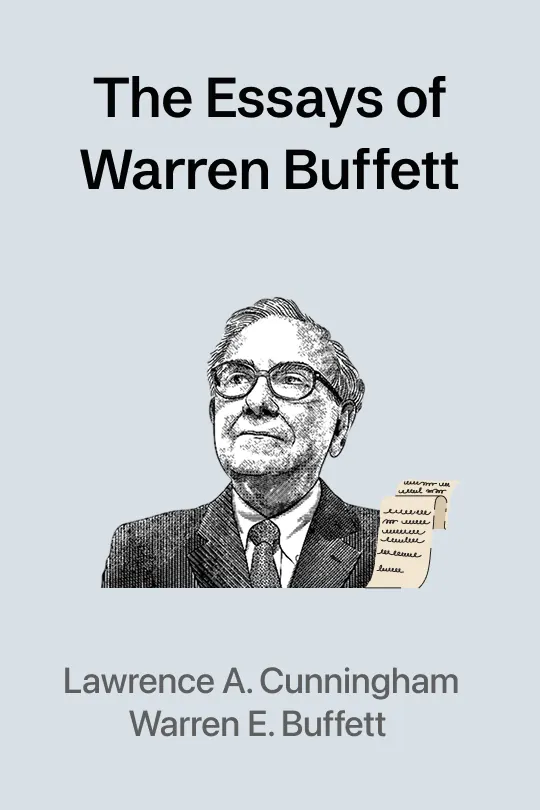
The Essays of Warren Buffett: Lessons for Corporate America
Lawrence A. Cunningham, Warren Buffett
Stumbling on Happiness
Daniel Gilbert
Transformation in Christ
Dietrich Von Hildebrand

The Almanack of Naval Ravikant
Naval Ravikant, Eric Jorgenson

The Intelligent Investor
Benjamin Graham
The Crash Course
Chris Martenson

The Road to Financial Freedom
Bodo Schäfer
The Art of Contrarian Trading
Carl Futia

Out of Control
Kevin Kelly
Bad Samaritans
Ha-Joon Chang
No Rules Rules: Netflix and the Culture of Reinvention
Reed Hastings, Erin Meyer

The Fifth Discipline
Peter M. Senge