
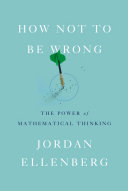
How Not to Be Wrong
"Mathematics is an atomic-powered prosthesis for your common sense, revealing the hidden logic of a messy world."
- 1Mathematics is the extended science of not being wrong. It provides a formal framework for rigorous argument and error-checking, honed over centuries. This transforms intuition into reliable knowledge, allowing us to navigate uncertainty and avoid logical fallacies in everyday reasoning.
- 2Seek the data you don't see to avoid survivorship bias. Critical decisions require analyzing missing information, like the bullet holes on planes that didn't return. What is absent from a dataset often holds the most crucial insight, preventing catastrophic oversights in business and life.
- 3Statistical significance is frequently misunderstood and misused. The common 95% confidence threshold is not a magic truth detector. Without proper experimental design, it can produce spurious correlations, leading to false scientific claims and public misinformation about causes and effects.
- 4Adopt Bayesian thinking to update beliefs with new evidence. Probability is not just a fixed property but a measure of reasonable expectation. This framework teaches you to continuously revise your beliefs in light of new data, moving from prior assumptions toward more accurate conclusions.
- 5Linear reasoning often fails in a non-linear world. Many real-world relationships, from economics to biology, are not straight lines. Mathematical thinking reveals the limits of simple extrapolation and helps model complex, curved realities like diminishing returns or exponential growth.
- 6Use mathematical modeling to clarify moral and political debates. Concepts like game theory, voting theory, and network analysis strip away rhetoric to expose the underlying structures of social dilemmas. This brings precision to discussions about fairness, strategy, and collective decision-making.
Jordan Ellenberg’s How Not to Be Wrong dismantles the pervasive myth that mathematics is a sterile set of rules confined to the classroom. Instead, he positions it as a vital, dynamic mode of thought—an "atomic-powered prosthesis" for common sense—that permeates every facet of human endeavor, from interpreting political polls to making personal decisions. The book argues that the core of mathematics is not about computation but about the rigorous avoidance of error, a hard-won discipline developed through centuries of intellectual argument.
Ellenberg guides the reader through a breathtaking array of historical and contemporary vignettes to illustrate this mathematical thinking in action. He begins with Abraham Wald’s legendary analysis of World War II bomber survivability, a masterclass in recognizing survivorship bias. From there, the narrative threads explore the philosophical foundations of probability, the pitfalls of statistical significance in modern science, and the elegant logic of Bayesian inference, which formalizes how rational beings should update their beliefs. These concepts are unpacked through discussions of lottery schemes, Renaissance art, and the geometry of voting districts.
The journey extends into the realms of economics, psychology, and cosmology, demonstrating how mathematical lenses can clarify everything from the regression to the mean in sports to the geometry of the universe. Ellenberg consistently returns to a central theme: mathematics provides the tools to see the hidden structures beneath the chaotic surface of reality, transforming vague intuition into precise understanding. It equips us to question assumed narratives and detect the subtle errors in reasoning that lead to poor judgments.
Ultimately, the book is an intellectual manifesto for the educated layperson, revealing mathematics as a profound and deeply humanistic pursuit. Its target audience is anyone who wishes to navigate an increasingly data-saturated world with more clarity and skepticism. Ellenberg’s work legacy is its successful demystification of advanced concepts, arguing that mathematical literacy is not a niche skill but an essential component of engaged citizenship and personal agency.
The critical consensus celebrates the book as a revelatory and accessible triumph, successfully translating sophisticated mathematical concepts into engaging, real-world narratives. Readers are consistently delighted by Ellenberg’s witty prose and his knack for selecting compelling historical anecdotes, such as the analysis of WWII bomber armor, which make abstract principles tangible. A recurring critique, however, targets the book’s middle sections, where some find the pacing slows under the weight of denser theoretical explanations, creating a perceived unevenness. Nonetheless, it is widely hailed as an essential primer for cultivating quantitative literacy and a more skeptical, reasoned approach to daily life.
- 1The profound 'aha' moment provided by the WWII bomber survivorship bias example, frequently cited as the book's most memorable lesson.
- 2Debates on the accessibility of later chapters, with some readers challenged by deeper dives into Bayesian inference and geometry.
- 3Appreciation for Ellenberg's humorous and engaging writing style, which transforms potentially dry subject matter into a pleasure to read.
- 4Discussion on the book's practical utility in fostering skepticism towards news headlines, polls, and scientific studies.
Transformation in Christ
Dietrich Von Hildebrand
The Psychology of Money: Timeless Lessons on Wealth, Greed, and Happiness
Morgan Housel

Sapiens: A Brief History of Humankind
Yuval Noah Harari

The Intelligent Investor
Benjamin Graham

Outliers: The Story of Success
Malcolm Gladwell
The Art of Contrarian Trading
Carl Futia

Code: The Hidden Language of Computer Hardware and Software
Charles Petzold
Bad Samaritans
Ha-Joon Chang

The Norwegian Method
Brad Culp
The Essays of Warren Buffett: Lessons for Corporate America
Lawrence A. Cunningham, Warren Buffett

Just Listen: Discover the Secret to Getting Through to Absolutely Anyone
Mark Goulston

Permanent Record
Edward Snowden