
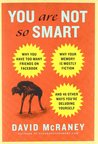
You Are Not So Smart: Why You Have Too Many Friends on Facebook, Why Your Memory Is Mostly Fiction, and 46 Other Ways You're Deluding Yourself
"A revelatory tour of your brain's elegant self-deceptions, proving that irrationality is the core feature of human intelligence."
- 1Your conscious mind is a masterful, post-hoc storyteller. The brain constructs logical narratives to explain decisions and emotions after the fact, creating an illusion of rational control where often none exists.
- 2Social cognition is biologically capped, not digitally expandable. Dunbar's number limits meaningful social connections to roughly 150, making online 'friendships' largely illusory performances rather than genuine relational expansions.
- 3Memory is a reconstructive act, not a archival playback. Each recollection rewrites the past, blending fact with fiction, which explains why eyewitness testimony and personal nostalgia are profoundly unreliable.
- 4You are statistically likely to overestimate your own abilities. The 'above-average effect' demonstrates that most people believe they are better than median in driving, intelligence, and ethics—a mathematical impossibility revealing systemic self-bias.
- 5Perception is a sparse model, not a high-definition feed. The brain receives scant sensory data and fills in vast gaps with assumptions and predictions, meaning you experience a convincing simulation, not reality itself.
- 6Confirmation bias actively filters contradictory evidence. The mind seeks and prioritizes information that reinforces existing beliefs, creating echo chambers that feel like objective reasoning but are intellectual cul-de-sacs.
- 7Recognizing cognitive delusions is the first step toward intellectual humility. Understanding these built-in flaws doesn't eliminate them but allows for meta-cognition—the ability to doubt your own certainty and engage with the world more flexibly.
You Are Not So Smart dismantles the comforting myth of human rationality, positing that self-delusion is not a bug but a fundamental feature of our cognitive architecture. Drawing from the robust canon of social psychology and behavioral economics, David McRaney presents 48 concise explorations of the mental shortcuts, biases, and illusions that govern daily life. The book argues that the conscious self is largely a narrator, crafting plausible stories to explain behaviors initiated by subconscious processes, leaving us perpetually overconfident in our own objectivity.
Each chapter serves as a discrete primer on a specific cognitive fallacy, from the 'illusion of transparency'—the belief that our internal states are obvious to others—to 'learned helplessness,' where perceived lack of control breeds passivity. McRaney grounds these concepts in classic experiments and modern research, illustrating how phenomena like the 'sunk cost fallacy' drive irrational business decisions and why 'confabulation' leads us to invent reasons for choices we didn't consciously make. The structure transforms complex psychology into accessible, often humorous vignettes that reveal the machinery behind our judgments.
The work’s significance lies in its democratization of psychological insight, translating academic research into a survival guide for modern cognition. It targets anyone navigating a world saturated with persuasive technology and misinformation, providing the tools to recognize manipulation both external and internal. By mapping the limits of our own minds, the book fosters a profound and necessary intellectual humility.
Ultimately, this is not a manifesto for despair but a liberation from the tyranny of supposed rationality. Understanding these universal flaws reduces personal frustration and cultivates empathy, as we recognize that everyone is operating with the same flawed hardware. It redefines smartness not as error-free thinking, but as the capacity to acknowledge and compensate for our innate irrationality.
The consensus celebrates the book as an engaging and accessible gateway into behavioral psychology, with its digestible, blog-derived format widely praised for making complex science enjoyable. Readers consistently report moments of personal revelation regarding their own biases. Criticisms focus on a perceived lack of depth—some find the chapters too brief and the explanations superficial, craving more rigorous analysis or practical guidance beyond identification. The humorous tone is generally appreciated but occasionally deemed flippant when addressing weighty subjects.
- 1The book's blog-style format is debated: praised for accessibility but criticized for lacking analytical depth and practical application.
- 2Readers fiercely debate whether recognizing cognitive biases leads to meaningful behavioral change or merely creates a new layer of intellectual vanity.
- 3The chapter on Dunbar's Number and online social connections sparks discussion about the authenticity of digital relationships versus physical ones.
- 4The humorous, pop-science tone divides readers; some find it engaging, while others feel it undermines the seriousness of the subject matter.
Code: The Hidden Language of Computer Hardware and Software
Charles Petzold
Outliers: The Story of Success
Malcolm Gladwell

The Intelligent Investor
Benjamin Graham

The Art of Contrarian Trading
Carl Futia

The Road to Financial Freedom
Bodo Schäfer
The Essays of Warren Buffett: Lessons for Corporate America
Lawrence A. Cunningham, Warren Buffett
The Crash Course
Chris Martenson
The Almanack of Naval Ravikant
Naval Ravikant, Eric Jorgenson
Out of Control
Kevin Kelly
Just Listen: Discover the Secret to Getting Through to Absolutely Anyone
Mark Goulston

Sapiens: A Brief History of Humankind
Yuval Noah Harari

Bad Samaritans
Ha-Joon Chang