
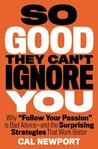
So Good They Can't Ignore You: Why Skills Trump Passion in the Quest for Work You Love
"Stop searching for a perfect passion; instead, cultivate rare and valuable skills that grant you autonomy, control, and eventual fulfillment."
- 1Reject the passion hypothesis as dangerous career advice. The popular mantra to 'follow your passion' is flawed and often harmful, leading to anxiety and chronic job-hopping because pre-existing passions are rare and seldom align with viable careers.
- 2Build career capital through deliberate skill acquisition. Focus on developing rare and valuable skills—your career capital—which you can then trade for greater autonomy, control, and mission in your work, not the other way around.
- 3Apply the craftsman mindset, not the passion mindset. Adopt the craftsman's focus on what value you can offer the world through your skills, rather than obsessing over what your job offers you in terms of pre-existing fulfillment.
- 4Use career capital to gain control and autonomy. True satisfaction in work stems from control over what you do and how you do it. This control is not given but purchased with the career capital you accumulate.
- 5Pursue a compelling mission only after mastering your field. A unifying mission for your career becomes viable only after you have sufficient career capital to identify and execute on rare and valuable opportunities within your domain.
- 6Embrace deliberate practice to achieve mastery. Moving beyond mere experience, engage in focused, feedback-driven deliberate practice at the edge of your ability to accelerate the acquisition of expertise and career capital.
Cal Newport’s 'So Good They Can't Ignore You' mounts a systematic and evidence-based critique of one of modern culture's most cherished career axioms: "Follow your passion." Newport argues this "passion hypothesis" is not only misleading but actively dangerous, setting people on a quest for a pre-existing perfect match that rarely exists, often resulting in chronic dissatisfaction and professional rootlessness. The book positions itself as a corrective, advocating for a more pragmatic, skill-centric philosophy of work.
Newport introduces the core concept of "career capital"—the rare and valuable skills you develop in a field. He posits that fulfilling work is not discovered but constructed through the deliberate accumulation of this capital. The narrative is structured around four key rules: don't follow your passion, adopt the craftsman mindset (focus on what you offer), gain control by trading capital, and find a mission by leveraging your expertise. Newport grounds these rules in case studies from diverse fields, from a vineyard farmer to a venture capitalist, illustrating how mastery precedes passion.
The methodology draws from academic research and interviews, framing career development as an economic transaction where skills are the currency. Newport delves into the psychology of deliberate practice, the importance of creating "remarkable" work to achieve autonomy, and the strategic patience required to identify a true mission only after achieving competence. The argument meticulously dismantles romanticized career narratives, replacing them with a builder's blueprint.
Ultimately, the book serves as a manifesto for a generation anxious about work-life fit. It is targeted at students, early-career professionals, and anyone feeling trapped or unfulfilled in their current role. Newport’s contribution lies in shifting the focus from an internal search for passion to an external discipline of value creation, offering a rigorous, actionable path toward crafting a deeply satisfying professional life.
The consensus praises the book's practical, counterintuitive framework as a vital corrective to clichéd career advice, particularly valuable for early-career readers. Reviewers consistently highlight the empowering concept of "career capital" and the actionable "craftsman mindset." Criticisms are mild, occasionally noting the prose is straightforward and the examples repetitive, but these are far outweighed by appreciation for its evidence-based, step-by-step approach to building a fulfilling career from the ground up.
- 1The powerful, liberating rejection of 'follow your passion' as flawed and anxiety-inducing advice.
- 2The practical utility of the 'career capital' framework for making concrete professional decisions.
- 3Debate on the book's applicability for mid-career professionals versus those just starting out.
- 4Appreciation for the actionable 'craftsman mindset' versus the passive 'passion mindset.'
Breath: The New Science of a Lost Art
James Nestor

Boom: Bubbles and the End of Stagnation
Byrne Hobart
The Art of Contrarian Trading
Carl Futia

The Intelligent Investor
Benjamin Graham
The Crash Course
Chris Martenson

Code: The Hidden Language of Computer Hardware and Software
Charles Petzold
The Norwegian Method
Brad Culp
Transformation in Christ
Dietrich Von Hildebrand

Permanent Record
Edward Snowden

Breakthrough: The Quest for Life-Changing Medicines
Dr William Pao
The Creative Habit
Twyla Tharp, Mark Reiter

The Almanack of Naval Ravikant
Naval Ravikant, Eric Jorgenson