
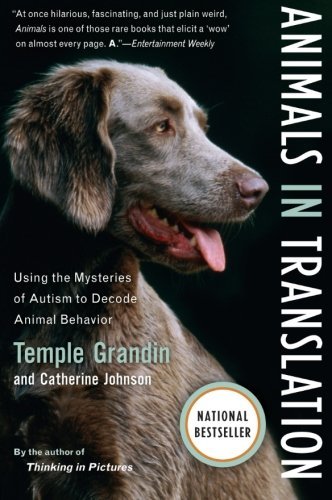
Animals in Translation: Using the Mysteries of Autism to Decode Animal Behavior
"An autistic scientist translates animal consciousness through sensory detail, revealing a world invisible to neurotypical minds."
Nook Talks
- 1Consciousness exists without linguistic abstraction. Animals possess rich interior lives and awareness that operate through sensory and emotional channels rather than symbolic language. Their consciousness is direct, detailed, and fundamentally different from human narrative thought.
- 2Hyper-specificity reveals the animal's sensory reality. Autistic perception and animal cognition share a focus on concrete sensory details over abstract concepts. This 'forest-for-the-trees' sensitivity grants access to environmental nuances neurotypical brains filter out.
- 3Fear is the primary cause of behavioral dysfunction. Fearful animals cannot learn or thrive; it corrupts their welfare and distorts natural behavior. Managing environments to minimize fear is the foundational principle of ethical animal handling.
- 4Animal genius manifests as specialized superhuman skills. Species possess innate cognitive talents—like a dog's olfactory mapping or a bird's navigational precision—that constitute forms of savant intelligence. These are not inferior to human intelligence but are differently optimized.
- 5Emotion is a primary cognitive tool for prediction. Animals use emotional states as data to assess situations and anticipate outcomes. Their decision-making is an emotional calculus, not a detached logical process, making their feelings integral to their intelligence.
- 6Design systems that respect the animal's sensory viewpoint. Effective husbandry and facility design require seeing the world through the animal's sensory lens—noticing distracting shadows, alarming reflections, or comforting sightlines that dictate stress or calm.
Temple Grandin’s groundbreaking work bridges two seemingly disparate worlds: the interior experience of autism and the hidden minds of animals. Drawing from her unique position as an autistic animal scientist, Grandin posits that the non-verbal, detail-oriented cognition characteristic of autism provides a rare translational key to understanding how animals perceive, think, and feel. The book dismantles the anthropocentric assumption that language is necessary for consciousness, arguing instead that animals live in a rich, conscious reality built from sensory data and emotional states.
Grandin introduces the critical concept of 'hyper-specificity'—the autistic and animal tendency to see the world in concrete, granular detail rather than broad conceptual categories. Where the neurotypical human brain employs an 'interpreter' to generalize and narrate, filtering out overwhelming sensory input, animals and autistic individuals perceive this unfiltered reality. This explains phenomena from a cow’s fixation on a dangling chain to a horse’s panic at a subtle change in fencing. The book systematically explores how this sensory-based cognition informs animal behavior in domains of fear, aggression, social bonding, learning, and even extraordinary 'genius,' as seen in the complex vocalizations of prairie dogs or the problem-solving of parrots.
The narrative is fortified with insights from neuroscience, genetics, and ethology, alongside Grandin’s firsthand experiences redesigning livestock facilities to reduce animal suffering. She examines the unintended consequences of selective breeding on animal minds, the ethical contradictions of humane slaughter, and the practical applications of her principles for trainers, farmers, and pet owners. The work positions animals not as primitive versions of humans but as sophisticated entities with their own forms of intelligence, often superior to ours in specific domains.
Ultimately, 'Animals in Translation' is a paradigm-shifting manifesto that challenges readers to step outside the human narrative and perceive the world as animals do. Its legacy lies in fostering a deeper, more empathetic science of animal behavior, one that acknowledges consciousness across species and insists that improving animal welfare begins with seeing through their eyes.
The consensus celebrates Grandin’s revolutionary perspective, finding her synthesis of autism experience and animal science both intellectually fascinating and pragmatically invaluable. Readers consistently praise the book’s ability to reframe animal consciousness, though some express discomfort with her acceptance of animal captivity as a permanent condition. Criticisms occasionally target her broad generalizations across the animal kingdom, yet even skeptical reviewers concede the work’s profound insights into sensory-based cognition and its transformative implications for ethical animal treatment.
- 1The ethical tension between advocating for humane treatment while accepting the permanence of animal captivity and use by humans.
- 2The revolutionary premise that autistic cognition provides a unique, legitimate lens for understanding non-human animal minds.
- 3Fascination with specific examples of animal 'genius,' such as prairie dog language complexity and animal emotional prediction.
- 4Debate over the book's sweeping generalizations across vastly different species, from clams to mammals.

The Almanack of Naval Ravikant
Naval Ravikant, Eric Jorgenson

Just Listen: Discover the Secret to Getting Through to Absolutely Anyone
Mark Goulston
The Creative Habit
Twyla Tharp, Mark Reiter

The Road to Financial Freedom
Bodo Schäfer

Bad Samaritans
Ha-Joon Chang
The Crash Course
Chris Martenson

Permanent Record
Edward Snowden

The Intelligent Investor
Benjamin Graham

Breakthrough: The Quest for Life-Changing Medicines
Dr William Pao
Outliers: The Story of Success
Malcolm Gladwell

Code: The Hidden Language of Computer Hardware and Software
Charles Petzold

How to Win Friends & Influence People
Dale Carnegie