
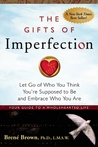
The Gifts of Imperfection: Let Go of Who You Think You're Supposed to Be and Embrace Who You Are
"Cultivate the courage to be vulnerable, the compassion to be kind to yourself, and the connection that comes from authentic belonging."
- 1Cultivate worthiness by letting go of perfectionism. Perfectionism is a self-destructive shield against shame, not a path to excellence. True belonging requires releasing the exhausting performance of who you think you should be to make space for who you are.
- 2Practice vulnerability as the birthplace of courage. Vulnerability is not weakness but the fundamental emotional risk essential for love, innovation, and creativity. It requires uncertainty and emotional exposure, which are the prerequisites for meaningful connection.
- 3Develop shame resilience through critical awareness. Shame thrives in secrecy and silence. Resilience is built by recognizing shame triggers, practicing self-compassion, and selectively sharing your story with those who have earned the right to hear it.
- 4Embrace rest and play as non-negotiable necessities. In a culture of exhaustion, play and rest are not indulgences but vital components of Wholehearted living. They fuel creativity, restore spirit, and counteract the scarcity-driven belief that our worth is tied to productivity.
- 5Set boundaries to make compassion sustainable. Compassion for others is impossible without clear boundaries. Saying 'no' with integrity protects your energy and authenticity, allowing you to engage with the world from a place of generosity rather than resentment.
- 6Cultivate gratitude and joy as daily spiritual practices. Joy is often foreclosed by a foreboding fear that it will be taken away. Practicing gratitude—actively acknowledging the good—builds a resilience that allows joy to be experienced fully in the present moment.
Brené Brown’s The Gifts of Imperfection is a manifesto for Wholehearted Living, a research-grounded framework for cultivating a life defined not by perfectionism and scarcity, but by authenticity, resilience, and a deep sense of worthiness. Drawing from a decade of qualitative data on shame, vulnerability, and connection, Brown posits that the relentless pursuit of being who we think we’re supposed to be is the primary barrier to genuine belonging and self-acceptance. The book dismantles the cultural myth that perfection is attainable or desirable, arguing instead that our imperfections are not inadequacies but portals to our most courageous and connected selves.
Brown structures her argument around ten guideposts, each outlining a critical attitude or practice for Wholehearted Living. These include cultivating authenticity by letting go of what people think, fostering self-compassion by releasing perfectionism, and nurturing resilience by moving from a mindset of scarcity to one of ‘enough.’ Central to the entire project is her redefinition of vulnerability as the core of daring greatly—the emotional exposure, uncertainty, and risk that are fundamental to love, creativity, and innovation. She frames vulnerability not as a liability to be managed, but as the birthplace of courage.
The guideposts extend into practical, daily disciplines: setting boundaries to make compassion sustainable, prioritizing rest and play as antidotes to exhaustion, and practicing gratitude and joy as spiritual bulwarks against foreboding. Brown emphasizes that this work is not a one-time achievement but a continuous practice of ‘digging deep,’ requiring deliberate intention and effort. The methodology is deeply personal, interwoven with anecdotes from her own breakdown and spiritual awakening, which serve as a testament to the theory’s application.
Ultimately, the book’s significance lies in its synthesis of academic research with accessible, actionable wisdom. It targets anyone weary of the exhausting performance of a curated life, offering a path out of comparison and shame. Brown’s legacy, cemented by this work, is in providing a vocabulary and a map for the internal journey from ‘I am what I accomplish’ to the liberating declaration, ‘I am enough.’
The consensus celebrates the book as a transformative, accessible guide to self-acceptance, with Brown’s personal anecdotes and research lending powerful credibility. Readers consistently praise its actionable ‘guideposts’ for fostering resilience and dismantling perfectionism. Criticisms are nuanced; some find the content repetitive if familiar with her TED talks, while others debate the practical application of vulnerability, questioning its boundaries in professional settings. The tone is overwhelmingly one of gratitude for its timely, compassionate message.
- 1The practical application of vulnerability, especially in workplace or professional environments, sparks debate among readers.
- 2Many discuss the book's life-changing impact on overcoming perfectionism and cultivating self-compassion.
- 3Comparisons between the book's depth and Brown's more famous TED talks on vulnerability and shame are frequent.
- 4The balance between academic research and relatable, anecdotal storytelling is a point of repeated commentary.

Boom: Bubbles and the End of Stagnation
Byrne Hobart
The Psychology of Money: Timeless Lessons on Wealth, Greed, and Happiness
Morgan Housel
Breath: The New Science of a Lost Art
James Nestor

The Artist's Way
Julia Cameron

Bad Samaritans
Ha-Joon Chang

The Intelligent Investor
Benjamin Graham
The Art of Contrarian Trading
Carl Futia

Permanent Record
Edward Snowden
The Norwegian Method
Brad Culp

Chip War: The Quest to Dominate the World's Most Critical Technology
Chris Miller
Blueprints: How mathematics shapes creativity
Marcus du Sautoy

Out of Control
Kevin Kelly