
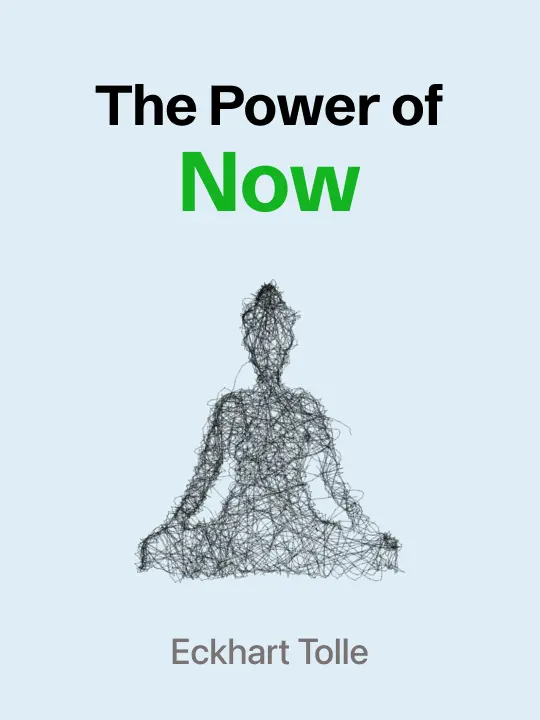
The Power of Now: A Guide to Spiritual Enlightenment
"Transcend the tyranny of your own mind to discover profound peace in the present moment."
Nook Talks
- 1The Present Moment is All You Have. Realize deeply that the present moment is all you ever have. The past is a memory trace, and the future is a mental projection; life is only a series of present moments.
- 2You are Not Your Mind. Free yourself from your mind by becoming the 'observer' or 'watcher' of your thoughts. Recognize that your true essence is the underlying presence behind the stream of thinking.
- 3Resistance Creates Pain. Pain is the result of non-acceptance and resistance to what is. The more you resist the present moment, the more you suffer, as pain thrives on your identification with the mind.
- 4Surrender to the Now. Accept the present moment as if you had chosen it. Surrender is not a passive resignation but an inner transition from resistance to acceptance, allowing for a deeper quality of action.
- 5The Illusion of the Ego. The ego is a false sense of self derived from identification with the mind and external labels. It constantly seeks validation and lives in fear because its existence depends on the past and future.
- 6Dissolve the Pain-Body. The 'pain-body' is the accumulation of old emotional pain. By bringing the light of presence and consciousness to it, you stop feeding it and prevent it from controlling your identity.
- 7Joy Arises from Within. Distinguish between pleasure, which is derived from external objects, and joy, which arises from the stillness of Being. Inner peace is independent of your life circumstances.
Eckhart Tolle’s seminal work, The Power of Now, emerges not from academic philosophy but from a profound personal transformation. Following a period of intense despair, Tolle experienced a radical inner shift that dissolved his constructed sense of self, leaving him in a state of sustained peace and presence. The book is his attempt to map the territory of this awakening, translating a timeless spiritual truth—that liberation is found only in the present moment—into a practical guide for the modern seeker. It positions itself against the backdrop of a humanity lost in what Tolle terms the "pain-body," a collective and individual accumulation of past trauma that fuels incessant mental narration.
At its core, the book is a systematic deconstruction of the human mind's tyranny. Tolle argues that we are enslaved by an incessant stream of involuntary thinking, which creates a false self, the ego. This egoic mind-structure lives almost exclusively in psychological time—rehashing the past and projecting into the future—thereby obscuring the only reality that exists: the eternal Now. Through a question-and-answer format, Tolle meticulously differentiates between the mind as a useful tool and the mind as a dominating master, teaching readers to become the silent witness of their own thought processes. This act of observation creates a critical gap, a space of pure consciousness free from identification with mental content.
The methodology is intensely practical, moving beyond theory into somatic experience. Tolle introduces techniques like feeling the "inner body," a subtle energy field within the physical form, and using conscious breathing as anchors to the present. He explores how this presence transforms relationships, work, and even the acceptance of physical pain and death. The book delves into the nature of enlightenment not as a distant peak to be scaled, but as an accessible state of alignment with the present moment, where one’s essential nature as consciousness itself is realized.
Its significance lies in its demystification of enlightenment and its direct applicability to daily life. While rooted in perennial wisdom found in Zen Buddhism, Advaita Vedanta, and Christian mysticism, Tolle’s language is deliberately non-denominational and clear, aimed at a Western audience drowning in information yet starved for wisdom. The book’s legacy is that of a modern spiritual classic, creating a global vocabulary for mindfulness and serving as a foundational text for millions seeking respite from anxiety, overthinking, and the existential unease of contemporary life.
The consensus positions this as a transformative, life-altering manual for a significant majority of readers, who credit it with reducing anxiety and providing a tangible sense of inner peace. Its clear, repetitive structure is praised for making profound concepts accessible, acting as a practical workbook rather than an abstract treatise. Criticism, though less frequent, centers on its occasionally circular logic, perceived repetitiveness, and a tone some find quasi-religious or dismissive of severe mental health conditions. The book is broadly seen as demanding re-reading and active practice, not passive consumption.
- 1The book's repetitive structure, seen either as a necessary pedagogical tool for deep integration or as a stylistic flaw that pads the core message.
- 2Debates over its applicability to clinical anxiety and depression, with some finding it revolutionary and others cautioning it is insufficient for serious mental health struggles.
- 3The transformative 'aha moment' from the 'I cannot live with myself' paradox, frequently cited as the passage that fundamentally shifted readers' self-perception.
- 4Discussions on Tolle's redefinition of 'God' and 'enlightenment' as present-moment awareness, sparking both appreciation for its universality and theological disagreement.
- 5The practicality of 'living in the now' amidst modern responsibilities, with readers sharing strategies and confessing the difficulty of sustaining the state.
The Road to Financial Freedom
Bodo Schäfer
Boom: Bubbles and the End of Stagnation
Byrne Hobart
The Norwegian Method
Brad Culp
The Essays of Warren Buffett: Lessons for Corporate America
Lawrence A. Cunningham, Warren Buffett

The Intelligent Investor
Benjamin Graham
Blueprints: How mathematics shapes creativity
Marcus du Sautoy
Just Listen: Discover the Secret to Getting Through to Absolutely Anyone
Mark Goulston
Sapiens: A Brief History of Humankind
Yuval Noah Harari
Stumbling on Happiness
Daniel Gilbert
The Creative Habit
Twyla Tharp, Mark Reiter
Breath: The New Science of a Lost Art
James Nestor

Permanent Record
Edward Snowden