
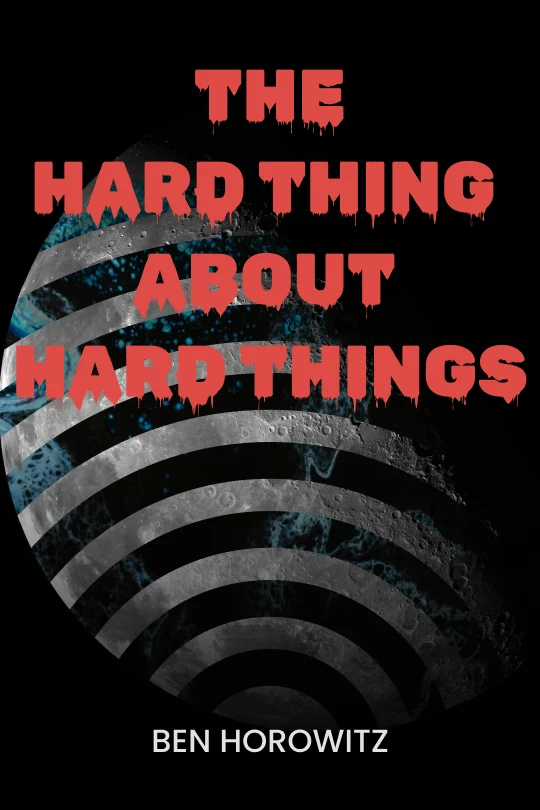
The Hard Thing About Hard Things: Building a Business When There Are No Easy Answers
"A founder's unvarnished manual for surviving the psychological warfare and impossible decisions of running a company."
Nook Talks
- 1[object Object]
- 2[object Object]
- 3[object Object]
- 4[object Object]
- 5[object Object]
- 6[object Object]
The Hard Thing About Hard Things dispenses with the triumphalist mythology of entrepreneurship to deliver a stark, operational guide for the wartime CEO. Ben Horowitz, co-founder of the seminal venture firm Andreessen Horowitz, draws from his brutal journey through the dot-com boom and bust—first as CEO of the cloud pioneer Loudcloud, then through its tumultuous transformation into Opsware and eventual sale. This is not a theoretical treatise but a field manual forged in the crucible of near-failure, payroll crises, and impossible personnel decisions, offering wisdom for when the elegant platitudes of business school completely fail.
Horowitz structures the book around the specific, gut-wrenching problems that conventional management literature avoids. He provides frameworks for demoting loyal friends, navigating layoffs, poaching competitors, and managing one's own deteriorating mental health while the fate of hundreds rests on your decisions. The narrative is punctuated with lessons from his unlikely muse: hip-hop lyrics, which he uses to underscore themes of resilience, strategy, and survival against the odds. This approach reframes leadership as a continuous psychological battle rather than a series of strategic offsites.
The core argument posits that the CEO's ultimate job is to make the handful of critical decisions for which there are no clear data or easy answers—the 'hard things.' Horowitz delves into the mechanics of building a senior team, arguing passionately for the founder-CEO model and detailing how to hire executives who can scale with chaos. He dissects the nuances of organizational design, communication in a crisis, and creating a culture that can withstand relentless external pressure.
Its enduring significance lies in its raw authenticity and tactical specificity, making it indispensable for founders, executives, and anyone in a position of high-stakes leadership. The book carves out a unique niche as a peer-to-peer confession and playbook, speaking directly to the lonely reality at the top. It acknowledges that while many can start a business, only those prepared for the profound emotional and moral weight of running one will survive.
The consensus positions this as an essential, brutally honest antidote to sanitized business memoirs. Readers, particularly founders and operators, praise its unflinching practicality on firing, fundraising, and psychological survival, valuing its peer-level empathy over theoretical advice. Criticisms focus on a repetitive structure, a narrowly Silicon Valley-centric perspective, and a prose style some find overly blunt or colloquial. It is universally deemed most valuable for those already in the trenches, offering solace and strategy when conventional wisdom has evaporated.
- 1The unique value of advice from a CEO who has endured near-failure, not just celebrated success.
- 2The practical and emotional guidance on demoting or firing a loyal friend who cannot scale.
- 3The effectiveness of using hip-hop lyrics as analogies for business leadership and struggle.
- 4Debates on the book's applicability outside of the high-growth tech startup context.

The Fifth Discipline
Peter M. Senge
No Rules Rules: Netflix and the Culture of Reinvention
Reed Hastings, Erin Meyer
Stumbling on Happiness
Daniel Gilbert

The Artist's Way
Julia Cameron

Code: The Hidden Language of Computer Hardware and Software
Charles Petzold
The Crash Course
Chris Martenson

The Intelligent Investor
Benjamin Graham
The Art of Contrarian Trading
Carl Futia
Transformation in Christ
Dietrich Von Hildebrand

Chip War: The Quest to Dominate the World's Most Critical Technology
Chris Miller

Breath: The New Science of a Lost Art
James Nestor

How to Win Friends & Influence People
Dale Carnegie