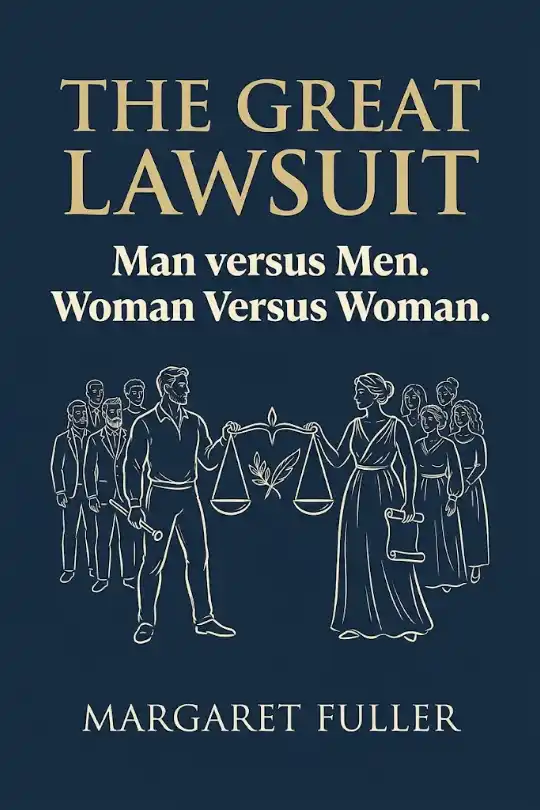
The Great Lawsuit
Man versus Men. Woman Versus Woman
Book Summaries
Hosts: Clara
Timeline
Summary Preview
In 1843, Margaret Fuller posed a question that would drive her entire essay: Will humans ever reach an enlightened state, one that brings them closer to the divine? She wasn't asking about small improvements or gradual progress. She was asking about transformation—a fundamental shift in human consciousness.
Fuller saw the people of her time as asleep. Not metaphorically tired, but spiritually unconscious. Their eyes were shut. They could not see divine love, even though it surrounded them. This slumber wasn't innocent. It was maintained by selfishness, by the refusal to wake up and face what truth demanded.
She called this state of affairs "The Great Lawsuit"—a term that captured both a legal claim and a moral argument. Humanity had a rightful inheritance: transcendence, a higher state of being. But that inheritance was being blocked. People were living far below what they were capable of, trapped in habits of thought and society that kept them small.
Fuller believed that every human soul knew how to seek what it needed. As she wrote, "Whatever the soul knows how to seek, it must attain." This wasn't wishful thinking. It was a statement of destiny. If humans could imagine a better state, they were meant to reach it. The problem wasn't ability. It was action.
The path to this enlightenment, she argued, required something radical: equality. Not partial equality, not equality for some, but full equality for all people. Men and women. Free and enslaved. This wasn't a political position tacked onto spiritual concerns. For Fuller, equality was the precondition for transcendence. You couldn't rise toward divine love while keeping others down.
She looked at American society and saw the opposite of equality everywhere. Slavery was the most obvious example, a system that treated human beings as property. But the problem went deeper. Women were denied education, denied property rights, denied voices in public life. They were treated as children who needed male guidance. This wasn't just unjust—it was spiritually destructive.
Fuller's transcendentalist framework gave her argument its urgency. She believed that divinity flowed through all people and all nature. God had made every human equal. When society enforced inequality, it wasn't just breaking laws. It was blocking the divine plan. People who oppressed others were also harming themselves, keeping themselves asleep, unable to see what they were meant to become.
The essay opened with a vivid image: humanity asleep, eyes closed, unaware of the love available to them. This sleep wasn't peaceful. It was restless, filled with selfish dreams and petty concerns. People chased power, comfort, and status while missing what actually mattered. They built systems that benefited them at others' expense and called it natural.
Fuller wasn't content to describe the problem. She wanted to diagnose it. Why were people asleep? What kept them from waking? She pointed to selfishness as the primary obstacle. When a person's main concern is their own advantage, they cannot see truth clearly. They justify injustice. They call oppression tradition. They mistake their comfort for wisdom.
This selfishness showed up in daily life. Men insisted they knew what was best for their wives, their daughters, their society. They claimed to act out of love and protection. But Fuller saw through this. Love that controls isn't love. Protection that denies freedom isn't protection. These were masks for power, for the desire to be superior over at least one other person.
The essay's title, "The Great Lawsuit," pointed to a cosmic case. Humanity was suing for its inheritance—the divine state it was meant to reach. But the case couldn't be won through legal arguments alone. It required transformation. People had to wake up, see clearly, and act on what they saw.
Fuller believed this awakening was possible. She had seen glimpses of it in the abolitionist movement, where people put equality into action. She had experienced it in her own life, raised by a father who treated her as an equal. She knew that self-reliance, clear thinking, and inner strength were not just male virtues. They were human virtues.
The question she posed at the start wasn't academic. It was urgent. Will humans reach their destiny? The answer depended on whether people could overcome their selfishness, embrace equality, and open their eyes to the divine love that had been waiting all along.
But how could a society so steeped in inequality even begin this journey? What would it take for people to wake from their long slumber—and who would be brave enough to shake them?
About the Book
In 1843, Margaret Fuller challenged a sleeping world with a radical question: Can humanity reach transcendence while denying equality? This visionary essay exposes how selfishness, slavery, and women's subjugation block spiritual progress. Through personal stories, legal critiques, and bold reimagining of marriage and education, Fuller argues that full equality—not partial reform—is the essential path to enlightenment and divine union.
Key Takeaways
Humanity's inheritance is transcendence, not mere survival.
Fuller argues that every soul knows how to seek what it needs, and what it seeks, it must attain—meaning humans are destined for spiritual awakening, not just incremental progress, and the failure to reach this state is a betrayal of our own potential.
Equality is the precondition for spiritual enlightenment.
Fuller insists that you cannot rise toward divine love while keeping others down; true transcendence requires full equality for all people, because inequality blocks the divine plan and keeps both oppressor and oppressed spiritually asleep.
Selfishness masquerades as tradition to maintain power.
The primary obstacle to human progress is ordinary selfishness—people who benefit from injustice call it tradition, nature, or common sense, but these are rationalizations that allow them to remain comfortable while blocking others from their rightful inheritance.
Self-reliance is the foundation of inner peace and true freedom.
Fuller shows that when a person learns to trust their own mind—as her father taught her—they develop clear thinking and peace within, becoming immune to manipulation and able to stand as an equal rather than a dependent.
Marriage can ascend from utility to spiritual union through equality.
Fuller identifies four types of marriage, from household partnership to religious union, arguing that the highest form requires both partners to be fellow travelers toward the divine, meeting mind to mind rather than one dominating the other.
Education must develop intellect for its own sake, not to serve others.
Fuller rejects the idea that women should be educated to become better companions or mothers, insisting instead that every person deserves a full intellectual development because they have a soul destined for transcendence, not merely utility.
Every human contains both masculine and feminine qualities.
Fuller uses the myths of Minerva and Apollo to show that rigid gender stereotypes are false—there is no wholly masculine man or purely feminine woman, and true liberation comes from honoring the full blend of qualities within each person.
Every woman carries the potential for divine motherhood within herself.
Fuller reimagines the Virgin Mary not as a unique exception but as a model for all women—by claiming their own spiritual inheritance and looking inward, every woman can give birth to a fully realized soul and achieve transcendence on her own terms.
Who Should Listen?
Readers of feminist classics who want to understand the transcendentalist roots of modern gender equality arguments.
Spiritual seekers interested in how social justice and personal transcendence are intertwined in 19th-century American thought.
History enthusiasts curious about early American critiques of slavery, patriarchy, and legal inequality from a woman's perspective.
Students of rhetoric and philosophy who want to study how a single essay can weave together autobiography, mythology, and political argument.