
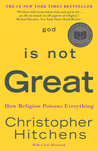
god is Not Great: How Religion Poisons Everything
"A polemical dismantling of religious faith, championing a life illuminated by reason, science, and intellectual courage."
Nook Talks
- 1Religion as a Man-Made Invention. Hitchens argues that religions are human-designed myths created during our species' 'infancy' to explain the world before science, and they continue to persist through indoctrination.
- 2Opposition to Scientific Progress. The book details how religious institutions have historically resisted scientific discoveries—from Galileo’s astronomy to modern biology—viewing objective truth as a threat to faith-based authority.
- 3The Immorality of Vicarious Redemption. Hitchens critiques the concept of 'vicarious atonement' (someone else dying for your sins) as an immoral shift of personal responsibility that encourages ethical laziness.
- 4Indoctrination and Child Abuse. A significant portion of the book is dedicated to the argument that imposing terrifying religious dogmas and physical rituals on children who lack the capacity for consent is a form of psychological abuse.
- 5The Totalitarian Nature of Faith. Hitchens compares a 'theocracy' or a supreme deity to a 'celestial North Korea,' where one is under constant surveillance even in thought, which he views as the ultimate form of mental enslavement.
- 6Plagiarism of Myth. The author examines how major religious texts often 'borrow' or plagiarize from older, pagan myths and legends, undermining the claim that these texts are uniquely divine revelations.
- 7Secular Humanism and the Enlightenment. The book concludes that humanity should look to science, literature, and reason—the values of the Enlightenment—to provide a more moral and awe-inspiring foundation for life than any scripture.
Christopher Hitchens’s 'god is Not Great' is a formidable entry in the modern atheist canon, a sustained and erudite polemic that mounts a comprehensive case against organized religion. Hitchens frames his argument not as a philosophical abstraction but as a urgent historical and moral critique, asserting that the monotheistic faiths—and religion broadly—constitute a malignant force that has poisoned human civilization from its origins to the present day.
With a journalist’s eye for detail and a scholar’s command of texts, Hitchens conducts a forensic examination of the Bible, the Quran, and other sacred scriptures, highlighting their internal contradictions, historical inaccuracies, and ethical depravities. He documents religion’s role in fomenting violence, enabling tyranny, suppressing sexuality, and stifling intellectual curiosity. The narrative moves from the crimes of the Inquisition and the fatwa against Salman Rushdie to the contemporary influence of fundamentalist movements, painting a portrait of faith as inherently totalitarian.
The book champions a secular worldview rooted in the Enlightenment principles of reason, scientific skepticism, and humanist ethics. Hitchens eloquently contrasts the cramped cosmology of paradise and hell with the expansive wonders revealed by the Hubble telescope and the elegant truth of the double helix. He posits that our capacity for art, love, and moral progress derives not from divine commandment but from human cooperation and creativity.
'god is Not Great' is ultimately a manifesto for intellectual emancipation. It is targeted at the wavering believer, the agnostic, and the convinced secularist alike, serving as both a provocation and a call to arms. Its lasting impact lies in its unapologetic demand for a public square governed by evidence and debate, free from what Hitchens sees as the dangerous infantilism of religious faith.
The consensus positions this as a brilliant, provocative, and essential read for skeptics, while acknowledging it as deliberately offensive to the devout. Readers praise Hitchens's formidable intellect, razor-sharp prose, and compelling compilation of historical evidence against religious institutions. The primary critique is its one-sided, polemical tone, which some find reductive and needlessly abrasive, arguing it preaches to the atheist choir rather than persuading the uncertain. Its accessibility is hailed for those open to its premise, but its confrontational style is recognized as a significant barrier for others.
- 1The effectiveness of Hitchens's abrasive, confrontational style versus a more diplomatic approach in persuading readers.
- 2Debate over whether the book's historical examples prove religion 'poisons everything' or selectively ignores its positive cultural and charitable roles.
- 3The emotional impact of personal anecdotes, particularly regarding the indoctrination and fear imposed on children within religious communities.
- 4Comparisons to other 'New Atheist' works by Sam Harris and Richard Dawkins, discussing which author presents the most compelling or accessible case.

Chip War: The Quest to Dominate the World's Most Critical Technology
Chris Miller
Transformation in Christ
Dietrich Von Hildebrand

The Intelligent Investor
Benjamin Graham
Breath: The New Science of a Lost Art
James Nestor
Bad Samaritans
Ha-Joon Chang
Amusing Ourselves to Death: Public Discourse in the Age of Show Business
Neil Postman

Out of Control
Kevin Kelly

The Almanack of Naval Ravikant
Naval Ravikant, Eric Jorgenson
Radical Markets: Uprooting Capitalism and Democracy for a Just Society
Eric A. Posner, E. Glen Weyl
The Road to Financial Freedom
Bodo Schäfer
The Psychology of Money: Timeless Lessons on Wealth, Greed, and Happiness
Morgan Housel
Stumbling on Happiness
Daniel Gilbert